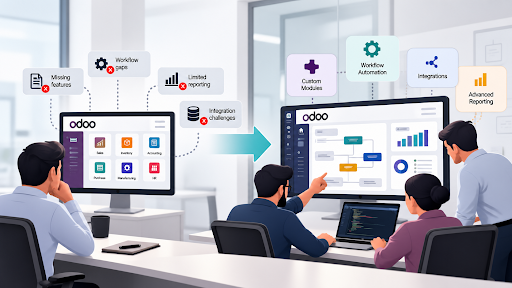
Odoo can handle a wide range of business processes out of the box, making it a practical ERP choice for growing companies. But as operations become more complex, businesses often need workflows, integrations, reports, and automation that standard Odoo cannot provide.
At this stage, the challenge is not necessarily replacing the ERP. It is extending Odoo without creating more manual work or technical problems. When these requirements start exceeding the capacity of an existing team, businesses may hire remote Odoo developers to build the functionality they need and keep the ERP aligned with changing operational requirements.
Signs Your Business Has Outgrown Standard Odoo
1) Increasing Customization Requests: As business processes become more specialized, teams may need changes that standard Odoo does not support. Frequent requests for custom fields, modules, approvals, or workflows are a clear sign that the ERP needs further development.
2) Manual Workarounds: If employees regularly export data to spreadsheets, enter information into multiple systems, or rely on manual approvals, the ERP may no longer match the way the business operates.
3) Growing Integration Requirements: Businesses often add CRM platforms, payment gateways, e-commerce stores, logistics tools, or other applications as they grow. Connecting these systems reliably can require custom Odoo development.
4) Reporting Limitations: Standard reports may not provide the operational or management insights a growing business needs. Custom dashboards and reports may become necessary for more informed decision-making.
5) Development Backlogs: When customization requests, integration work, bug fixes, and automation projects keep accumulating, limited development capacity can slow down improvements across the business.
Where Standard Odoo Features Fall Short
Standard Odoo provides a strong foundation, but growing businesses rarely operate exactly like an out-of-the-box ERP workflow. As processes become more specialized, companies may encounter gaps that require customization, integration, or additional automation.
1) Industry-Specific Processes
Standard Odoo workflows may not fully support specialized processes in industries such as manufacturing, logistics, healthcare, or retail.
Example: A furniture manufacturer may need a production workflow that handles custom product configurations, multiple quality checks, and job-specific approvals beyond its standard manufacturing process.
2) Complex Approval Workflows
Growing organizations often introduce multiple approval levels, department-specific rules, or conditional approvals that go beyond standard workflows.
Example: A company may require purchase orders above a certain value to pass through procurement, finance, and management approvals before the order can be confirmed.
3) Advanced Automation
Businesses may want to automate actions based on specific conditions, events, or data. When standard automation cannot handle these requirements, custom development can bridge the gap.
Example: A business could require an automatic notification and purchasing workflow when projected inventory falls below the level needed for upcoming production.
4) Third-Party Integrations
As companies adopt more digital tools, Odoo may need to exchange data with external platforms. Reliable two-way integrations often require custom development, APIs, and ongoing maintenance.
Example: An e-commerce business may need orders, customer details, inventory levels, and shipment updates to move automatically between Odoo and its online store.
5) Specialized Reports and Dashboards
Management may need reports that combine information from multiple Odoo modules or external systems. Custom development can turn these requirements into dashboards tailored to specific business needs.
Example: A manufacturing company may want one dashboard showing production output, material consumption, pending purchases, order status, and production costs instead of checking several Odoo reports separately.
How Odoo Developers Solve These Business Gaps
As businesses grow, their existing Odoo workflows may no longer match the way their teams operate. For example, a manufacturer might need different approval steps for customized products, while a logistics company may require shipment updates to flow automatically between systems. Addressing these gaps may require changes to existing modules or new functionality through Odoo ERP customization services.
- Developers can build modules for processes that are not available in standard Odoo, such as industry-specific workflows, fields, approvals, or business rules.
- Existing workflows can be modified to reduce manual steps and match specific operational requirements.
- Developers can connect Odoo with external platforms through APIs, allowing systems to exchange data without repeated manual entry.
- Repetitive tasks can be automated based on predefined rules, events, or business conditions, helping teams reduce errors and save time.
- Developers can create reports and dashboards that bring together the specific information managers need for operational and financial decisions.
- As customizations and data volumes increase, developers can review the Odoo environment, optimize inefficient processes, and make improvements that support future growth.
When Businesses Should Hire Dedicated Odoo Developers
Hiring dedicated Odoo developers becomes valuable when ERP requirements are no longer occasional fixes but an ongoing part of business operations.
1) If new modules, workflows, fields, or business rules are regularly requested, dedicated development support can help prevent the customization backlog from growing.
2) When bug fixes, integrations, automation projects, and enhancement requests compete for limited internal resources, additional developers can increase development capacity.
3) Businesses adding e-commerce platforms, payment systems, CRM tools, logistics applications, or other software may need developers who can manage integrations and maintain them over time.
4) Major Odoo version changes can require custom modules and integrations to be reviewed, updated, and tested. Dedicated developers can handle this work while minimizing disruption to daily operations.
5) Companies may have ERP users or general software developers but lack specialists who understand Odoo’s framework, modules, APIs, and customization practices.
6) When delayed ERP improvements are affecting employees or business operations, adding dedicated Odoo development capacity can help move high-priority requirements from backlog to implementation.
Dedicated Odoo Developers vs One-Off Development Support
One-off development support can work for isolated fixes or small customizations. But when Odoo development becomes an ongoing requirement, dedicated developers can provide more consistent support.
| Business Requirement | One-Off Development Support | Dedicated Odoo Developers |
| Ongoing customization | Suitable for individual requests | Better for continuous customization needs |
| Knowledge of your Odoo setup | Developers may need time to understand the system | Developers build familiarity with your modules and workflows |
| Development backlog | Limited capacity for multiple requests | Can handle and prioritize ongoing requirements |
| Integrations | Suitable for specific integration projects | Better for developing and maintaining multiple integrations |
| Odoo upgrades | Support is usually project-based | Developers can manage upgrades and related customizations continuously |
| Maintenance | Usually focused on specific issues | Covers ongoing fixes, improvements, and optimization |
| Long-term scalability | Better for short-term requirements | Better suited to businesses with evolving ERP needs |
For example, a business that starts with a few custom fields may later need supplier portal access, automated purchase approvals, and real-time inventory updates. These requirements often involve more than isolated fixes. Ongoing Odoo ERP software development helps businesses connect these changes into a system that supports their evolving processes.
How to Get the Most Value From Odoo Developers
Hiring Odoo developers is only the first step. Businesses also need a clear approach to make sure development work solves real operational problems and remains manageable as the ERP grows.
- Before development starts, document the process, problem, expected outcome, and users involved. Clear requirements help developers build solutions that address the actual business need.
- Not every customization needs to be developed immediately. Focus first on changes that reduce manual work, improve accuracy, support revenue-generating processes, or solve major operational bottlenecks.
- Customizations should be built with future growth in mind. Developers should avoid unnecessary changes to Odoo’s core functionality and use maintainable approaches that make future upgrades easier.
- Keep technical and functional documentation for custom modules, integrations, workflows, and business rules. This makes future maintenance and troubleshooting much easier.
- Custom features should be tested against real business scenarios before they reach production. Testing helps identify workflow issues, integration failures, and unexpected effects on existing Odoo processes.
- Business requirements change over time. Regularly reviewing customizations, integrations, reports, and workflows can help identify outdated processes and opportunities for further automation.
Conclusion: When Odoo Needs to Grow With Your Business
Standard Odoo can support many business processes, but growing operational complexity may require functionality beyond its existing capabilities. When manual workarounds, customization requests, and integration requirements begin slowing down teams, extending the ERP can be more practical than replacing it.
The right development support helps businesses address these gaps while keeping Odoo aligned with their changing needs. If your team is struggling to keep up with new requirements, Odoo ERP migration may be worth considering when your current version or setup needs a transition. Otherwise, experienced Odoo developers can help you improve the existing system and prepare it for future growth.
