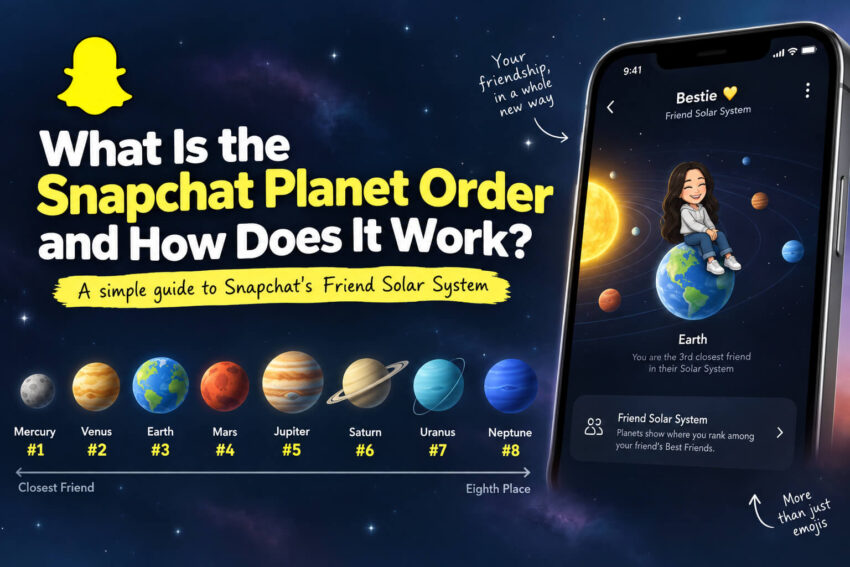
If you have Snapchat+ and spend a lot of time chatting or exchanging Snaps with friends, you may have noticed something unusual on a Friendship Profile: a planet. Mercury, Venus, Earth, Mars and the other planets are not there simply for decoration. They belong to Snapchat’s Friend Solar System, a feature designed to give users another way of understanding their closest connections on the app.
The idea is surprisingly simple. Snapchat uses the planets in our real Solar System to represent different positions among a user’s closest Snapchat friends. Mercury represents the closest position, while Neptune represents the eighth position. The planets between them follow the same order they have in the actual Solar System.
That sounds straightforward, but the feature can become confusing when users start asking questions such as: Why am I Mars instead of Earth? Can my planet change? Does Mercury mean someone is my closest friend in real life? And can everyone see these rankings?
This guide explains the complete Snapchat planet order, what every planet means and how the Friend Solar System actually works.
What Is the Snapchat Planet Order?
The Snapchat planet order is part of a Snapchat+ feature officially called Friend Solar Systems. It turns friendship positions into a visual representation inspired by the Solar System.
Snapchat says that Best Friends are the people you Snap and Chat with the most, and users can have up to eight Best Friends at a time. That list is updated regularly as interaction patterns change.
In the Solar System feature, a friend is represented as the Sun, while your Bitmoji appears on a planet. The planet indicates where you stand within that person’s close-friend interaction pattern. Snap itself describes the feature as a way of illustrating how frequently a friend communicates with you.
The order follows this familiar sequence:
| Position | Snapchat Planet |
|---|---|
| 1 | Mercury |
| 2 | Venus |
| 3 | Earth |
| 4 | Mars |
| 5 | Jupiter |
| 6 | Saturn |
| 7 | Uranus |
| 8 | Neptune |
Remembering the order of the real planets is therefore enough to understand the basic Snapchat planet order.
Mercury
Mercury represents the first position in the Snapchat Friend Solar System.
Because Mercury is the closest real planet to the Sun, Snapchat uses it for the closest position in its Solar System display. If your Bitmoji appears with Mercury while viewing a friend’s Solar System, you occupy the first position among the friends represented by that system.
Mercury is therefore usually the planet people are most curious about. Seeing it can suggest that you and that person communicate very frequently on Snapchat.
However, it is important to keep the feature in perspective. Snapchat is measuring activity on its own platform. It is not deciding who someone trusts the most, spends the most time with offline or considers their closest friend in everyday life.
A childhood friend who rarely uses Snapchat could rank lower than a classmate or coworker who sends dozens of Snaps every day.
Venus
Venus represents the second position.
It comes immediately after Mercury, just as Venus is the second planet from the Sun in the real Solar System.
If you are shown as Venus in someone’s Friend Solar System, you are in a very high position within their Snapchat interaction circle, but you are not occupying the Mercury position.
That does not necessarily mean there is a dramatic difference between first and second place. Snapchat does not publish a public points table showing exactly how far apart individual friends are.
One person could have two friends with very similar activity levels. Small changes in how frequently they communicate could potentially affect the order over time because Snapchat says its Best Friends are updated regularly.
Earth
Earth is the third Snapchat planet.
When Earth appears in the Friend Solar System, it represents the third position. The recognizable blue-and-green appearance makes Earth one of the easier planets to identify visually.
Being Earth still places someone comfortably within the eight-friend Solar System. It simply means Mercury and Venus occupy positions closer to the Sun.
The biggest mistake users make is treating the difference between these planets as an emotional ranking. Snapchat’s system is better understood as an interaction indicator.
Your planet can reflect how you use the app together, not the full depth of your relationship.
Mars
Mars represents the fourth position in the Snapchat planet order.
Since Mars is the fourth planet from the Sun, it takes the fourth position in the Friend Solar System.
Appearing as Mars means you are roughly around the middle of the eight positions. That may sound less significant than Mercury or Venus, but being included in the Solar System still means you are within a relatively small group of frequently contacted friends.
Snapchat officially allows users to have up to eight Best Friends, which gives useful context to the planetary design.
A Mars position should therefore not automatically be interpreted negatively. It is simply another point within the eight-planet structure.
Jupiter
Jupiter represents position five.
Jupiter is the fifth planet from the Sun, so Snapchat places it after Mars and before Saturn.
If you see Jupiter, it means four other positions currently sit closer to the Sun within that particular Friend Solar System.
This is where interpreting the feature carefully becomes especially important. Users sometimes assume that moving from Earth or Mars to Jupiter means something has gone wrong in their friendship.
That conclusion is not necessarily justified.
Your own activity may not have changed at all. Another person could simply have started communicating more frequently with the account. Since Best Friends are updated over time, movement can happen naturally as Snapchat habits change.
Saturn
Saturn represents the sixth position.
It follows Jupiter in both the real Solar System and Snapchat’s Friend Solar System.
Saturn is usually easy to recognize because of its distinctive rings. In ranking terms, it means five positions are closer to the Sun and two remain farther away.
Someone appearing as Saturn can still be an important Snapchat contact. A sixth-place position should not be translated into statements such as “they don’t care about me” or “we aren’t close anymore.”
Snapchat’s own public explanation emphasizes communication frequency rather than emotional closeness.
That distinction matters throughout the entire system.
Uranus
Uranus represents position seven.
As the seventh real planet from the Sun, it appears near the outer edge of Snapchat’s eight-planet order.
If you appear as Uranus, there is only one planet behind you: Neptune.
That may look relatively distant in the visual design, but it does not necessarily say much about your relationship outside Snapchat.
Perhaps you communicate mostly on WhatsApp, Instagram, iMessage or in person. Snapchat cannot measure those interactions when creating its own friendship features.
The Solar System should therefore be interpreted within the context of Snapchat itself.
Neptune
Neptune represents the eighth position, making it the final planet in the Snapchat planet order.
Because Neptune is the farthest of the eight recognized planets from the Sun, Snapchat uses it for the outermost position.
Some users mistakenly think that seeing Neptune means they are barely friends with someone. That is too simplistic.
Neptune still belongs to the eight-position Friend Solar System. What it indicates is that your position is farther from the Sun than Mercury through Uranus.
It should not be treated as a verdict on the quality of your friendship.
How the Solar System Works
The basic mechanics are easier to understand once you stop thinking of the feature as a traditional list.
Snapchat says that its Best Friends are the friends you Snap and Chat with the most. These friends can appear prominently in places such as the Send To screen and Chat section, and Snapchat may also display special Friend Emojis alongside them.
The Solar System takes the idea further by giving those friendship positions a planetary visual.
According to Snapchat’s support documentation, a Snapchat+ subscriber can see a gold-ringed Best Friends badge on a Friendship Profile. Tapping the badge reveals which planet the viewer occupies in that person’s Solar System. Each planet represents a different position in that person’s Best Friends list.
In other words, the planets help turn an otherwise abstract friendship position into something visually understandable.
Mercury is nearest to the Sun. Neptune is farthest away. Everything in between follows normal planetary order.
What Determines Your Planet?
This is an area where it is worth separating confirmed information from internet speculation.
Snapchat clearly says that Best Friends are based on the people you Snap and Chat with the most. Snap has also described the Solar System as illustrating how frequently a friend communicates with you.
However, Snapchat does not publicly provide a complete mathematical formula explaining exactly how every activity is weighted.
That means claims such as “one Snap equals a certain number of points” or “story views contribute exactly this percentage” should be treated cautiously unless Snapchat itself confirms them.
The safest way to understand the system is that communication activity on Snapchat matters, while the precise calculation remains part of Snapchat’s internal system.
Why Your Planet Can Change
Your Snapchat planet does not have to stay the same forever.
Snapchat says Best Friends are updated regularly, which means positions can change as communication patterns change.
Imagine that you have been someone’s Earth for several weeks. If that person begins exchanging significantly more Snaps and Chats with another friend, the order may eventually shift.
You might move to Mars while the other person moves closer to the Sun.
Likewise, increasing communication with someone can potentially affect your position over time.
The important point is that movement does not automatically indicate conflict. It can simply reflect changing Snapchat usage.
School schedules change. People travel. Someone becomes busy at work. New friendships form. Some users stop opening Snapchat as frequently.
Digital rankings naturally move with digital behavior.
Do You Need Snapchat+?
Yes. Friend Solar Systems are a Snapchat+ feature.
Snapchat+ is the company’s paid subscription service offering additional and experimental features. Snapchat currently lists Solar System among the features included with Snapchat+.
There is another detail that often causes confusion: the Solar System may not automatically appear immediately after subscribing.
Snapchat says the feature is off by default for first-time Snapchat+ subscribers. Users who want it can visit the Snapchat+ feature management area and turn Solar System on. It can later be switched off again.
So if you have Snapchat+ but cannot see planets, checking whether the Solar System option is enabled is a sensible first step.
How to Check Your Planet
Checking your planet is relatively simple when the feature is available.
Open Snapchat and navigate to the Friendship Profile of the person whose Solar System you want to check.
Look for the gold-ringed friendship badge associated with the Solar System feature.
Tap the badge.
Snapchat can then display the planet representing your position in that friend’s Solar System.
Once you recognize the planets, interpreting the result becomes easy.
Mercury = first. Venus = second. Earth = third. Mars = fourth. Jupiter = fifth. Saturn = sixth. Uranus = seventh. Neptune = eighth.
You do not need to memorize a complicated Snapchat-specific sequence because it mirrors the real planetary order.
Is It Public?
No. The Friend Solar System is designed as a private feature.
Snap specifically explained that the Solar System does not publicly display other friends and is not visible to everyone else. The company has also said it is not intended as a public numerical ranking.
This is important because people sometimes imagine that friends can open a profile and see an entire public leaderboard showing positions one through eight.
That is not how Snapchat describes the feature.
The planetary presentation provides personal friendship context rather than a public popularity chart.
Snapchat’s regular Best Friends list is private as well. Snapchat notes that people may be able to tell whether they are among your Best Friends, but other users cannot simply view your complete Best Friends list.
Planets vs. Chat Order
Another common misunderstanding is assuming that the order of conversations on the Snapchat Chat screen must exactly match the Friend Solar System.
They are related to interaction, but they should not automatically be treated as the same thing.
Snapchat says the order of friends on the Chat screen is influenced by who you keep in touch with most and who has contacted you most recently.
That means someone appearing near the top of your Chat screen does not by itself prove a specific planetary position.
Recency can influence what you see in Chat, while the Friend Solar System is specifically designed around friendship interaction context.
Planets vs. Friend Emojis
Snapchat planets are also different from traditional Friend Emojis.
Friend Emojis such as hearts and smiley faces have long been used by Snapchat to provide visual cues about friendships.
Snap explains that these emojis change according to the way users interact and are private to the people involved.
The Solar System takes a different visual approach. Instead of simply showing an emoji beside someone’s name, it places a Bitmoji in a planet-based system.
Both features relate to interaction, but they should not be confused with each other.
Does Mercury Mean Your Real Best Friend?
Not necessarily.
This is perhaps the most important thing to understand about the Snapchat planet order.
Mercury may represent the closest position in someone’s Snapchat Friend Solar System, but Snapchat cannot measure an entire real-world relationship.
It does not know how many hours two people spend together in person. It cannot measure private conversations happening on other apps. It cannot understand years of shared experiences, family connections, trust or emotional support.
What Snapchat can observe is activity taking place on Snapchat.
Snap itself has acknowledged the emotional sensitivity surrounding features such as the Solar System. In 2024, the company explained that some people felt uncomfortable when they discovered they were not as close to a friend in the system as they expected. Snapchat consequently moved toward making Solar System an optional feature that subscribers proactively enable.
That is a useful reminder not to give a planet more meaning than it deserves.
Why Snapchat Uses Planets
The planet design works because almost everyone understands the basic idea of distance from the Sun.
Instead of presenting users with an ordinary numbered list, Snapchat turns friendship information into a visual experience.
Mercury feels close because it is physically close to the Sun in the real Solar System. Neptune feels distant because it is far away.
Snap has said the feature was developed after users expressed interest in gaining more context about their friendships.
The Solar System therefore fits Snapchat’s broader approach of using visual elements, Bitmojis and emojis rather than presenting everything through plain text.
Common Misunderstandings
A few misconceptions regularly appear around Snapchat planets.
First, Neptune does not mean someone is no longer your friend. It represents the outermost position within the eight-planet system.
Second, Mercury does not prove someone is your closest real-world friend. It relates to Snapchat interaction.
Third, planetary positions are not necessarily permanent. Snapchat says its Best Friends are updated regularly.
Fourth, Snapchat does not publicly disclose a simple scoring formula that allows users to calculate exactly how many Snaps are required to move from one planet to another.
Finally, the Friend Solar System is a Snapchat+ feature and may need to be manually enabled, particularly for first-time subscribers.
Understanding those points prevents most confusion surrounding the feature.
Final Thoughts
The Snapchat planet order is easier to understand than it initially appears. Snapchat simply uses the order of the eight planets in our Solar System to represent different friendship positions.
The sequence starts with Mercury, followed by Venus, Earth, Mars, Jupiter, Saturn, Uranus and Neptune.
Mercury represents the closest position to the Sun, while Neptune represents the eighth and outermost position.
The system is connected to Snapchat interaction, particularly the people users Snap and Chat with frequently. It is private, available through Snapchat+, and can change as interaction patterns change.
Most importantly, a Snapchat planet should be treated as a feature of the app rather than an exact measurement of friendship.
Real relationships are far more complicated than Mercury, Mars or Neptune.
FAQs
What is the Snapchat planet order?
The order is Mercury, Venus, Earth, Mars, Jupiter, Saturn, Uranus and Neptune. The sequence represents positions from closest to farthest within Snapchat’s eight-planet Friend Solar System.
What does Mercury mean on Snapchat?
Mercury represents the first and closest position in the Friend Solar System. It generally indicates a very high level of Snapchat interaction between the accounts involved.
What does Neptune mean on Snapchat?
Neptune represents the eighth position. It is the farthest planet in the Solar System display, but being Neptune should not be interpreted as proof that a real-world friendship is weak.
Why did my Snapchat planet change?
Snapchat regularly updates Best Friends based on interaction. Changes in how frequently you or other friends Snap and Chat can therefore affect the positions shown over time.
Do I need Snapchat+ to see Snapchat planets?
Yes. Friend Solar Systems are part of Snapchat+. Snapchat also says Solar System is off by default for first-time subscribers, so it may need to be enabled through Snapchat+ feature settings.