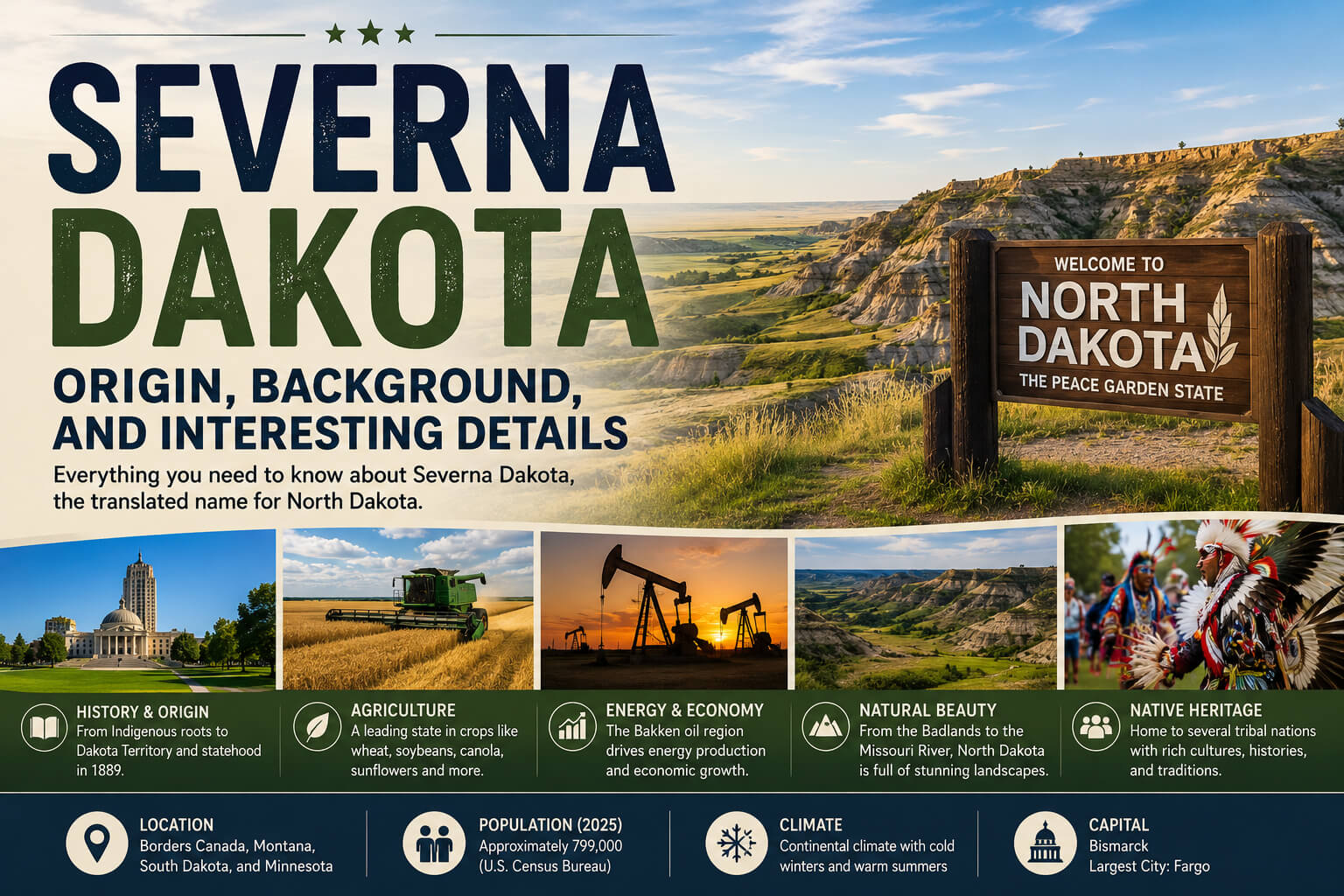
The term Severna Dakota can be confusing at first, especially for readers who encounter it on translated websites, international news pages, or search engines. It may sound like the name of a separate region, country, or historical territory. In most cases, however, Severna Dakota simply refers to North Dakota, the U.S. state located along the Canadian border in the northern Great Plains. In Serbian and some related South Slavic usage, Severna Dakota is the translated form of North Dakota, with severna meaning “northern.”
North Dakota itself has a much deeper story than the translated name suggests. Its identity has been shaped by Indigenous nations, prairie landscapes, agriculture, migration, railroads, harsh weather, energy development, and communities spread across a remarkably open landscape. Understanding Severna Dakota therefore means looking beyond the name and exploring the history and character of North Dakota itself.
What Severna Dakota Means
Severna Dakota is not an additional U.S. state and it is not an officially recognized English geographical name. It is essentially a linguistic version of North Dakota. The expression appears because geographical names are often translated differently from one language to another.
The Serbian translation of North Dakota is Северна Дакота — Severna Dakota. This explains why someone searching the term in English may encounter pages discussing the American state rather than another location. Similar changes occur with many international place names when words such as north, south, east, and west are translated into local languages.
For an English-language article, therefore, it is useful to establish from the beginning that Severna Dakota and North Dakota refer to the same place in this context. Once that distinction is clear, the history behind the word Dakota becomes even more interesting.
The Dakota Name
The word Dakota has Indigenous origins. According to the North Dakota state government, Dakota Territory took its name from the Dakota people, and Dakota is commonly translated as “friend.” North Dakota Studies similarly explains that Dakota and Lakota can carry the meaning of friends or allies.
This origin matters because the state did not begin with European-American settlement. Long before modern borders existed, Indigenous peoples lived, traded, farmed, hunted, traveled, and established communities throughout the northern Plains.
The name of the state is therefore directly connected with the Indigenous history of the region. That connection is sometimes overlooked when North Dakota is discussed only in terms of farming, oil production, or modern cities.
Before Statehood
The land now called North Dakota had been inhabited for thousands of years before it became part of the United States. Several Indigenous nations developed distinct cultures and ways of life suited to the northern Plains.
The Mandan and Hidatsa established permanent communities, including villages built with earthlodges. Agriculture was important to them, alongside hunting and trade. The Arikara, also known as Sahnish, later moved northward along the Missouri River and became closely connected with the Mandan and Hidatsa.
These communities were not isolated. Trade networks connected people over considerable distances. Crops, hides, tools, horses and other goods moved between communities, making the Missouri River region an important center of exchange.
Other Indigenous peoples associated with present-day North Dakota include Dakota and Lakota communities and the Turtle Mountain Chippewa. North Dakota Studies notes that today several sovereign tribal nations are located within the state’s borders, including the Three Affiliated Tribes, Spirit Lake Nation, Standing Rock Sioux Tribe, Sisseton-Wahpeton Sioux Tribe and Turtle Mountain Band of Chippewa.
Indigenous Heritage Today
Native American history in North Dakota should not be treated simply as something belonging to the distant past. Tribal nations remain an important part of the state’s cultural and political landscape today.
The Three Affiliated Tribes bring together the Mandan, Hidatsa and Arikara nations while maintaining distinct histories and traditions. Spirit Lake and Standing Rock include Dakota and Lakota communities, and the Turtle Mountain Band of Chippewa has its own cultural and historical identity.
Tribal sovereignty is also important. Federally recognized tribes are political entities with their own governments rather than simply cultural groups living inside a state. North Dakota Studies emphasizes that tribal nations exercise governmental authority in their communities.
Understanding this living Indigenous presence provides a much more complete picture of North Dakota than descriptions based only on later American settlement.
Dakota Territory
A major political change came on March 2, 1861, when Congress created Dakota Territory. Its boundaries were initially much larger than those of today’s North Dakota and South Dakota.
According to the State Historical Society of North Dakota, the original territory included present-day North Dakota and South Dakota as well as large portions of what later became Montana and Wyoming. Territorial boundaries changed repeatedly during the following years. From 1868 until statehood in 1889, Dakota Territory largely consisted of the areas that would become North Dakota and South Dakota.
The creation of the territory did not mean the land was empty or newly discovered. Indigenous societies already had long histories there. Territorial government represented the expansion of U.S. political control across the region.
Railroads and Settlement
Large-scale Euro-American settlement accelerated during the nineteenth century. Railroads played a particularly important role.
The Northern Pacific Railway reached farther into the territory during the 1870s, encouraging towns to develop along transportation routes. Fargo and Bismarck both grew partly through their connections with railroad expansion. Federal land policies, including the Homestead Act, also encouraged settlers to establish farms.
A major settlement boom occurred between 1879 and 1886, when more than 100,000 people entered northern Dakota, according to the State Historical Society. Many were homesteaders, while others became involved in large-scale commercial farming.
Immigrants from Europe contributed greatly to the development of rural communities. Over time, Scandinavian, German, Eastern European and other traditions influenced local food, churches, farming practices and community celebrations.
Becoming a State
North Dakota officially entered the United States on November 2, 1889, the same date as South Dakota. President Benjamin Harrison signed the proclamations admitting both states.
An unusual historical detail surrounds their order of admission. Harrison reportedly arranged matters so that no one would know whether he had signed North Dakota’s or South Dakota’s proclamation first. As a result, there is no definite answer about which one technically entered the Union before the other. North Dakota is traditionally listed as the 39th state because it comes before South Dakota alphabetically.
The division transformed the former Dakota Territory into two separate political identities that would develop along somewhat different economic and demographic paths.
Where North Dakota Is
North Dakota sits in the north-central United States, along the international border with Canada. Montana lies to the west, South Dakota to the south and Minnesota to the east.
The landscape is often imagined as endless flat prairie, but that description is incomplete. Eastern North Dakota includes the remarkably fertile Red River Valley, while central areas are shaped by the Missouri River and rolling plains. Western North Dakota becomes more rugged, eventually reaching the colorful formations of the Badlands.
The Red River forms part of North Dakota’s eastern boundary, while most other state borders were defined through surveyed lines rather than natural features.
The Badlands
One of North Dakota’s most distinctive landscapes lies in the west. The Little Missouri Badlands contain eroded hills, exposed geological layers, grasslands, valleys and striking rock formations.
North Dakota Game and Fish describes the Badlands as extending roughly 150 miles through the western part of the state and occupying around four percent of North Dakota’s area. Their rugged terrain provides a dramatic contrast with the agricultural plains found farther east.
This landscape is particularly famous because it contains Theodore Roosevelt National Park, one of the state’s best-known natural attractions.
Theodore Roosevelt
Theodore Roosevelt’s connection with North Dakota began in 1883, when he traveled to Dakota Territory to hunt bison. He later became involved in cattle ranching and spent significant periods in the Badlands.
Roosevelt repeatedly described his experiences there as important to his development. The National Park Service notes that his time in the Dakota Badlands strengthened his interest in nature and conservation, subjects that would later become major themes of his presidency.
Theodore Roosevelt National Memorial Park was established in 1947 and was redesignated Theodore Roosevelt National Park in 1978. Today it preserves Badlands scenery, wildlife habitat and locations connected with Roosevelt’s ranching years.
Climate
North Dakota has a continental climate, which means temperatures can vary sharply between seasons.
Winters are famously cold, while summers can become surprisingly hot. The state also experiences strong winds and relatively limited precipitation compared with wetter regions of the United States. Cold Arctic air can move south across the open plains with few geographical barriers to slow it down.
North Dakota Game and Fish describes the climate as having large daily and seasonal temperature variations. The same landscape can therefore experience bitter winter conditions, thunderstorms, warm summer days and rapidly changing weather during transitional seasons.
The climate has always affected agriculture, road travel, housing design and the routines of rural communities.
Agriculture
Agriculture remains one of the strongest parts of North Dakota’s identity. Vast areas are used for crop production and livestock operations, and farming continues to influence local economies throughout the state.
According to USDA data for 2025, North Dakota had about 24,500 farm operations covering roughly 38.5 million acres. Major crops included corn, soybeans, wheat, canola, sunflowers, barley, potatoes, sugar beets, flaxseed, lentils and dry peas.
The state is especially important for crops that thrive in its northern climate. In 2025, North Dakota was the country’s leading producer of both canola and sunflowers, according to USDA crop-production statistics.
Agriculture is more than an economic sector here. It has shaped town locations, transportation systems, seasonal work patterns and family histories for generations.
Energy
Modern North Dakota is also closely associated with energy production, especially in the western part of the state.
Oil development connected with the Bakken formation transformed communities such as Williston and Dickinson during the twenty-first century. Advances in horizontal drilling and hydraulic fracturing allowed companies to access oil resources that had previously been difficult to produce economically.
The Bakken region, covering parts of North Dakota and Montana, remained one of the country’s major oil-producing areas in 2025. The U.S. Energy Information Administration reported that the Bakken accounted for about nine percent of U.S. crude oil production that year.
Energy development brought jobs, investment and population growth to parts of western North Dakota, but it also created debates over infrastructure, housing, land use, environmental protection and long-term economic dependence on commodity markets.
Major Cities
Despite its enormous rural spaces, North Dakota has several important urban centers.
Bismarck is the state capital and serves as a center of government, healthcare and regional business. Fargo is the state’s largest city and an important center for education, technology, medicine, retail and finance.
Grand Forks is strongly associated with higher education and regional commerce, while Minot serves a broad area of north-central North Dakota. Williston and Dickinson have become particularly well known because of their connections with western energy development.
These cities operate as service hubs for much larger surrounding rural regions, creating a close relationship between urban and agricultural life.
A Small Population
North Dakota is large geographically but relatively lightly populated. The U.S. Census Bureau estimated its population at 799,358 on July 1, 2025.
This creates one of the state’s defining characteristics: wide distances between communities and large stretches of open land.
At the same time, population patterns are changing. Cities such as Fargo and Bismarck have grown, while some small rural communities have struggled with population loss. Energy development has periodically attracted workers to western communities as well.
The contrast between growing regional centers and sparsely populated countryside is an important part of modern North Dakota.
Culture and Everyday Life
North Dakota’s culture reflects several layers of history. Indigenous traditions remain deeply significant, while later migration brought influences from Norway, Germany, Russia, Ukraine and other parts of Europe.
Community life can look very different depending on location. Fargo has universities, restaurants, arts venues and growing technology-related industries, while smaller towns may remain closely tied to farming and seasonal agricultural rhythms.
Outdoor recreation is also important. Fishing, hunting, hiking, camping and boating are common activities, supported by lakes, rivers, grasslands and public lands.
Local fairs, rodeos, sporting events, cultural festivals and community gatherings continue to play an important role, particularly in smaller towns where social networks often extend across generations.
Places Worth Knowing
Visitors who expect North Dakota to consist entirely of flat farmland may be surprised by the variety of landscapes and historical sites.
Theodore Roosevelt National Park offers some of the most dramatic scenery, including Badlands formations, prairie habitats and wildlife. The International Peace Garden, located on the border between North Dakota and Manitoba, represents the peaceful relationship between the United States and Canada and helped inspire North Dakota’s nickname, the Peace Garden State.
Other destinations include historic sites along the Missouri River, museums devoted to state and Indigenous history, prairie landscapes, lakes and communities connected with early settlement and transportation.
Together, they reveal a state with considerably more geographical and cultural variation than its reputation sometimes suggests.
Interesting Details
One unusual fact about North Dakota is that nobody can say with certainty whether it officially became a state before or after South Dakota on November 2, 1889. President Benjamin Harrison intentionally prevented the signing order from becoming a source of rivalry.
Another interesting detail is how large the original Dakota Territory was. When created in 1861, it included land that today belongs not only to the two Dakotas but also portions of Montana and Wyoming.
North Dakota also combines two industries that might seem very different: traditional agriculture and large-scale energy development. Wheat fields, cattle operations and sunflower crops coexist with oil wells and energy infrastructure, especially in the west.
Perhaps most importantly, its Indigenous history stretches far beyond the creation of Dakota Territory. Permanent farming villages and regional trading networks existed centuries before modern political boundaries appeared.
Why People Search for Severna Dakota
The keyword Severna Dakota illustrates how language can shape online searches. Someone may encounter the phrase on a Serbian-language page, in a machine translation, in international geographical material or while researching American locations from another country.
Because Severna translates the directional part of North Dakota, the term can easily appear unfamiliar when placed inside otherwise English text. That does not make it a separate place.
For readers searching the expression, the most useful interpretation is therefore straightforward: Severna Dakota generally means North Dakota when translated from Serbian or related linguistic contexts.
Understanding that simple language connection opens the door to a much larger story involving Indigenous nations, territorial expansion, immigration, agriculture, railroads, conservation and modern energy production.
North Dakota Today
Modern North Dakota is difficult to describe with a single image. It is simultaneously agricultural and industrial, rural and increasingly urban, historically Indigenous and shaped by generations of later migration.
The state’s population remains below one million, yet it plays an important role in American agriculture and energy production. Its large cities continue to grow while many smaller communities preserve strong connections with farming and local traditions.
At the same time, the Missouri River, Red River Valley and western Badlands give the state geographical identities that differ noticeably from one another.
Anyone encountering the name Severna Dakota for the first time may initially be interested only in what the phrase means. Exploring the place behind the name reveals something much richer.
Conclusion
Severna Dakota is best understood as a translated name for North Dakota rather than a separate geographical region. The word Severna reflects the idea of “north” in Serbian and related linguistic contexts, while Dakota connects the state with the Indigenous peoples whose history is inseparable from the northern Plains.
North Dakota officially became a state in 1889, but its human history stretches back far earlier. The Mandan, Hidatsa, Arikara, Dakota, Lakota, Chippewa and other Indigenous peoples shaped the region long before territorial boundaries were drawn. Later came railroads, homesteaders, immigrant communities, expanding agriculture and eventually major energy development.
Today, North Dakota combines prairies, farmland, river valleys, Badlands, small towns and growing cities within one expansive landscape. Agriculture remains central, oil production has reshaped parts of the west, and Indigenous nations continue to contribute to the state’s living cultural and political identity.
That combination of language, history, landscape and culture is what makes the story behind Severna Dakota more interesting than the name alone might initially suggest.
