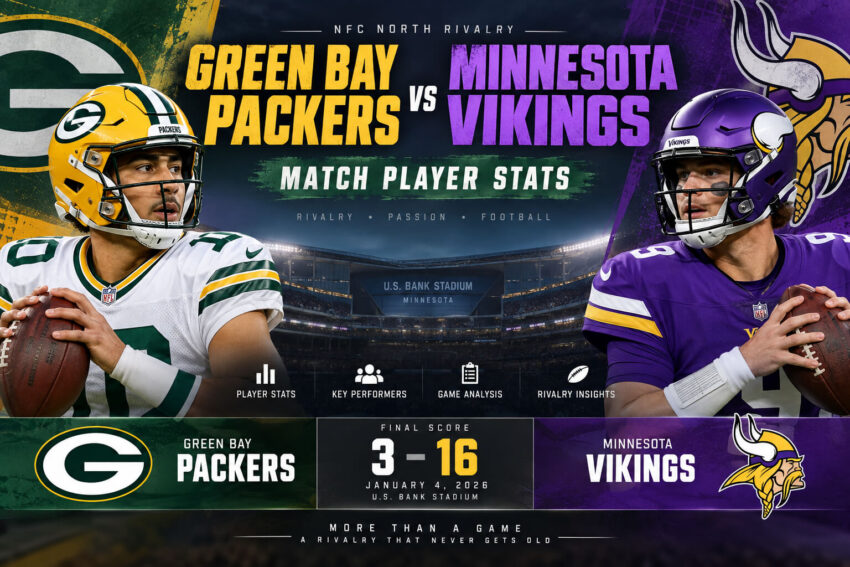
The Green Bay Packers vs Minnesota Vikings match player stats tell the story of a game decided less by explosive scoring and more by Minnesota’s control of the football, defensive pressure, and ability to prevent Green Bay from building any passing rhythm. In the most recent completed meeting between these NFC North rivals, played on January 4, 2026, at U.S. Bank Stadium, Minnesota defeated Green Bay 16-3 in the final week of the 2025 regular season.
This was an unusual Packers-Vikings meeting because Green Bay had already secured the No. 7 seed in the NFC playoffs and chose to rest many regular starters. Jordan Love did not start, while several other important players were also kept out of the lineup. Clayton Tune therefore made his first start for Green Bay against a Minnesota team using more of its regular personnel.
That context matters when reading the numbers. Minnesota finished with 363 total net yards compared with Green Bay’s 121, generated 23 first downs to the Packers’ 12, and held the ball for 33 minutes and 30 seconds. Green Bay’s ground game produced some useful yardage, but its passing offense was almost completely shut down.
Match Overview
Minnesota established control early without needing a high-scoring offensive performance. Will Reichard opened the scoring with a 43-yard field goal in the first quarter.
He added another field goal from 25 yards in the second quarter before fullback C.J. Ham scored the game’s only touchdown on a one-yard run.
That sequence gave Minnesota a 13-0 halftime advantage. Neither team scored in the third quarter, and Reichard’s 37-yard field goal made it 16-0 late in the fourth.
Green Bay finally avoided the shutout when Brandon McManus converted a 24-yard field goal on the final play of the game.
The quarter-by-quarter score looked like this:
| Quarter | Packers | Vikings |
|---|---|---|
| First | 0 | 3 |
| Second | 0 | 10 |
| Third | 0 | 0 |
| Fourth | 3 | 3 |
| Final | 3 | 16 |
The score was relatively modest, but the statistical difference between the offenses was much larger than the 13-point margin suggests.
Team Stats
A look at the full team numbers makes Minnesota’s advantage immediately clear.
| Statistic | Packers | Vikings |
|---|---|---|
| Total net yards | 121 | 363 |
| First downs | 12 | 23 |
| Rushing yards | 128 | 137 |
| Gross passing yards | 34 | 239 |
| Net passing yards | -7 | 226 |
| Offensive plays | 50 | 64 |
| Yards per play | 2.4 | 5.7 |
| Third downs | 3/12 | 2/10 |
| Fourth downs | 0/0 | 1/1 |
| Penalties | 4-47 | 2-20 |
| Red-zone efficiency | 0/1 | 1/4 |
| Turnovers lost | 0 | 1 |
| Time of possession | 26:30 | 33:30 |
The strangest figure is Green Bay’s minus-seven net passing yards. Clayton Tune threw for 34 gross yards, but Minnesota sacked him four times for 41 yards in losses.
Under NFL team-stat accounting, those sack yards reduce net passing production, leaving Green Bay below zero.
That number captures the biggest difference in the contest. The Packers could run the football with some success, but they had almost no ability to threaten Minnesota through the air.
Packers Passing
Clayton Tune faced a difficult assignment in his first Packers start. He completed 6 of 11 passes for 34 yards, with no touchdowns and no interceptions.
His passer rating was 60.4, and his longest completion covered only eight yards.
Those figures alone are limited, but the pressure statistics provide the fuller picture. Tune was sacked four times for 41 yards, meaning Minnesota frequently turned passing situations into negative plays.
Green Bay consequently had only one first down through the passing game. Ten of its 12 total first downs came on runs, while another came through a penalty.
Minnesota, in contrast, recorded 14 passing first downs.
It was not simply a matter of Tune throwing inaccurate passes. Green Bay’s makeshift offense struggled to create situations in which a productive passing game could develop at all.
Vikings Passing
J.J. McCarthy delivered the more effective quarterback performance. He completed 14 of 23 passes for 182 yards, averaged 7.9 yards per attempt, and finished without a touchdown or interception.
His passer rating was 85.8.
McCarthy did not need to force the issue. Minnesota was ahead throughout the afternoon, the running game was functioning, and the defense kept returning the football to the offense in favorable circumstances.
Max Brosmer also appeared and completed 7 of 8 attempts for 57 yards.
Combined, Minnesota’s quarterbacks went 21-of-31 for 239 gross passing yards.
That gave the Vikings an enormous advantage over Green Bay through the air. Even without a passing touchdown, Minnesota consistently moved the chains and created enough field position to stay comfortably in front.
Rushing Leaders
Green Bay’s best offensive work came on the ground. Chris Brooks led the Packers with 61 yards on 13 carries, averaging 4.7 yards per attempt.
His longest run gained 12 yards.
Emanuel Wilson received the largest workload, carrying 18 times for 44 yards. Tune contributed another 23 rushing yards on four attempts, including Green Bay’s longest run of the game at 16 yards.
Altogether, the Packers rushed 35 times for 128 yards.
Those totals are respectable when viewed alone. The difficulty was that the Packers could not complement them with a passing threat.
Minnesota could defend short-yardage situations knowing Green Bay had shown little ability to punish aggressive defensive pressure downfield.
For the Vikings, Jordan Mason was one of the game’s most productive players. He rushed 14 times for 94 yards, averaging an excellent 6.7 yards per carry, with a longest run of 24 yards.
Ty Chandler added 23 yards on 10 attempts, while C.J. Ham’s one-yard touchdown was Minnesota’s only trip into the end zone.
The Vikings totaled 137 rushing yards on 31 carries.
Receiving Leaders
Justin Jefferson produced the strongest receiving line of the game. The Minnesota star caught 8 of 11 targets for 101 yards, averaging 12.6 yards per reception.
His performance was important because it provided the Vikings with steady production even though they did not score a passing touchdown.
Jefferson’s longest reception went for 18 yards, and he accounted for more receiving yards individually than Green Bay accumulated in gross passing yardage as an entire team.
Jalen Nailor was another valuable contributor, catching three passes for 49 yards, including the longest pass play of the game at 26 yards.
Josh Oliver added two catches for 29 yards, while Ben Sims recorded an 18-yard reception.
Green Bay’s receiving totals were far smaller.
Jakobie Keeney-James led the Packers with two receptions for 15 yards. Matthew Golden had one reception for eight yards, while Josh Whyle and Emanuel Wilson each recorded four receiving yards.
No Green Bay player had a reception longer than eight yards.
Defensive Leaders
Minnesota’s defense was arguably the most important unit on the field. The Vikings did not allow Green Bay to develop any meaningful offensive rhythm and kept the Packers out of the end zone for the entire game.
Dallas Turner was particularly disruptive.
He recorded two sacks for 20 yards, two tackles for loss, and a forced fumble. Blake Cashman added a 10-yard sack, and Theo Jackson recorded another sack for an 11-yard loss.
Together, Minnesota registered four sacks for 41 yards.
Andrew Van Ginkel also contributed two tackles for loss and two passes defended, while Eric Wilson led Minnesota with nine combined tackles.
Green Bay’s defense had far more work to do because Minnesota ran 64 offensive plays.
Jamon Johnson finished with 10 combined tackles, the highest total for the Packers.
Barryn Sorrell recorded eight combined tackles and a sack, while Jaylin Simpson also had eight tackles.
Brenton Cox Jr. recorded another sack and was credited with three quarterback hits.
Green Bay’s defense also forced a Minnesota fumble, preventing the score from becoming more lopsided.
Jefferson’s Impact
Justin Jefferson’s 101-yard afternoon stands out when studying the Green Bay Packers vs Minnesota Vikings match player stats because Minnesota did not require a touchdown from its best receiver to benefit from his influence.
His eight receptions helped keep drives moving and gave McCarthy a dependable target.
Minnesota generated 14 passing first downs, compared with only one for Green Bay, and Jefferson was central to that difference.
It was a strong example of a receiver affecting a game through consistency rather than one spectacular scoring play.
Green Bay had to account for Jefferson throughout the contest, and Minnesota was able to spread additional catches among Nailor, Oliver, Chandler, and others.
Mason’s Performance
Jordan Mason deserves equal attention.
His 94 rushing yards on only 14 carries gave Minnesota a strong 6.7-yard average.
That efficiency was especially useful with the Vikings protecting a lead.
Instead of putting McCarthy in situations where he needed to make risky throws, Minnesota could maintain balance and continue moving the football on the ground.
Mason did not score a touchdown, but his production was one of the reasons Minnesota averaged 5.7 yards per offensive play compared with Green Bay’s 2.4.
Packers’ Offensive Problem
The Packers rushed for 128 yards and still finished with only 121 net offensive yards.
That seems contradictory until the sack yardage is considered.
Green Bay lost 41 yards on four sacks, completely erasing much of the progress made by its running game.
The Packers punted eight times, compared with four punts for Minnesota, and Green Bay struggled to produce sustained drives.
At halftime, the difference was even more dramatic.
Green Bay had managed only 12 net yards, while Minnesota had accumulated 244.
The Vikings held a 13-0 lead and had already generated 14 first downs compared with three for the Packers.
Green Bay improved after halftime, particularly on the ground, but never created the explosive play required to change the direction of the contest.
Scoring Difference
Minnesota’s offense was not flawless.
The Vikings reached the red zone four times but scored a touchdown on only one of those possessions, producing a 25 percent red-zone touchdown rate.
That normally leaves an opponent with opportunities to remain competitive.
Green Bay simply could not take advantage because its offense produced no touchdowns and reached the red zone only once.
Will Reichard therefore became an important figure.
His three made field goals—from 43, 25, and 37 yards—provided nine points and allowed Minnesota to steadily expand the lead without needing aggressive fourth-down decisions.
C.J. Ham supplied the game’s lone touchdown, and Reichard converted the extra point.
Brandon McManus scored Green Bay’s only three points as time expired.
Possession Battle
Minnesota controlled the football for 33:30, compared with Green Bay’s 26:30.
The difference of seven minutes was significant, but the quality of those possessions mattered even more.
Minnesota recorded 23 first downs and averaged 5.7 yards per offensive play.
Green Bay generated only 12 first downs and 2.4 yards per play.
That meant the Vikings were consistently playing ahead of the chains while Green Bay frequently faced long passing situations.
Once Minnesota’s pass rush could anticipate those situations, the challenge became even greater for Tune and the Packers’ altered offensive line.
Key Turning Point
The second quarter effectively shaped the afternoon.
Minnesota led only 3-0 when it produced a 14-play, 84-yard drive lasting 6:02, ending in Reichard’s 25-yard field goal.
Later in the quarter, the Vikings moved 59 yards in nine plays and finished with Ham’s one-yard touchdown with 23 seconds remaining.
The Vikings went into halftime ahead 13-0, while Green Bay had produced just 12 net offensive yards.
From that point, Minnesota did not need to chase points.
The Vikings could protect the football, run the ball, and allow their defense to control Green Bay’s short-handed offense.
Rivalry Context
Packers-Vikings games rarely lack meaning because the two franchises have spent decades competing inside the same division.
This matchup is commonly known as the Border Battle, and meetings often affect playoff races or NFC North positioning.
The January 2026 game was slightly different.
Green Bay had already clinched a playoff spot and was locked into the NFC’s No. 7 seed, which influenced the decision to rest numerous regular starters.
Minnesota, meanwhile, was finishing its season while carrying strong late-season momentum.
The victory extended Minnesota’s winning run and gave the Vikings a 9-8 final record.
Green Bay finished the regular season 9-7-1.
The result also meant the teams split their two 2025 meetings.
Green Bay had defeated Minnesota 23-6 on November 23, 2025, before the Vikings answered with the 16-3 victory in Week 18.
What the Stats Show
The biggest lesson from the Green Bay Packers vs Minnesota Vikings match player stats is not simply that Minnesota gained more yards.
It is the way those yards were distributed.
Green Bay’s 128 rushing yards showed that the offense could still move the ball on the ground.
But the passing game provided almost nothing, allowing Minnesota’s defense to concentrate on winning obvious passing situations.
Minnesota, meanwhile, had balance.
Mason approached 100 rushing yards, Jefferson surpassed 100 receiving yards, McCarthy protected the football, and the defense produced four sacks.
Minnesota did not need a spectacular offensive game because it controlled almost every important area of the matchup.
The Vikings gained 242 more total net yards, more than doubled Green Bay’s first-down total through the passing game, and kept the Packers out of the end zone for all 60 minutes.
Final Thoughts
The 16-3 score may look like a simple defensive victory, but a closer look at the Green Bay Packers vs Minnesota Vikings match player stats reveals several individual performances worth remembering.
Jordan Mason led all rushers with 94 yards, Justin Jefferson led all receivers with 101 yards, J.J. McCarthy threw for 182 yards without an interception, and Minnesota’s defense sacked Clayton Tune four times.
For Green Bay, Chris Brooks was the most productive offensive player with 61 rushing yards, while Jamon Johnson led the defense with 10 combined tackles.
The biggest statistical difference was unmistakably the passing game.
Minnesota produced 226 net passing yards, while Green Bay finished at minus-seven after sack losses.
That disparity allowed the Vikings to control field position, sustain drives, and comfortably close their 2025 season with a victory over a familiar rival.
FAQs
Who won the latest completed Packers vs Vikings game?
The Minnesota Vikings defeated the Green Bay Packers 16-3 on January 4, 2026, at U.S. Bank Stadium.
Who had the most passing yards?
J.J. McCarthy led the game with 182 passing yards, completing 14 of 23 attempts without a touchdown or interception.
Who was the leading rusher?
Minnesota’s Jordan Mason led all players with 94 rushing yards on 14 carries, averaging 6.7 yards per attempt.
Who had the most receiving yards?
Justin Jefferson led the matchup with 101 receiving yards on eight catches. His longest reception gained 18 yards.
Why did Jordan Love not start for Green Bay?
Green Bay was already locked into the NFC’s No. 7 playoff seed and rested many regular starters. Clayton Tune started at quarterback as the Packers prioritized player health before the postseason.