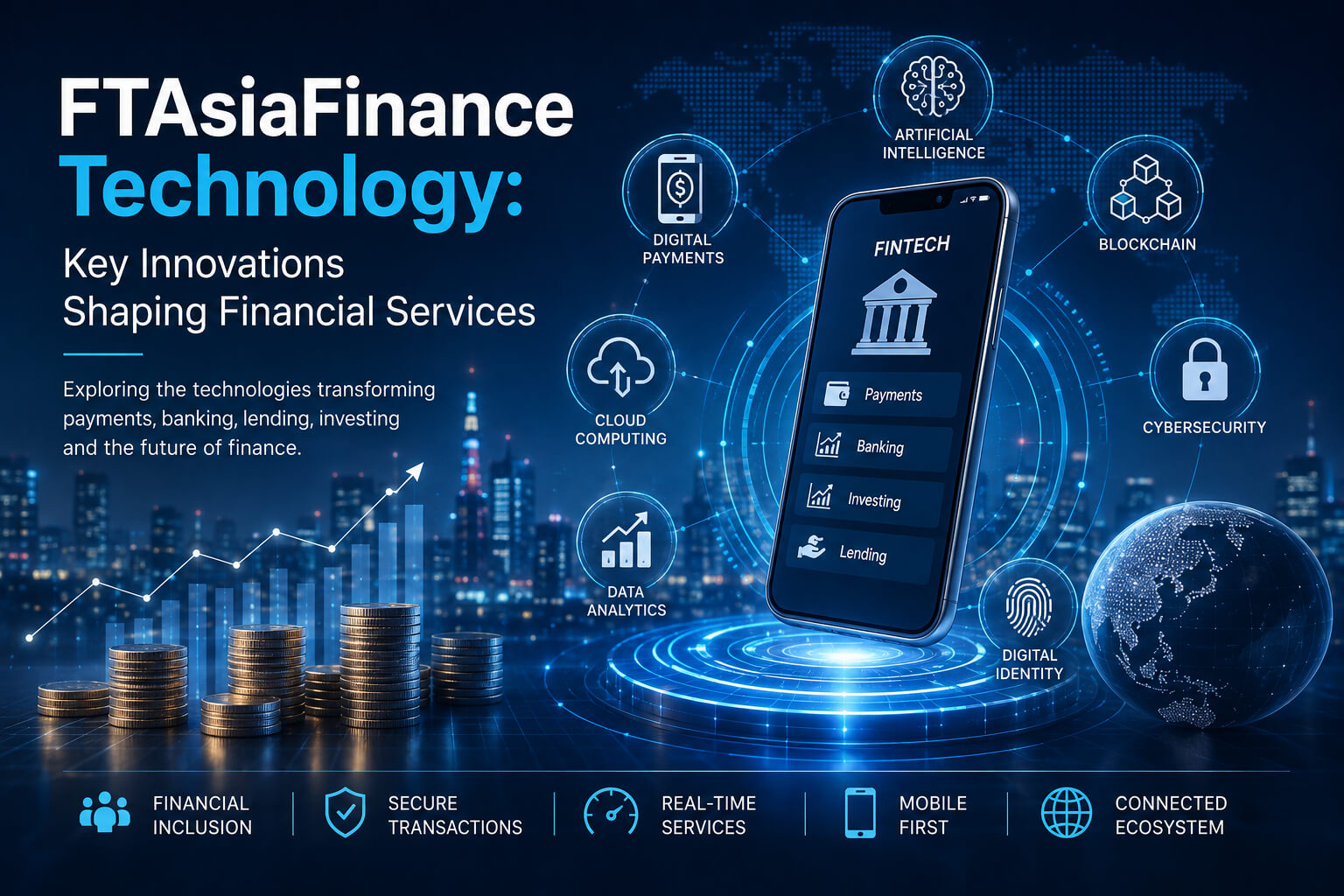
Financial services have changed dramatically over the past decade. Banking that once depended on physical branches, paperwork, cash payments, and lengthy approval procedures is increasingly moving onto smartphones and digital platforms. Payments can arrive within seconds, customers can open accounts remotely, businesses can automate financial processes, and sophisticated systems can examine thousands of transactions for signs of fraud.
The keyword FTAsiaFinance Technology is often used online in connection with this wider intersection of finance and technology, particularly developments affecting Asian financial markets. It is important, however, not to confuse the phrase with a universally recognized banking institution or a clearly established standalone technology product. Available sources use the expression differently. For this reason, the most useful way to understand FTAsiaFinance Technology is through the financial innovations associated with the term: digital payments, artificial intelligence, blockchain, mobile banking, open finance, cloud infrastructure, data analytics, cybersecurity, and digital lending.
These technologies are no longer side projects within finance. In many areas, they are becoming part of the basic infrastructure through which consumers and companies move, borrow, save, and manage money.
What Is FTAsiaFinance Technology?
FTAsiaFinance Technology can be understood as a broad discussion around the technologies transforming financial services, particularly in Asia. Some websites using the term associate it with fintech developments such as digital banking, artificial intelligence, payment technology, blockchain, and financial data systems.
That broader interpretation fits the established definition of fintech. The World Bank describes financial technology as the use of technologies including data analytics, cloud services, machine learning, artificial intelligence, and distributed-ledger systems to improve financial activities. Digital financial services can include electronic money, digital wallets, payments, savings, loans, insurance, and investment products.
Seen this way, FTAsiaFinance Technology is less about one particular application and more about understanding how technology is changing the financial system.
Why Financial Technology Matters
Consumers expect financial services to work with the same speed and convenience they receive from other digital services. Few people want to visit a branch simply to transfer money, check an account balance, pay a bill, or submit routine information.
Technology gives financial institutions an opportunity to simplify those activities. It can also reduce operating costs and extend services to customers who live far from physical branches.
The World Bank notes that digital financial services can help make transactions faster, more secure, more transparent, and potentially less expensive, while also giving providers the ability to offer more customized financial products. This is especially significant in markets where traditional financial infrastructure does not reach every community.
Digital finance therefore matters for more than convenience. It can influence financial inclusion, competition, business productivity, and the way entire payment systems function.
Digital Payments
Payments are among the clearest examples of financial technology becoming part of everyday life. Mobile wallets, QR codes, instant bank transfers, contactless cards, and app-based payments have reduced dependence on cash in many markets.
Asia is particularly important in this development. Countries across the region have invested heavily in domestic instant-payment systems while also exploring ways of making cross-border payments easier.
An IMF study published in 2026 highlighted substantial progress in digital payments across ASEAN and examined how stronger regional payment connectivity could promote financial integration and greater use of local currencies.
For consumers, the attraction is straightforward: sending money becomes quicker and purchasing goods becomes simpler. For businesses, digital payments can provide faster settlement, clearer transaction records, and easier integration with accounting systems.
The challenge is making those systems reliable and interoperable. A payment technology is only truly useful when consumers can trust it to work securely every time.
Artificial Intelligence
Artificial intelligence has become one of the most discussed innovations in modern financial services. Banks, insurers, investment companies, payment providers, and fintech firms can use AI to process information at a scale that would be extremely difficult through manual analysis.
One major application is fraud detection. AI systems can examine transaction patterns and identify behaviour that differs from a customer’s normal activity. A suspicious transaction can then be flagged for additional review.
AI can also help financial companies automate routine customer service, examine documents, assist compliance teams, improve risk modelling, and personalize services.
The Financial Stability Board reports that financial firms are already applying AI to areas including risk modelling, fraud detection, financial-crime prevention, trading, claims processing, and internal operations.
Yet AI should not be considered automatically accurate simply because it processes large amounts of data. Poor-quality information, weak model design, and insufficient oversight can still produce poor decisions.
Machine Learning
Machine learning is closely connected with AI but deserves particular attention in finance. Instead of relying entirely on manually programmed rules, machine-learning models can detect patterns in historical information and use those patterns when evaluating new data.
In lending, for example, a model may analyze financial information to estimate credit risk. Fraud systems may learn which transaction patterns frequently correspond with unauthorized activity.
Research published by the Bank for International Settlements has examined how AI-based credit scoring can work alongside traditional relationship lending rather than necessarily eliminating human judgment.
That distinction matters. Financial decisions often involve circumstances that cannot be fully understood from numbers alone. The strongest systems are likely to combine automated analysis with appropriate human review, particularly when decisions significantly affect customers.
Digital Banking
Modern banking increasingly begins with an app rather than a branch.
Customers can check balances, transfer funds, freeze cards, receive notifications, submit documents, and communicate with their bank without leaving home. Some digital-first providers operate with a much smaller physical footprint than traditional banks.
This model offers clear advantages. Services can be available around the clock, onboarding can become faster, and institutions can potentially reach customers in locations where opening branches would be uneconomical.
Digital banking also creates stronger competition. Traditional banks now compete not only against other banks but against fintech firms, payment companies, digital wallets, and technology platforms.
That competition encourages financial institutions to improve user experience rather than treating digital banking as a simple electronic version of the old branch model.
Open Finance
Another important development associated with modern financial technology is open finance.
The basic idea is that customers should be able, subject to appropriate consent and security protections, to share financial information between authorized services. Application programming interfaces, commonly called APIs, can allow different financial systems to communicate more efficiently.
The BIS has noted that open banking and open-finance frameworks have developed across many jurisdictions and can encourage competition, innovation, and inclusion. Its Project Aperta, published in 2026, explored how open-finance networks could eventually become more interoperable across borders.
Such interoperability could be particularly valuable for businesses operating internationally. Repeated verification, incompatible data formats, and duplicated paperwork remain significant obstacles in cross-border finance.
Embedded Finance
Financial services are also becoming embedded inside platforms that consumers may not think of as financial companies.
An online marketplace may offer payment services during checkout. A business software platform may provide financing. A travel application may incorporate insurance. A retailer may allow customers to select an installment-payment option without separately visiting a bank.
This approach is known as embedded finance.
Its importance comes from convenience. Instead of forcing customers to leave one platform and begin another financial process somewhere else, a relevant financial product appears at the point where it is needed.
However, convenience should not make financial obligations less transparent. Consumers still need to understand interest, fees, repayment conditions, and the identity of the regulated provider behind the service.
Digital Lending
Traditional borrowing often involves forms, supporting documents, credit checks, and days or weeks of processing. Digital lending platforms attempt to shorten that process.
Applications can be submitted online, identity checks can be automated, financial information can be analyzed electronically, and decisions can sometimes be delivered much faster.
For small businesses, this can be useful when working capital is needed quickly. Digital lenders may also use alternative information when conventional credit histories are limited.
Yet speed creates risks. A faster loan is not automatically a better loan. Responsible lenders still need appropriate affordability checks, transparent terms, privacy safeguards, and processes for correcting errors.
The World Bank includes digital credit among the important areas that regulators must consider when building safe digital financial systems.
Blockchain
Blockchain is frequently associated with cryptocurrency, but distributed-ledger technology has potential applications beyond trading digital assets.
At its core, blockchain provides a method for maintaining records across a distributed network. In financial services, researchers and institutions have explored its possible use in settlement systems, trade finance, asset tokenization, identity processes, and smart contracts.
A smart contract can automatically perform agreed actions when predetermined conditions are satisfied. In theory, this may reduce certain manual processes and reconciliation steps.
Still, blockchain should not be presented as a universal solution. Traditional databases may remain simpler and more efficient for many financial applications. Its value depends on the specific problem being solved, the regulatory environment, scalability, security, and whether multiple parties genuinely benefit from a shared ledger.
Big Data
Finance has always depended on information. What has changed is the amount of data that organizations can now collect and analyze.
Payment histories, account activity, customer interactions, market movements, and operational information can generate enormous datasets. Modern analytical systems can turn some of this information into useful insights.
Banks can use data to understand customer behaviour. Payment companies can monitor suspicious patterns. Lenders can improve risk assessment. Investment firms can analyze markets. Businesses can forecast cash requirements.
But more data also means greater responsibility.
Customers should know how important personal information is being collected and used. Financial institutions need strong controls around access, storage, retention, and sharing. Data-driven finance cannot maintain public trust without serious privacy protection.
Cloud Technology
Cloud computing has quietly become another major part of digital financial transformation.
Instead of operating every computing resource through infrastructure owned directly by the financial institution, companies can use cloud environments to scale applications, store information, develop services, and process workloads.
This can make technology development faster and more flexible. A growing fintech platform can increase computing capacity without constructing a large physical data center whenever demand rises.
There are also risks. Heavy reliance on a small number of technology providers could create concentration and operational vulnerabilities. The Financial Stability Board has specifically identified third-party dependencies and service-provider concentration as potential concerns arising from increasingly technology-dependent financial systems.
Financial companies therefore need resilience plans rather than assuming cloud infrastructure can never fail.
Cybersecurity
The more financial activity moves online, the more valuable financial systems become to criminals.
Cybersecurity now sits at the heart of digital finance. Attackers may attempt to steal login credentials, impersonate customers, compromise devices, manipulate employees, or exploit weaknesses in financial software.
Institutions respond with measures such as encryption, multi-factor authentication, biometric verification, transaction monitoring, access controls, and continuous security testing.
Artificial intelligence complicates this environment. The same technology that helps institutions identify fraud can also help criminals create more convincing phishing messages, impersonations, and synthetic content.
The FSB has warned that generative AI may increase fraud and cyber risks while making some existing attack methods more effective.
Security therefore cannot be treated as a feature added after a financial product is built. It must be part of its design.
Digital Identity
Before a financial institution opens an account or provides certain services, it normally needs to establish who the customer is.
Digital identity technology can make that process faster. Customers may submit identity documents through an application, complete biometric checks, or use other electronic verification systems rather than appearing physically at a branch.
Done well, digital identification can reduce onboarding friction and make financial services accessible remotely.
Done badly, it can create privacy concerns or exclude customers whose documents, devices, or biometric information cannot be verified correctly.
The challenge is therefore to combine speed, security, accessibility, and meaningful customer protection.
RegTech
Regulatory technology, usually called RegTech, applies software and data tools to compliance requirements.
Financial institutions process enormous volumes of transactions and must comply with rules relating to customer identification, money laundering, sanctions, reporting, risk, and consumer protection.
Manual review alone becomes increasingly difficult at large scale.
Automated systems can identify unusual activity, organize compliance information, screen transactions, and help investigators focus on cases requiring human judgment. AI is also being explored by regulators themselves to improve supervision and process large volumes of financial data.
RegTech does not eliminate regulatory responsibility. A company remains accountable for its compliance even when software performs part of the work.
Financial Inclusion
One of the strongest arguments for digital finance is its potential to reach people who have historically had limited access to formal financial services.
A physical branch costs money to operate. A mobile service may reach customers across a much wider geographic area.
The World Bank emphasizes that digital financial services can help overcome barriers faced by underserved individuals and businesses while offering faster and more customized financial products.
However, technology does not automatically create inclusion.
People still need affordable internet access, suitable devices, identification, financial literacy, and confidence using digital systems. Poorly designed interfaces can exclude older users, people with disabilities, or customers with limited technical experience.
True financial inclusion means making technology usable, not simply making it available.
Asia’s Role
Asia is one of the most important regions to watch when examining the future of financial technology.
The region combines enormous consumer markets, expanding digital economies, technology-focused cities, major banking systems, mobile-first populations, and large numbers of small businesses.
Yet Asia should never be treated as a single uniform market. Financial infrastructure, regulation, income levels, banking penetration, and technology adoption differ significantly between China, India, Singapore, Indonesia, Japan, South Korea, Pakistan, Thailand, Malaysia, the Philippines, and other economies.
Recent IMF work on ASEAN demonstrates how regional initiatives are increasingly focused not only on domestic digital payments but on improving cross-border payment connectivity as well.
That makes Asia an important laboratory for what interconnected digital finance may eventually look like elsewhere.
Benefits for Consumers
For ordinary customers, financial technology can remove many small frustrations that once surrounded money management.
Payments can become faster. Account information can be viewed immediately. Transfers can be made at any hour. Spending notifications can arrive in real time. Investment platforms can make certain markets easier to access.
Greater competition can also encourage providers to improve fees, interfaces, speed, and customer service.
Perhaps the most important benefit is control. When financial information is available immediately, customers have a better opportunity to understand where their money is going and respond quickly when something appears wrong.
Benefits for Businesses
Businesses experience many of the same advantages at a larger scale.
Automated invoicing can reduce administrative work. Digital payments can improve collection speed. Accounting integrations can simplify recordkeeping. Data analytics can improve cash-flow forecasts. Online lenders can broaden financing options.
Cross-border technologies may also become increasingly important for companies trading internationally.
The World Bank emphasizes that efficient payment systems and financial infrastructure contribute to economic development, digital commerce, financial inclusion, and financial stability.
For smaller companies in particular, simple financial technology can free employees from repetitive administrative tasks and allow them to focus more attention on customers and operations.
Risks
Financial innovation also creates risks that deserve as much attention as the benefits.
Cybercrime can expose customer funds and personal information. Automated lending models can make unfair decisions. Poor data can create misleading recommendations. Digital platforms can experience outages. Consumers may take loans they do not fully understand.
Artificial intelligence introduces additional concerns around explainability and bias. If historical data contains unfair patterns, an automated system may reproduce them.
The Financial Stability Board has also highlighted risks involving model quality, data governance, privacy, third-party technology dependence, cyber threats, and correlated behaviour among institutions using similar systems.
Innovation therefore needs controls strong enough to match its scale.
Regulation
Financial technology develops quickly, while financial regulation must remain careful.
Regulators have several responsibilities at once. They want to encourage useful competition and innovation, but they must also protect customers, maintain financial stability, fight financial crime, and ensure institutions manage risk properly.
Those goals can sometimes conflict.
Rules that are too restrictive can discourage useful experimentation. Rules that are too weak can allow harmful lending practices, poor data handling, fraud, or unstable financial products to grow.
The World Bank’s digital-finance guidance emphasizes the importance of effective legal and regulatory frameworks covering areas such as consumer protection, data privacy, cybersecurity, digital credit, outsourcing, e-money, and competition.
This balance between innovation and protection will shape the future of fintech.
The Human Side
Technology can automate many activities, but finance remains deeply personal.
A declined loan can affect someone’s business. A blocked payment can interrupt travel or household expenses. A fraud investigation can be stressful. An investment loss can affect years of savings.
For those reasons, financial companies should avoid assuming that every interaction should be fully automated.
Customers still need clear explanations and access to human assistance when circumstances become complicated.
The most effective financial technology is therefore not necessarily the technology that removes people completely. It is technology that handles routine work efficiently while allowing human judgment to remain available where it matters.
The Future
Several developments are likely to influence the next stage of financial technology.
AI will probably become more deeply integrated into fraud detection, compliance, financial analysis, and customer support. Open-finance systems may allow information to move more easily between authorized providers. Payment networks will continue working toward faster cross-border transactions.
Digital identity could simplify onboarding. Embedded finance will place financial products inside more everyday services. Cloud computing will continue supporting scalable applications, while cybersecurity spending will remain essential.
At the same time, regulators will pay closer attention to AI governance, privacy, operational resilience, third-party dependencies, algorithmic fairness, and financial stability.
The future is therefore unlikely to be a simple story of technology replacing traditional finance. It will be a gradual merging of banking knowledge, regulation, software, data, and consumer expectations.
What FTAsiaFinance Technology Means
Viewed in this wider context, FTAsiaFinance Technology represents the ongoing connection between financial services and technological innovation.
Its most important themes are not limited to one website or one product. They include the shift toward digital payments, smarter financial analysis, automated compliance, mobile banking, open finance, digital lending, stronger cybersecurity, and more connected financial markets.
For readers following finance in Asia, these developments are worth understanding because the region is already playing a significant role in testing how digital payments and interconnected financial systems can work at scale.
The useful question is therefore not simply which technology will become fashionable next. It is which technologies can make finance more efficient, accessible, secure, transparent, and trustworthy.
Conclusion
FTAsiaFinance Technology sits within a much larger transformation occurring across modern financial services. Banking is becoming digital, payments are becoming faster, algorithms are helping institutions analyze risk, cloud platforms are changing financial infrastructure, and open-finance initiatives are creating new possibilities for connected services.
Artificial intelligence, digital payments, machine learning, blockchain, open finance, cybersecurity, digital identity, cloud computing, and RegTech all have the potential to improve how financial institutions operate and how customers interact with money.
But innovation alone is not enough.
Financial companies must protect data, design fair systems, maintain cybersecurity, explain important decisions, and preserve meaningful human oversight. Regulators must encourage useful innovation without allowing convenience to undermine consumer protection or financial stability.
That balance will determine whether the next generation of financial technology genuinely improves people’s financial lives.
For anyone researching FTAsiaFinance Technology, the biggest lesson is clear: the future of finance is becoming increasingly digital, but successful financial technology will be measured not by how advanced it looks, but by how reliably and responsibly it serves the people who depend on it.
FAQs
What is FTAsiaFinance Technology?
FTAsiaFinance Technology is a term found online in discussions about finance and technological innovation, particularly Asian fintech. Because sources use the name differently, it is safer to understand it broadly through areas such as digital banking, payments, AI, blockchain, cloud technology, and financial data services rather than assuming it represents one universally recognized financial company.
How is FTAsiaFinance Technology changing financial services?
The technologies associated with the topic are helping financial organizations automate processes, improve payments, analyze data, identify fraud, provide digital banking services, and reach customers through mobile platforms.
Which technologies are most important in modern fintech?
Some of the most influential technologies include artificial intelligence, machine learning, digital payments, cloud computing, APIs, blockchain, cybersecurity systems, biometric identity tools, and big-data analytics.
Is FTAsiaFinance Technology connected with AI and blockchain?
Both AI and blockchain frequently appear in discussions surrounding modern financial technology. AI already has practical applications in fraud detection, customer service, compliance, and risk assessment, while blockchain is being explored for areas such as digital assets, settlements, smart contracts, and shared financial records.
What are the biggest risks of digital financial technology?
Major concerns include cyberattacks, privacy violations, financial fraud, biased automated decisions, technology outages, weak consumer protection, model errors, and excessive dependence on third-party technology providers.