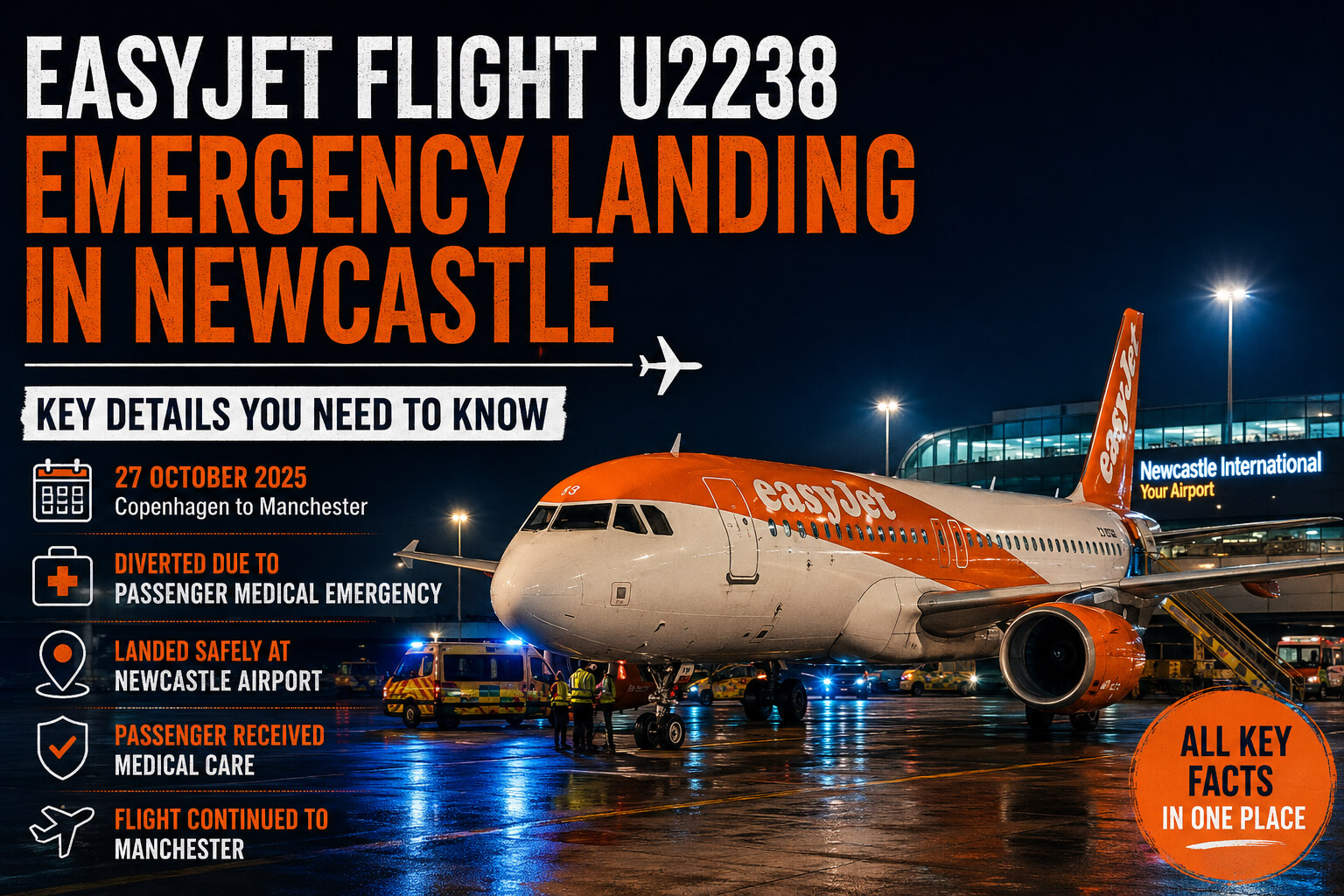
An easyJet flight travelling from Copenhagen to Manchester made an unexpected diversion to Newcastle International Airport on 27 October 2025 after a passenger onboard required urgent medical attention. The event later became widely searched under the phrase easyJet flight U2238 emergency landing Newcastle, although there is an important detail about the flight number that needs to be explained.
The flight involved in the incident was easyJet U2 2238, normally written as U22238, while aviation tracking systems identified it as EZY2238. It was operating between Copenhagen Airport and Manchester Airport when the crew changed course and landed at Newcastle. easyJet later confirmed that the diversion happened because a customer needed urgent medical assistance and that medical services met the passenger after arrival. The aircraft subsequently continued to Manchester.
Although the words “emergency landing” naturally sound alarming, the available evidence does not point to an engine problem, fire, structural fault or another major technical failure. Instead, this was a medical diversion, demonstrating how airlines and airports respond when someone onboard needs professional treatment without unnecessary delay.
What Happened?
The flight left Copenhagen, Denmark, on the evening of 27 October 2025, with Manchester as its scheduled destination. It was an ordinary European short-haul journey until a passenger developed a medical problem that required urgent attention.
Rather than continuing all the way to Manchester, the flight crew decided to divert to Newcastle International Airport. Contemporary reporting carried a statement from easyJet confirming that Flight EZY2238 had diverted because a customer onboard needed urgent medical attention. The airline also confirmed that medical personnel met the passenger once the aircraft arrived.
This is an important distinction. The aircraft itself was not publicly reported to have developed a serious technical problem. The urgent issue concerned the wellbeing of a person onboard.
The Flight Number
One reason the incident became confusing online is the way the easyJet flight number is written.
easyJet’s two-character airline designator is U2, while the specific flight number in this case was 2238. Written together, that becomes U22238. In aviation tracking and operational records, the flight can also appear as EZY2238, using easyJet’s three-letter ICAO designator.
The shorter term U2238, which has become common in searches about the Newcastle incident, can actually be interpreted as U2 flight 238 rather than U2 flight 2238. Some current flight records associate that shorter designation with a different easyJet service. For readers researching the October 2025 incident, U22238 or EZY2238 are therefore the clearer identifiers.
That small difference may look unimportant, but flight numbers are useful for distinguishing one service from another. Using the accurate identifier prevents separate flights from being mixed together.
Why Newcastle?
During a medical emergency, reaching the scheduled destination is no longer necessarily the main priority. The crew must consider where the aircraft can safely land and where appropriate help can be reached quickly.
Newcastle was a practical diversion point while the aircraft was approaching the United Kingdom from across the North Sea. A commercial jet cannot simply land at whichever airport appears geographically closest. Pilots and air traffic controllers must consider runway suitability, airport operating conditions, available ground services, weather and the urgency of the situation.
For a passenger who may need hospital treatment, reducing the amount of time before professional medical care becomes available can be important. Diverting to a suitable airport rather than continuing the original journey is therefore a standard safety option available to the captain.
In this case, the crew’s decision allowed medical services to meet the aircraft at Newcastle rather than requiring the passenger to remain onboard until Manchester.
The Emergency Declaration
Reports about the incident state that the aircraft used transponder code 7700 while dealing with the emergency. This often attracts attention on public flight-tracking websites because the code is associated with an aircraft requiring emergency handling.
It is important, however, to understand what 7700 does and does not mean. Under UK aviation rules, Code 7700 indicates a state of emergency. It does not identify the cause. The same code may be used in very different circumstances, ranging from aircraft problems to urgent medical situations.
European aviation rules similarly identify 7700 as the code pilots can select when an aircraft is in an emergency situation.
Therefore, seeing a flight “squawk 7700” should not automatically be interpreted as evidence that the aircraft was close to crashing or suffering a catastrophic mechanical failure. The code tells air traffic control that the aircraft requires emergency handling; further information is needed to understand why.
In the case of EZY2238, easyJet’s own reported explanation was a passenger requiring urgent medical attention.
A Medical Diversion
Medical diversions happen because aircraft crews must consider the health of everyone onboard, not simply the operational schedule.
Cabin crew receive first-aid training and can provide initial assistance when someone becomes ill. Depending on the circumstances, crew members may also ask whether a qualified medical professional is travelling as a passenger. Some airlines can obtain additional advice through medical support services on the ground.
There are limits, however, to what can reasonably be done thousands of feet above the ground. An aircraft cabin is not a hospital, and serious medical conditions may require equipment, testing, medication or treatment unavailable during flight.
If the condition appears serious enough, the captain may decide that landing at a suitable airport is safer than continuing. Such a decision can lead to delays and additional operational work, but passenger wellbeing takes precedence.
That appears to have been the reasoning behind the Newcastle diversion.
The Newcastle Landing
The easyJet Airbus landed safely at Newcastle, where emergency medical personnel were available to deal with the affected passenger. Some later aviation reports place the landing shortly before 11 p.m. UK time, with approximately 22:52 GMT frequently reported.
The key point is that the landing itself was completed safely. There is no credible public reporting indicating that the aircraft suffered an accident during the approach or landing.
The phrase “emergency landing” sometimes gives readers the impression of a dramatic touchdown involving damaged equipment or immediate danger to everyone onboard. Aviation incidents are often less dramatic than that wording suggests.
Here, a more precise description is an emergency diversion followed by a safe landing.
Medical Help on Arrival
Once the aircraft reached Newcastle, the passenger was handed into the care of medical professionals. easyJet confirmed that medical services met the customer on arrival.
That is the most important publicly confirmed information about the individual involved. Detailed medical information, including the person’s identity and longer-term condition, has not been reliably established in the strongest available reporting.
For that reason, claims about a specific diagnosis or later outcome should be treated cautiously unless supported by authoritative evidence.
The absence of those personal details does not leave the main reason for the diversion unclear. easyJet itself identified the situation as one involving a passenger who required urgent medical attention.
Was the Aircraft Faulty?
There has been no reliable public confirmation that a mechanical defect caused this incident.
That matters because reports using terms such as “emergency,” “7700” and “emergency landing” can easily create the impression that the aircraft developed an engine or control problem.
The information available tells a different story. The reason provided by easyJet concerned the passenger, and the aircraft later continued its journey to Manchester after the situation at Newcastle had been dealt with.
While an onward departure alone cannot prove the complete technical condition of an aircraft, it is consistent with the airline’s explanation that the diversion was driven by a medical issue rather than a major aircraft failure.
There is consequently no sound basis for describing this incident as an engine failure, near-crash or serious aircraft malfunction.
The Journey Continued
Once the medical situation had been handled, the easyJet flight was able to leave Newcastle and continue toward Manchester.
easyJet’s statement confirmed that the flight continued to Manchester after the customer was met by medical services.
For the remaining passengers, the diversion meant an unexpected interruption and a later arrival than originally planned. Such disruptions can be inconvenient, particularly late in the evening, but they are sometimes unavoidable when a person’s health requires immediate attention.
From an operational perspective, continuing the journey also meant that passengers could still reach the destination for which they had originally booked rather than having the service terminated permanently at Newcastle.
What 7700 Really Means
The transponder code deserves further explanation because it is one of the most misunderstood parts of aviation incidents seen on public flight trackers.
Aircraft transponders send identifying information that assists air traffic control. Certain numerical codes have specific meanings. Code 7700 is associated with an emergency, while other codes are reserved for situations such as communication failure or unlawful interference.
UK Civil Aviation Authority rules state that a pilot may select 7700 to indicate a state of emergency. The FAA likewise describes 7700 as an emergency code, reinforcing that it is a general alert rather than an explanation of the underlying problem.
This distinction is useful whenever aviation stories circulate on social media. A screenshot showing 7700 can confirm that an emergency status was communicated, but it cannot by itself reveal whether the cause was medical, mechanical, operational or something else.
Context from the airline, airport or aviation authorities remains essential.
How Crews Make the Decision
A diversion is not a decision made casually. Changing destination affects fuel planning, air traffic arrangements, passenger connections, ground handling and airline operations.
During a medical event, however, the crew’s first consideration is safety and wellbeing.
Pilots can receive information from cabin crew about the passenger’s condition and may assess how urgently landing is required. Air traffic control can then assist by coordinating the change of route and giving the aircraft the handling appropriate to the situation.
Airport teams must also prepare. Depending on the circumstances, medical personnel, emergency vehicles and airline ground staff may need to be positioned before the aircraft arrives.
To travellers watching from inside the cabin, the process may appear relatively simple: the aircraft turns, descends and lands somewhere unexpected. Behind that change is coordination between several teams working to shorten the time between the emergency developing and professional help becoming available.
Why Diversions Are Important
Airline schedules are carefully planned, but safety procedures are deliberately designed to allow those plans to change.
An aircraft may divert for many reasons. Severe weather can make the planned destination unsuitable. A technical warning can require precautionary checks. An airport may become temporarily unavailable. A disruptive passenger can create a security or safety concern. And, as this incident demonstrates, someone onboard can become seriously ill.
A diversion should therefore not automatically be viewed as evidence that something has gone wrong with aviation safety. In many cases, the diversion is the safety system working as intended.
The important question is why the aircraft diverted and how the situation was handled.
For EZY2238, available evidence indicates that the crew responded to an urgent passenger medical situation, Newcastle received the aircraft safely, medical services attended the passenger, and the flight later continued.
Passenger Perspective
For passengers, an unexpected diversion can understandably create uncertainty. Unless the crew provides detailed information immediately, travellers may know only that the aircraft is changing course and that an emergency has been declared.
Some may see flight-tracking information online or receive messages from relatives who notice the change. Terms such as “7700” can add to the concern when their meaning is not properly understood.
In reality, pilots and cabin crew often have to balance the need to keep passengers informed with the need to manage the event itself. In a medical situation, protecting the privacy of the affected person is also important.
This is why official explanations may initially be brief. A statement that a passenger requires urgent medical attention can be sufficient to explain the operational decision without disclosing private health information.
Online Confusion
Much of the continuing interest around the easyJet flight U2238 emergency landing Newcastle story comes from the confusing flight number.
When a search term is repeated often enough, an inaccurate version can become more visible than the precise one. In this case, dropping a single “2” turns U22238 into U2238, creating a designation that can refer to another easyJet flight.
Responsible reporting should acknowledge the popular search phrase because readers genuinely use it, while also explaining the correction.
For the 27 October 2025 Copenhagen-to-Manchester diversion, the relevant identifiers are U2 2238 / U22238 and EZY2238.
That correction is especially useful for anyone attempting to compare archived flight information or tracking histories.
Safety Rather Than Drama
There is a broader lesson in the way incidents like this are reported.
Words such as “emergency landing” naturally generate attention. They can also remove important context if readers assume that every emergency involves an aircraft failure.
A passenger experiencing a serious medical problem can create a genuine emergency even when the aircraft remains completely capable of normal flight. The situation is urgent because of the person’s health, not necessarily because the aircraft is unsafe.
In this case, the publicly available facts support a straightforward account: a passenger needed urgent medical attention, the pilots diverted, Newcastle provided access to medical assistance, and the aircraft safely continued to Manchester.
That version may sound less dramatic than some headlines, but it is also more useful for readers trying to understand what actually happened.
Key Details
The incident took place on 27 October 2025 during an easyJet service from Copenhagen to Manchester. The flight is properly associated with U22238 / EZY2238, despite the shorter U2238 wording becoming widely used in online searches.
A passenger required urgent medical attention, prompting the crew to divert toward Newcastle International Airport. easyJet confirmed the medical reason for the diversion and said medical services met the customer on arrival. After the stop at Newcastle, the flight continued to Manchester.
Reports also indicate that the flight used the emergency transponder code 7700. Under UK and European aviation rules, that code indicates an emergency condition, but it does not specify what kind of emergency has occurred.
Most importantly, there is no credible evidence that the diversion was caused by an engine failure or other major aircraft malfunction.
Conclusion
The story commonly described as the easyJet Flight U2238 emergency landing in Newcastle was, more precisely, a medical diversion involving easyJet flight U22238 / EZY2238 from Copenhagen to Manchester.
A passenger became unwell enough to require urgent medical attention, and the pilots chose Newcastle as a suitable place to land. Medical services met the aircraft, the affected passenger was taken into their care, and the flight later continued to its original destination.
The event also shows why the word “emergency” needs context in aviation reporting. An emergency declaration does not necessarily mean that an aircraft is experiencing a technical failure or is in danger of crashing. In this case, the available evidence points to a crew responding appropriately to a medical situation and putting passenger wellbeing ahead of the original schedule.
For readers researching the incident, the clearest facts are simple: the aircraft landed safely, the diversion was made for an urgent passenger medical issue, and the flight subsequently continued to Manchester.
FAQs
Why did the easyJet flight make an emergency landing in Newcastle?
The aircraft diverted because a passenger onboard required urgent medical attention. easyJet confirmed that medical services met the customer after the aircraft arrived in Newcastle.
Was there a technical problem with the easyJet aircraft?
There is no reliable public evidence showing that a major mechanical failure caused the diversion. The reason confirmed by easyJet was an urgent passenger medical situation.
Was the flight really U2238?
The Copenhagen-to-Manchester service involved was U2 2238, normally displayed as U22238, and also identified operationally as EZY2238. The shortened U2238 wording has become common in online searches but can refer to a different flight number.
What does squawk 7700 mean?
Code 7700 indicates that an aircraft is in an emergency situation. It does not reveal the type of emergency, so it should not automatically be interpreted as evidence of an engine failure or imminent crash.
Did the flight eventually reach Manchester?
Yes. easyJet confirmed that after medical services met the passenger at Newcastle, the flight continued to Manchester.
