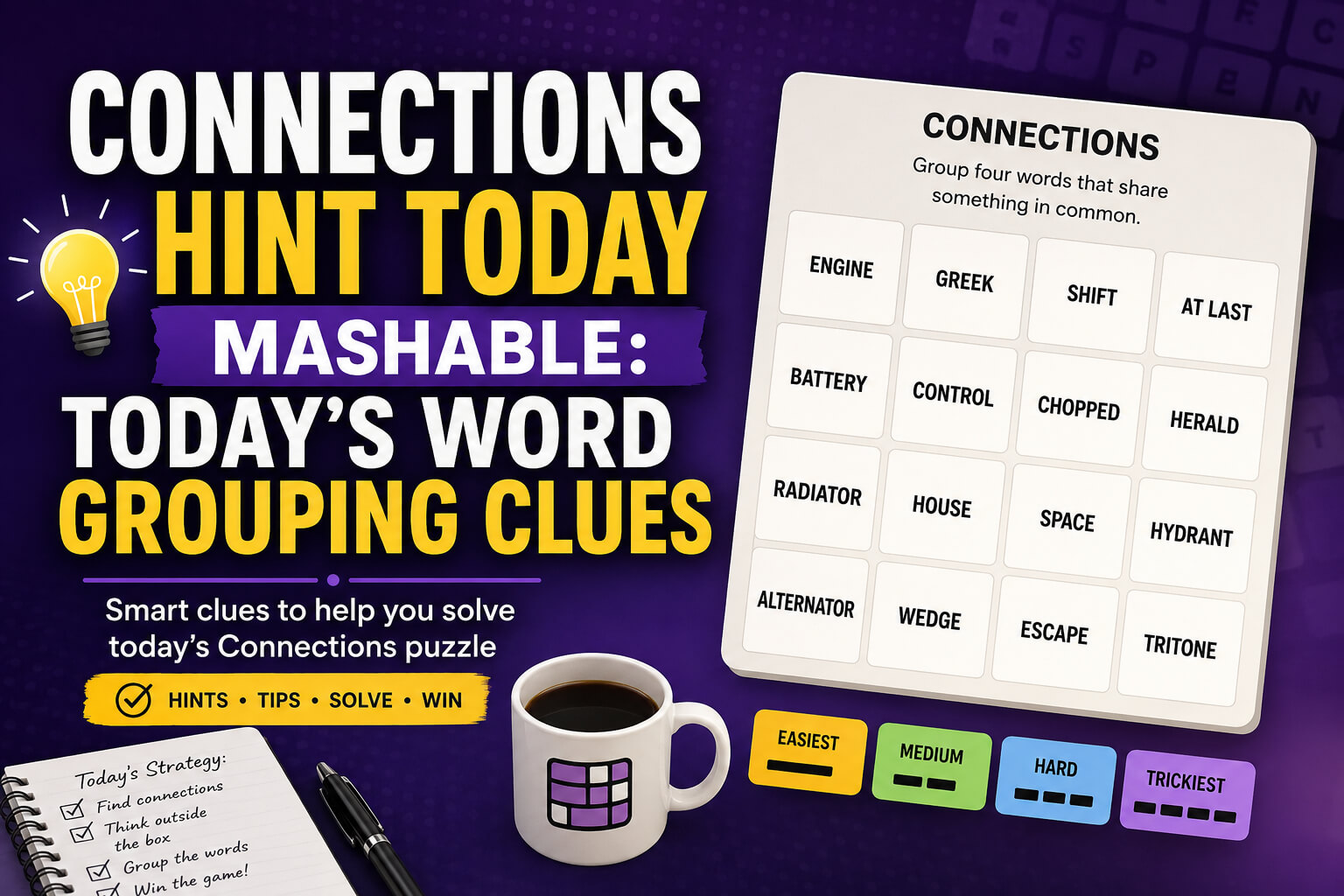
The daily NYT Connections puzzle has a way of making sixteen ordinary-looking words feel surprisingly complicated. One moment, several words seem obviously related; the next, you realize that one of them belongs somewhere completely different. That tension between recognition and misdirection is exactly what makes the game enjoyable.
For players searching “Connections hint today Mashable,” the goal is often not to see the complete solution straight away. Most people want a gentle push—a clue that changes how they look at the board while leaving enough of the puzzle intact to solve it themselves.
For Saturday, August 29, 2026, the daily game is Connections #1175. Today’s board combines familiar objects with a clever final piece of wordplay. Some categories can be spotted through everyday knowledge, while the toughest group requires looking at the beginnings of words rather than their ordinary meanings.
What Is Connections?
Connections is a daily word-grouping game published by The New York Times. Players receive a board containing 16 words and must divide those words into four groups of four. Every group shares a specific connection.
A connection might be simple. Four words could all be varieties of the same food, objects found in the same place, or terms associated with one activity. Harder groups may rely on phrases, alternate definitions, cultural references, hidden words, spelling patterns, or other kinds of wordplay.
Players are allowed four mistakes before the game ends. That limit matters because the board is deliberately designed to tempt you into plausible but incorrect combinations.
Today’s Puzzle
Today’s Connections puzzle is #1175, dated August 29, 2026.
The sixteen words are:
ALTERNATOR, AT LAST, BATTERY, CHOPPED, CONTROL, ENGINE, ESCAPE, GREEK, HERALD, HOUSE, HYDRANT, RADIATOR, SHIFT, SPACE, TRITONE, WEDGE.
At first glance, the board contains several tempting relationships. ENGINE and BATTERY immediately suggest vehicles. GREEK might make you think about mythology because words such as TRITONE and HERALD are also sitting nearby. CONTROL, SHIFT and ESCAPE may feel familiar to anyone who spends much of the day at a computer.
Those observations are useful, but Connections rewards players who resist submitting a group until they can explain exactly why all four words belong together.
First Hint
For the easiest group, imagine opening something you probably do not inspect every day unless there is a problem.
Think mechanical.
More specifically, picture raising the hood of a car.
That should make several words on the board stand out immediately.
The yellow group in today’s puzzle is built around familiar components found beneath a vehicle’s hood. Contemporary August 29 puzzle guides independently identify this as the most straightforward category.
Second Hint
The next connection moves away from machinery and toward food.
Do not focus on individual ingredients.
Instead, imagine looking at the menu in a casual restaurant and choosing what kind of salad you would like.
Several words on the grid can naturally appear before the word “salad.” Once you approach the board that way, this category becomes much easier to recognize.
Third Hint
The third group is probably sitting directly in front of many readers as they read this article.
Think about a computer keyboard.
You are looking for four words that are also names commonly printed on keys.
This group is particularly satisfying because its words have strong meanings outside computing. SPACE, for instance, immediately brings to mind distance or the universe, while CONTROL can describe authority. The puzzle uses those alternative meanings to make a straightforward relationship less obvious.
Final Hint
The purple group is where today’s puzzle becomes considerably more playful.
Do not concentrate entirely on what each word means.
Instead, examine how each word begins.
The beginnings hide or closely form the names of figures from Greek mythology.
This is classic Connections-style wordplay: the relationship is based on the structure of the words rather than their everyday definitions. Current August 29 solution guides consistently identify this as today’s purple category.
Color Categories
Connections uses four colors to distinguish the relative difficulty of its completed categories.
Yellow generally represents the most straightforward connection. Green becomes somewhat less obvious, while blue usually requires a more specific association or piece of knowledge. Purple is normally the trickiest and frequently involves wordplay, hidden constructions, unusual phrases, or lateral thinking.
The colors do not tell you what subject a category contains. They tell you how difficult the puzzle editors expect the relationship to be.
That distinction is important. A purple category does not have to involve obscure knowledge. Sometimes every word is familiar, but the connection between them is disguised in an unusual way.
Today’s purple group is a good example.
The Biggest Trap
The word GREEK deserves special attention.
Once you notice that the purple category relates to Greek mythology, GREEK itself seems like an obvious candidate. That is exactly why it can be misleading.
In the actual solution, GREEK belongs somewhere much more ordinary: the salad category.
That is an excellent illustration of how Connections creates difficulty. A word may have a very strong relationship with a theme without actually belonging to that group.
TRITONE creates another distraction. It looks strange enough to suggest that it must be central to an unusual category. Looking only at its full meaning may send you in the wrong direction. The more useful move is to examine the opening letters: TRITON.
Look for Four
One of the safest habits in Connections is refusing to trust a category until four words support it equally well.
Suppose you spot BATTERY, ENGINE and RADIATOR. The automotive connection is clear, but three words are not enough. Search the remaining board for one more item that fits the same relationship at the same level of specificity.
That fourth word is ALTERNATOR.
Now the group is stronger because all four are recognizable components associated with what is under the hood of a car.
This approach helps protect you from deliberate red herrings. Connections boards often contain words that could reasonably fit more than one broad idea.
Use Pairs Carefully
Finding pairs is useful, but pairs can also create false confidence.
CONTROL and SHIFT clearly look related if you are thinking about keyboards. That does not immediately mean you have found a complete category.
Likewise, GREEK and TRITONE might appear linked through ancient Greece. HERALD might then feel vaguely compatible because heralds appear in historical or legendary settings. A fourth word could perhaps be forced into the same idea.
Connections punishes that kind of loose reasoning.
A good category should usually be explainable in one short, precise sentence. If the explanation requires several exceptions or different interpretations for individual words, you probably have not found the intended group.
Try Elimination
Elimination becomes increasingly powerful as the board shrinks.
If you solve the car group first, four words disappear. Find the salad group next and you are down to eight. At that stage, spotting CONTROL, ESCAPE, SHIFT and SPACE as keyboard keys becomes much easier.
Once those are removed, only four words remain.
That automatically identifies the purple group, although there is still one important question: why do they belong together?
A complete solve is more satisfying when you understand that final relationship rather than simply receiving it through elimination.
Think Beyond Meaning
The purple category is a reminder that Connections is not simply a vocabulary classification game.
Sometimes you need to stop asking, “What does this word mean?” and start asking other questions:
What does it start with? What does it end with? What word commonly follows it? What word commonly comes before it? Does part of the word hide another name or term?
Those questions are especially useful when four remaining words appear completely unrelated.
Purple groups frequently reward this more structural approach to language. Puzzle guides describing the Connections difficulty system similarly note that purple often relies on hidden patterns or wordplay rather than direct semantic categories.
Why Mashable Hints Help
People searching for Connections hint today Mashable are usually looking for a middle ground between struggling alone and immediately reading the answers.
Mashable’s daily Connections coverage has traditionally used a progressive structure: first offering clues about the categories, then revealing the category names, and finally providing the complete solution farther down the page. That allows readers to choose how much assistance they want.
That format fits Connections particularly well.
Seeing all sixteen answers immediately removes most of the challenge. A carefully chosen hint, however, can simply unlock a different way of thinking. A player who has spent five minutes treating GREEK as part of a mythology group may only need the phrase “think lunch menu” to suddenly see the board differently.
Hints Before Answers
Progressive hints are especially useful because being stuck does not always mean you are far from the solution.
Sometimes one incorrect assumption blocks the entire board.
You may have identified three correct automotive terms but overlooked ALTERNATOR. Or perhaps you recognized three keyboard keys but kept SPACE in another imagined category.
A small clue can correct that interpretation without solving everything for you.
Daily hint pages from Mashable and other puzzle publications commonly separate light clues from category reveals and full solutions for precisely this reason.
Today’s Categories
Spoiler warning: The exact category names appear below.
If the hints above were enough, this is a good place to stop reading and return to the puzzle.
For Connections #1175 on August 29, 2026, the four categories are:
Yellow — Under the Hood of a Car
Green — Kinds of Salad
Blue — Keyboard Keys
Purple — Starting With Figures From Greek Mythology
The first three categories depend mainly on recognizing familiar objects or names. Purple changes the rules slightly by asking you to inspect pieces hidden at the beginnings of longer words.
Today’s Answers
Major spoiler warning: The complete August 29 Connections solution follows.
The yellow group, Under the Hood of a Car, contains:
ALTERNATOR — BATTERY — ENGINE — RADIATOR
These are all familiar components associated with a car’s engine area.
The green group, Kinds of Salad, contains:
CHOPPED — GREEK — HOUSE — WEDGE
Each can describe a recognized style or type of salad.
The blue group, Keyboard Keys, contains:
CONTROL — ESCAPE — SHIFT — SPACE
Each is the name of a key found on a typical computer keyboard.
The purple group, Starting With Figures From Greek Mythology, contains:
AT LAST — HERALD — HYDRANT — TRITONE
The trick becomes clearer when the beginnings are isolated:
AT LAST → ATLAS
HERALD → HERA
HYDRANT → HYDRA
TRITONE → TRITON
Multiple current sources independently report the same four categories and groupings for puzzle #1175.
Why Purple Is Clever
The purple solution is probably the most memorable part of today’s board because the words initially seem disconnected.
AT LAST is a phrase. HERALD can refer to a messenger or announcement. HYDRANT is an object associated with water and firefighting. TRITONE is a musical interval.
Their definitions do not give you a useful common theme.
The connection appears only after you stop reading them as complete expressions. Atlas, Hera, Hydra and Triton are all figures or beings associated with Greek mythology, and each appears at the start of one of the four answers.
This kind of construction explains why saving purple for later can be effective. Once twelve words have been removed, the final four force you to search for a relationship you might never have considered at the beginning.
Common Mistakes
One frequent Connections mistake is submitting the first four words that share a broad theme.
Another is assuming a word can have only one relevant meaning.
Today’s board demonstrates both problems. GREEK strongly suggests mythology, but it belongs to the salad group. SPACE can suggest astronomy, but here it belongs with keyboard keys. BATTERY could refer to electrical storage in many contexts, yet its intended group is automotive.
The lesson is simple: do not ask whether four words can be connected; ask whether they form the most precise connection available on the entire board.
That small change in thinking prevents many unnecessary mistakes.
A Better Routine
Start each puzzle by reading every word once without submitting anything.
Next, identify unusually strong sets of three or four. If four words fit one narrow category, mentally remove them and see whether the rest of the board becomes cleaner.
Then inspect ambiguous words. Ask whether each could function as a noun, verb, adjective, proper name, abbreviation, part of a phrase, or fragment of another word.
Finally, reserve at least one guess whenever possible. Because only four mistakes are allowed, speculative submissions can turn a promising solve into a loss remarkably quickly.
Why Connections Works
The appeal of Connections comes from the moment when confusion suddenly becomes structure.
Sixteen unrelated-looking terms gradually become twelve, then eight, then four. A word that seemed completely misplaced suddenly makes perfect sense. A category that looked impossible becomes obvious once a single misleading word is removed.
Unlike a straightforward trivia question, the puzzle asks players to hold several interpretations in mind at once. Vocabulary helps, but flexibility matters just as much.
That is also why hints are so popular. Players often do not want someone else to finish the puzzle for them. They simply want one clue that lets them experience that satisfying realization themselves.
Final Thoughts
Today’s Connections #1175 for August 29, 2026 is a good example of what the game does well. The yellow automotive group provides a relatively accessible entry point. The salad and keyboard groups reward everyday knowledge, while the purple category changes direction with a clever Greek-mythology word pattern.
If you arrived after searching Connections hint today Mashable, the best way to use a guide like this is gradually. Start with the light hints, return to the board, and only reveal the categories or answers when you genuinely need them.
Solving Connections is less about knowing every possible fact and more about learning when to trust an obvious relationship—and when to question it.
FAQs
What is Connections hint today Mashable?
The phrase usually refers to players searching for Mashable’s daily coverage of the New York Times Connections puzzle. That coverage typically offers category clues before revealing the complete answers, allowing readers to control how many spoilers they see.
What is today’s Connections puzzle number?
For Saturday, August 29, 2026, the daily puzzle is Connections #1175.
What are today’s Connections categories?
The four groups are Under the Hood of a Car, Kinds of Salad, Keyboard Keys, and Starting With Figures From Greek Mythology.
Which Connections color is usually hardest?
Purple is generally designed as the most difficult category. It frequently depends on wordplay, hidden patterns, unusual constructions, or lateral associations rather than a straightforward shared subject.
How many mistakes can you make in Connections?
Players can make four incorrect guesses. Another incorrect submission after those mistakes ends the attempt, so carefully confirming all four members of a possible category is usually better than guessing quickly.