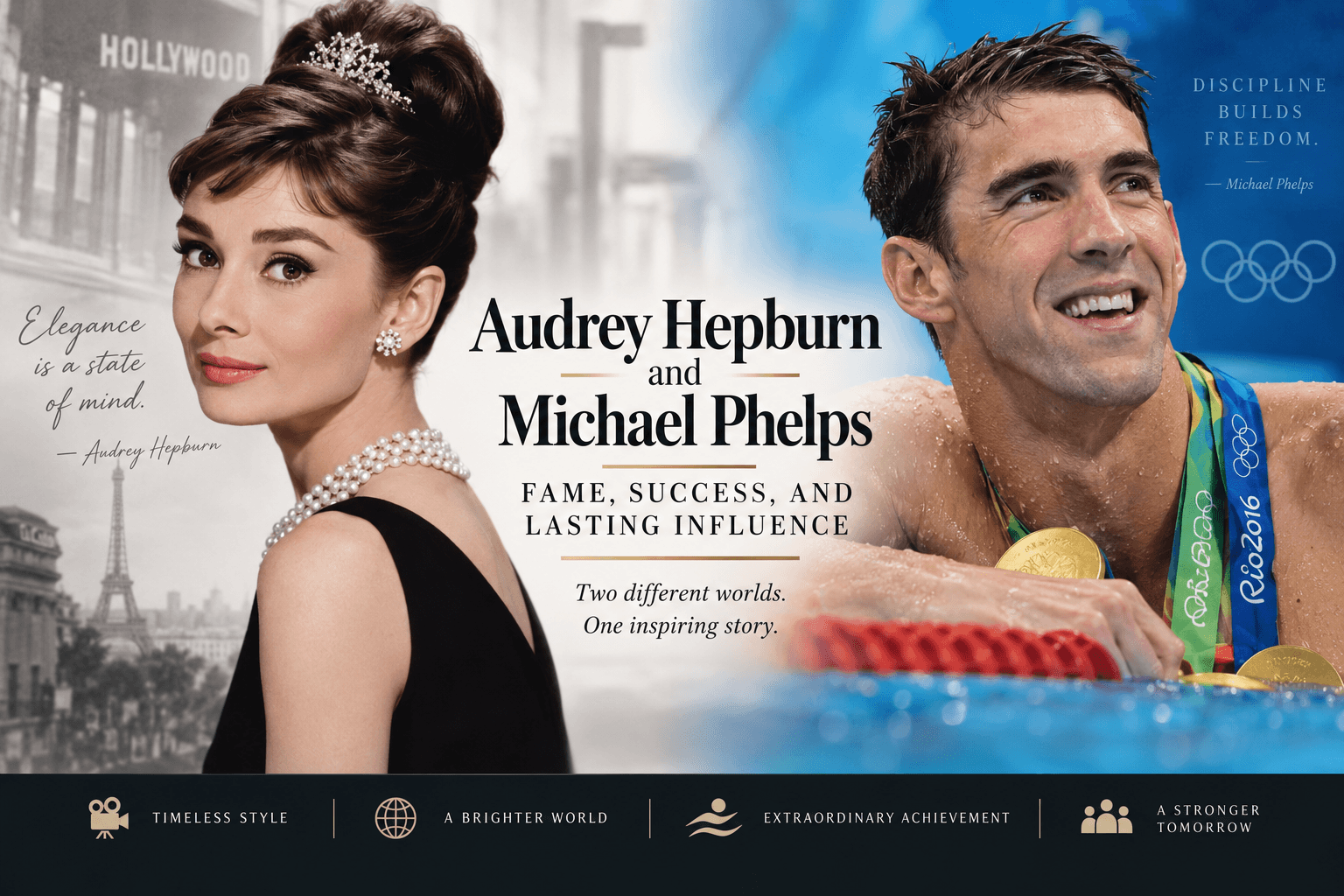
Audrey Hepburn and Michael Phelps belong to entirely different worlds. Hepburn became one of the defining faces of twentieth-century cinema, while Phelps established himself as one of the most accomplished athletes in Olympic history. Their careers were separated by decades, their professions had almost nothing in common, and their routes to international recognition could hardly have been more different.
Yet placing Audrey Hepburn and Michael Phelps side by side creates an interesting study of fame, discipline, achievement, and legacy. Both reached a level of recognition that extended far beyond their original professions. Hepburn eventually became known as much for humanitarian service and timeless style as for acting, while Phelps moved beyond record-breaking swimming to become involved in water safety, youth development, and conversations surrounding mental wellness.
Their stories also demonstrate an important truth about success: becoming famous is one achievement, but remaining meaningful after the applause fades is something else entirely.
Is There a Connection?
Before comparing their lives, it is worth clearing up a possible misunderstanding. There is no well-established evidence of a significant personal, family, or professional relationship between Audrey Hepburn and Michael Phelps.
The timeline makes such a connection unlikely. Hepburn was born in Brussels on May 4, 1929, and died in Switzerland on January 20, 1993. Phelps was born in 1985, meaning he was only seven years old when Hepburn died. Hepburn’s professional world centered on film, theater, fashion, and humanitarian service, while Phelps became internationally known years later through competitive swimming.
For that reason, the value in discussing Audrey Hepburn and Michael Phelps together does not come from a hidden friendship or collaboration. It comes from comparing two people who achieved extraordinary recognition through completely different forms of excellence.
Audrey Hepburn’s Early Life
Audrey Hepburn’s road to Hollywood was not an obvious one. Born in Belgium, she spent part of her youth in Europe during a turbulent historical period. She later trained in ballet in Amsterdam before moving toward stage and screen work.
The National Portrait Gallery records that Hepburn made her London stage debut in 1948 and appeared on Broadway in Gigi in 1951 after being recommended for the role by the French writer Colette. Small film appearances followed before the role that transformed her career.
Her early experiences also gave her later humanitarian work a deeply personal dimension. UNICEF records Hepburn recalling that she had received food and medical relief following World War II. Decades later, when she represented UNICEF internationally, she was therefore speaking about humanitarian assistance not only as a celebrity supporter but as someone who remembered what such help could mean.
Hollywood Breakthrough
Hepburn’s major breakthrough arrived with Roman Holiday, released in 1953. Playing Princess Ann opposite Gregory Peck, she delivered a performance that quickly established her as an international star.
The role earned Hepburn the Academy Award for Best Actress at the 1954 Oscars. Roman Holiday received ten Academy Award nominations and won three awards overall. Hepburn would later receive additional Best Actress nominations for films including Sabrina, The Nun’s Story, Breakfast at Tiffany’s, and Wait Until Dark.
Her success was not based only on glamour. Hepburn’s acting often combined restraint, vulnerability, humor, and sophistication in a way that distinguished her from many of the dominant Hollywood personalities of her era.
Films such as Funny Face, Breakfast at Tiffany’s, Charade, My Fair Lady, and Wait Until Dark helped create a body of work that remained recognizable long after her most active years as an actress. The National Portrait Gallery describes how her grace and distinctive appearance also helped make her style synonymous with fashion during the 1950s and beyond.
A Lasting Style Icon
Audrey Hepburn’s cultural impact cannot be measured only by film awards. Her clothes, hairstyles, photographs, and screen presence became part of popular visual culture.
One of the clearest examples is Breakfast at Tiffany’s. Hepburn’s portrayal of Holly Golightly became closely associated with an image of sophisticated New York style, particularly through the famous black dress and accessories featured in the film. The movie remains one of the performances most strongly connected with her public image.
That influence has survived changing fashion trends. Decades after her death, Hepburn remains referenced in photography, clothing, beauty, advertising, and film discussions.
The interesting part of her legacy is that elegance never became her entire story. The later stages of her life changed the meaning of her public image considerably.
From Fame to Service
Hepburn gradually reduced her acting commitments and devoted increasing attention to family life and humanitarian work. In 1988, she became a UNICEF Goodwill Ambassador, a position she held until her death in 1993.
Her role was substantial rather than ceremonial. UNICEF documents her missions to countries including Ethiopia, Bangladesh, Turkey, Venezuela, Ecuador, Guatemala, Honduras, El Salvador, Thailand, Viet Nam, and Sudan. She visited programs dealing with hunger, vaccination, clean water, education, displaced children, and other humanitarian needs.
She also testified before the U.S. Congress, participated in international advocacy and fundraising, and used the attention surrounding her name to direct media interest toward children living in difficult circumstances.
In 1992, Hepburn received the Presidential Medal of Freedom. The Academy also selected her for the Jean Hersholt Humanitarian Award; according to Academy records, the decision was made shortly before her death, and her son later accepted the award on her behalf.
This humanitarian chapter explains why Hepburn’s reputation eventually came to represent more than old Hollywood.
Michael Phelps’ Beginning
Michael Phelps’ route to fame started in a swimming pool rather than a film studio. Born in Baltimore, Maryland, in 1985, he began swimming as a child and developed unusually quickly as a competitive athlete.
Team USA notes that Phelps began swimming at seven and had already established a national age-group record only a few years later. His progress eventually led to the Olympic stage while he was still a teenager.
Phelps competed at the 2000 Sydney Olympics, beginning an Olympic career that would span five Games: Sydney 2000, Athens 2004, Beijing 2008, London 2012, and Rio 2016.
His versatility became one of his greatest strengths. Rather than concentrating on only one event, he competed successfully across butterfly, individual medley, freestyle, and relay events.
Olympic Greatness
Numbers tell a remarkable part of the Michael Phelps story.
Across his Olympic career, Phelps collected 28 medals: 23 gold, three silver, and two bronze. Team USA and World Aquatics both document those totals, placing him in a category that remains exceptional in Olympic history.
His most famous Olympic performance occurred in Beijing in 2008. Phelps entered eight events and won gold in all eight, surpassing Mark Spitz’s previous record of seven gold medals at a single Olympic Games.
That achievement required excellence across individual races and relays, different strokes and distances, and an exhausting schedule in which recovery was almost as important as performance itself.
His career did not end after Beijing. Phelps continued winning at London 2012 and later returned for Rio 2016, where he added another five gold medals and one silver to his record. His final Olympics demonstrated unusual longevity in a sport where fractions of a second often separate champions from the rest of the field.
The Work Behind the Records
Phelps’ medal count can make his success appear almost automatic when viewed in hindsight. It was anything but.
Elite swimming requires repetition on a scale that few spectators ever see. Starts, turns, breathing patterns, stroke efficiency, strength, endurance, pacing, nutrition, recovery, and mental preparation all have to work together. An Olympic race may last only seconds or minutes, but the preparation behind it can take years.
This is where a meaningful comparison with Hepburn becomes possible.
Their professions were completely different, but both relied on preparation and consistency rather than talent alone. Hepburn developed through ballet, theater, and film before becoming a major star. Phelps spent years refining technique and physical conditioning before standing on Olympic podiums.
Public success often looks effortless because audiences see the finished performance. The difficult preparation usually happens somewhere else.
The Pressure of Fame
Fame also creates demands that have little to do with the original profession.
Hepburn became one of the world’s most photographed actresses and was expected to maintain the grace and sophistication associated with her public image. Phelps experienced a different kind of pressure: the expectation that a record-breaking athlete should continue winning.
The difference is significant. A film star can be remembered through characters, photographs, and style. An elite swimmer confronts a clock. Performance is measured to hundredths of a second, and failure can be displayed immediately on a scoreboard.
Phelps has spoken publicly about the psychological challenges that existed alongside his success. His willingness to discuss his own experiences contributed to a broader conversation about mental health among elite athletes. Team USA has identified Phelps as one of the prominent sports figures who helped bring mental-health discussions into the open.
That part of his story matters because it adds context to the medals. Extraordinary achievement does not make a person immune to personal struggles.
Life Beyond Swimming
Phelps’ post-competition legacy increasingly involves work away from Olympic racing.
He founded the Michael Phelps Foundation in 2008, following his historic Beijing performance. The organization now describes its work around water safety, mental wellness, healthy living, confidence, and opportunities for young people.
Its signature IM Program combines learn-to-swim and water-safety education with lessons involving healthy living, emotional well-being, goal setting, and confidence. According to the foundation, its programs have reached participants across the United States and internationally.
This represents an important evolution in Phelps’ public identity. His name first became valuable because of what he accomplished in water. He later began using that recognition to promote safer and healthier experiences for other people in and around water.
Two Different Kinds of Fame
Audrey Hepburn and Michael Phelps illustrate two very different ways that a person can become globally recognizable.
Hepburn’s fame was cultural. Audiences connected with characters she played, the elegance of her public image, and the emotional qualities she brought to film. Much of her continuing influence is difficult to reduce to numbers.
Phelps’ fame was competitive. His achievements can be counted through medals, times, records, championships, and Olympic victories.
Yet numbers alone do not fully explain either legacy. Hepburn would not still command attention simply because she won an Oscar. Phelps would not have the same cultural importance simply because a medal table lists 28 medals.
Longevity comes from the wider story surrounding achievement.
What They Shared
The strongest similarity between Audrey Hepburn and Michael Phelps is the ability to expand beyond the field that originally made them famous.
Hepburn became an actress of international importance and then redirected much of her later life toward children affected by poverty, conflict, hunger, and poor access to health services.
Phelps became an Olympic champion and later directed attention toward water safety, healthy living, youth programs, and mental wellness.
Both therefore demonstrate how public recognition can become a platform rather than simply a reward.
There is also a common thread of discipline. Performing for a film camera and swimming an Olympic final require entirely different abilities, but neither leaves much room for casual preparation at the highest level.
Where Their Stories Differ
The differences between them remain just as important as the similarities.
Hepburn emerged during the classic Hollywood studio era and became famous at a time when cinema, magazines, fashion photography, and newspapers played enormous roles in shaping celebrity. Her legacy developed slowly across decades.
Phelps competed in the modern global sports environment, where television, digital news, social media, instant statistics, and international Olympic coverage could turn one performance into a worldwide event almost immediately.
Their achievements were also judged differently. Hepburn’s work depended partly on artistic interpretation. Viewers and critics could disagree about performances. Phelps competed in a world where the stopwatch provided an immediate result.
These differences are what make the comparison interesting rather than forced.
Lasting Influence
Audrey Hepburn died in 1993, yet her presence remains unusually strong. New audiences continue discovering her films, fashion publications still reference her style, and UNICEF continues to recognize her among its important legacy ambassadors.
Michael Phelps’ influence is still developing. His competitive career has ended, but his Olympic achievements remain a reference point whenever exceptional swimmers are discussed. His work beyond competition has also expanded the way his public career is understood.
Future generations may encounter Hepburn through cinema and photographs, while young swimmers may first learn about Phelps through Olympic history and record books.
In both cases, their influence outlasted the moment that originally produced their fame.
Why Their Stories Matter
There is something useful about examining Audrey Hepburn and Michael Phelps together precisely because they were so different.
Success does not have one appearance. For one person it can mean standing in front of a camera and creating a character remembered for generations. For another, it can mean touching the wall before every other swimmer after years of relentless preparation.
More importantly, both lives remind us that professional achievement is only one part of a public legacy.
Hepburn could have remained simply an admired actress. Instead, humanitarian service became central to how people remember her.
Phelps could have disappeared from public life after retirement with an Olympic record unlikely to be forgotten. Instead, he continued using his platform in areas connected to swimming, young people, water safety, and mental wellness.
That may be the most meaningful connection between them.
Conclusion
Audrey Hepburn and Michael Phelps represent two extraordinary but separate stories of fame, success, and lasting influence. There is no credible reason to present them as relatives, collaborators, friends, or members of the same professional circle. They belonged to different generations and achieved prominence in entirely different worlds.
Hepburn left her mark through acting, fashion, and humanitarian service. Her Academy Award-winning breakthrough in Roman Holiday developed into a celebrated film career, while her later UNICEF work gave her legacy a humanitarian dimension that remains important today.
Phelps created his reputation through competitive swimming, ultimately accumulating 28 Olympic medals, including 23 golds. His eight victories at Beijing 2008 became one of the defining achievements of modern Olympic history. After swimming, his foundation and public advocacy broadened his influence beyond medals and records.
What connects their stories is therefore not a personal relationship. It is the way exceptional ability, discipline, international recognition, and purpose beyond professional success can create a legacy.
Audrey Hepburn conquered the screen. Michael Phelps conquered the pool. Decades apart, both demonstrated that the most enduring form of fame is the kind that eventually stands for something larger than fame itself.
FAQs
Were Audrey Hepburn and Michael Phelps related?
No reliable biographical evidence shows that Audrey Hepburn and Michael Phelps were related. They came from different families, generations, and professional backgrounds.
Did Audrey Hepburn and Michael Phelps ever meet?
There is no well-established public record documenting a meaningful meeting or relationship between them. Hepburn died in January 1993, when Phelps was only seven years old.
What was Audrey Hepburn most famous for?
Audrey Hepburn was best known as an acclaimed actress whose films included Roman Holiday, Breakfast at Tiffany’s, Sabrina, and My Fair Lady. She was also widely respected for her later work as a UNICEF Goodwill Ambassador.
What is Michael Phelps most famous for?
Michael Phelps is best known for his extraordinary Olympic swimming career. He earned 28 Olympic medals, including 23 gold medals, and famously won eight golds at the 2008 Beijing Olympic Games.
What do Audrey Hepburn and Michael Phelps have in common?
Their professions were very different, but both achieved international fame, displayed exceptional discipline, and eventually used their public recognition for purposes beyond their main careers. Hepburn became deeply involved with UNICEF, while Phelps has worked through his foundation and spoken publicly about issues including water safety and mental wellness.