Introduction
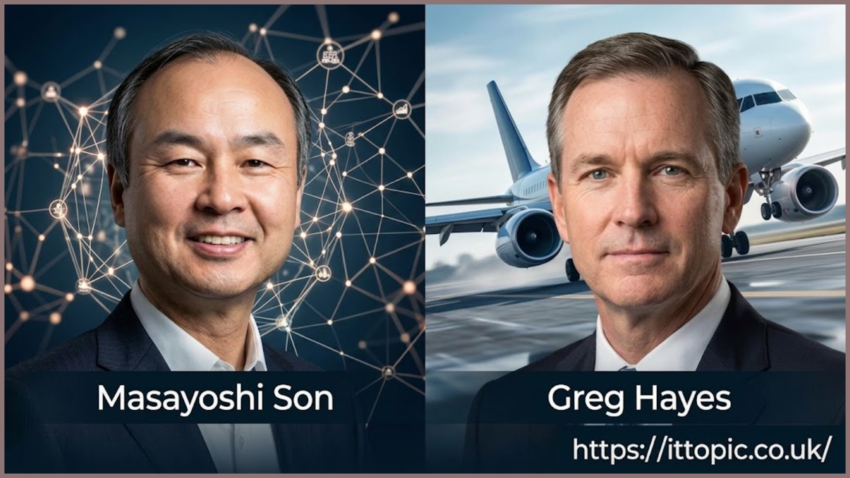
Masayoshi Son and Greg Hayes are two influential business leaders whose careers reflect different approaches to corporate leadership, investment, innovation, and long-term growth. Masayoshi Son is widely known as the founder of SoftBank Group, a Japanese investment and technology company that has backed major businesses across the digital economy. Greg Hayes, meanwhile, is best known for his leadership at RTX Corporation, formerly Raytheon Technologies, and his earlier role as chief executive of United Technologies Corporation. Their professional backgrounds represent two distinct areas of global business: technology investment and aerospace manufacturing.
The connection between Masayoshi Son and Greg Hayes is particularly interesting because both leaders have operated at the intersection of large-scale capital allocation, technological development, and changing global markets. Son has pursued ambitious investments in artificial intelligence, telecommunications, robotics, and emerging technologies. Hayes built his executive reputation in aerospace, defense, engineering, and industrial management, where reliability, operational efficiency, and long-term contracts play essential roles.
Although Masayoshi Son and Greg Hayes are not primarily known for leading the same company, examining their careers together offers valuable insight into how different leadership philosophies influence modern business. Their experiences also help explain the opportunities and challenges facing technology investors, industrial corporations, and companies preparing for a more automated and digitally connected world.
Who Is Masayoshi Son?
Masayoshi Son is a Japanese entrepreneur and investor who established SoftBank in 1981. Over several decades, he transformed the company from a relatively small software distribution business into a major international technology investment group. His business strategy has evolved alongside the growth of personal computing, internet services, telecommunications, mobile technology, and artificial intelligence.
Son is particularly recognized for making bold investments based on expectations about how technology might transform society. Rather than focusing exclusively on established businesses, he has frequently pursued companies that could become major players in emerging industries. This approach has generated significant successes as well as substantial financial setbacks.
His investment philosophy is closely associated with long-term technological change. Son has repeatedly argued that computing power, connectivity, and artificial intelligence will reshape industries, influence economic productivity, and change how people work and communicate.
The Early History of SoftBank
SoftBank began as a Japanese software distributor and gradually expanded into publishing, telecommunications, internet services, and international investments. Its growth reflected the increasing importance of personal computers and digital technology during the late twentieth century.
One of Son’s most notable early investment successes involved Yahoo. SoftBank invested in Yahoo Japan and became closely associated with the expansion of internet services in the Japanese market. This investment helped establish Son’s reputation as an entrepreneur who could recognize opportunities before they became obvious to the broader market.
SoftBank subsequently expanded through acquisitions and strategic investments. Its purchase of Vodafone Japan in 2006 strengthened its position in the country’s mobile telecommunications industry. The company also acquired ARM Holdings in 2016, giving it a major presence in semiconductor intellectual property and processor architecture.
These developments demonstrate how Son’s strategy evolved from software distribution toward a broader technology ecosystem. The company increasingly sought exposure to the infrastructure, devices, platforms, and computing capabilities expected to shape future economic growth.
Masayoshi Son’s Investment Philosophy
Son’s investment philosophy emphasizes identifying transformative technologies and supporting companies that could become industry leaders. He has often been willing to accept significant financial risk when he believes a business has the potential to grow dramatically.
This approach differs from conventional investment strategies that prioritize established profitability, predictable cash flows, and lower volatility. Son’s model places greater emphasis on future market opportunities, technological disruption, and the possibility of building dominant businesses.
The SoftBank Vision Fund became one of the clearest expressions of this philosophy. The fund invested in companies across sectors such as transportation, e-commerce, financial technology, enterprise software, and artificial intelligence. Its portfolio included businesses pursuing ambitious expansion strategies in highly competitive markets.
However, the results have been mixed. Some investments benefited from strong market demand and substantial business growth, while others suffered from excessive valuations, difficult economics, changing interest rates, or weaker-than-expected profitability. These outcomes illustrate an important lesson: a compelling technological idea does not automatically produce a successful investment.
Who Is Greg Hayes?
Greg Hayes is an American business executive known for his leadership in the aerospace, defense, and industrial sectors. He served as chief executive officer of United Technologies Corporation before becoming the chief executive of Raytheon Technologies following the combination of United Technologies and Raytheon Company in 2020.
Raytheon Technologies was subsequently renamed RTX Corporation in 2023. During his tenure as chief executive, Hayes oversaw a business with major operations in commercial aviation, aircraft engines, aerospace systems, and defense technologies.
Unlike Son, whose business model is centered largely on investments and technology ownership, Hayes developed his career within complex industrial organizations. His responsibilities involved managing manufacturing operations, coordinating global supply chains, overseeing research and development, and balancing commercial aviation demand with government defense requirements.
Hayes became known for emphasizing financial discipline, operational performance, portfolio management, and shareholder returns. His leadership experience demonstrates the challenges of managing large corporations whose products require extensive engineering, rigorous safety standards, and long development cycles.
Greg Hayes and United Technologies Corporation
United Technologies Corporation was a major industrial company with businesses serving aviation, building systems, and other engineering markets. Its portfolio included prominent aerospace and industrial operations, including Pratt & Whitney and Collins Aerospace.
Hayes became CEO of United Technologies in 2014 after serving in senior financial and operational roles. His background in finance helped shape his approach to acquisitions, corporate restructuring, cost management, and investment decisions.
One of the major strategic developments during his leadership was the separation of businesses that operated in different markets. United Technologies completed the separation of Otis and Carrier in 2020, allowing those businesses to operate independently while concentrating the remaining company on aerospace and defense.
This restructuring reflected a broader corporate strategy: businesses can sometimes become more focused and easier to manage when unrelated operations no longer compete for capital and executive attention within the same organization.
The Formation of Raytheon Technologies
In April 2020, United Technologies combined its aerospace businesses with Raytheon Company to create Raytheon Technologies. Hayes became the chief executive of the newly combined company.
The transaction brought together complementary capabilities. United Technologies contributed businesses with significant exposure to commercial aviation, aircraft engines, and aerospace systems, while Raytheon brought extensive defense electronics, missile systems, and military technology operations.
The combination created a large company serving both commercial and government customers. Its structure offered opportunities to coordinate engineering expertise, research spending, manufacturing capabilities, and customer relationships across related markets.
The merger also introduced challenges. Integrating large organizations requires careful management of corporate cultures, manufacturing systems, product portfolios, and financial priorities. In addition, the aviation industry faced exceptional disruption during the COVID-19 pandemic, creating uncertainty for businesses dependent on commercial air travel.
Hayes’s leadership during this period involved balancing immediate financial pressures with long-term investment in aerospace and defense capabilities.
Masayoshi Son and Greg Hayes: Understanding Their Business Connection
The topic of Masayoshi Son and Greg Hayes invites an important question: what connects a technology investor associated with SoftBank to an executive whose career centered on aerospace and defense?
Their connection is best understood through the broader relationship between technology investment and industrial innovation rather than through an assumed direct partnership. Both leaders have operated in industries where technological capabilities, capital allocation, research, and long-term strategic decisions influence competitive success.
SoftBank has invested in businesses and technologies that support digital infrastructure, computing, communications, and automation. RTX, under Hayes’s leadership, operated in aerospace and defense markets where advanced computing, electronics, software, sensors, and communications are increasingly important.
These overlapping technological themes make their careers useful to compare. However, a comparison of their business strategies should not be mistaken for evidence that they jointly managed a company, entered a formal investment partnership, or announced a specific business agreement.
Technology Investment Versus Industrial Management
Son’s approach generally involves allocating capital across a portfolio of businesses with different growth prospects. He seeks companies that could benefit from major technological shifts and expand into large markets. His influence is therefore often indirect, operating through investment decisions, board relationships, and corporate strategy.
Hayes’s executive responsibilities were more directly connected to the operation of large industrial businesses. Aerospace manufacturing requires the coordination of engineers, suppliers, production facilities, certification processes, customers, and regulators. Decisions often affect programs that remain active for decades.
The difference is significant. A technology investor may evaluate whether a company can establish a defensible position in a rapidly growing market. An industrial CEO must also determine whether products can be manufactured safely, delivered reliably, maintained economically, and supported over their entire service life.
Both approaches require strategic judgment, but the measures of success differ according to the business model.
Shared Interest in Technological Progress
Despite their different professional backgrounds, both leaders have worked in environments where technological progress can create competitive advantages. Artificial intelligence, advanced computing, semiconductor design, automation, and digital connectivity are relevant to a wide range of modern industries.
For Son, these technologies represent investment opportunities and potential drivers of economic transformation. For aerospace and defense companies, they can improve design processes, predictive maintenance, manufacturing efficiency, logistics, data analysis, and the performance of complex systems.
The broader lesson is that technology investment and industrial execution are complementary forces. New technology requires capital and entrepreneurial experimentation, but successful adoption also depends on engineering discipline, operational expertise, and the ability to integrate innovations into existing systems.
Comparing the Leadership Styles of Masayoshi Son and Greg Hayes
The leadership styles of Masayoshi Son and Greg Hayes reveal how executives adapt their strategies to different markets, organizational structures, and financial responsibilities. Both have dealt with complex decisions involving technology, competition, and large financial commitments, but their methods reflect the distinct demands of their industries.
Masayoshi Son’s Visionary and Entrepreneurial Leadership
Son is known for pursuing opportunities that may appear unusually ambitious at the time an investment is made. His approach depends on identifying long-term technological trends and positioning SoftBank to benefit from them before those trends become fully established.
This philosophy can create significant advantages when a selected technology experiences rapid adoption. Early investments may provide exposure to expanding markets, valuable intellectual property, and companies that eventually become important industry leaders.
However, visionary leadership also carries risks. Emerging businesses often operate with uncertain revenue models, high operating expenses, and strong competitors. If market conditions change or investors become less willing to finance growth, valuations can decline rapidly.
Son’s career therefore illustrates both the opportunities and limitations of ambitious investment strategies. Successful technology investing requires more than identifying promising innovations. It also requires evaluating management quality, competitive advantages, financial sustainability, and realistic paths to profitability.
Greg Hayes’s Operational and Financial Leadership
Hayes developed a different leadership approach through decades of experience in corporate finance, business development, and industrial management. His responsibilities required him to make decisions within established companies whose products and services support major transportation and defense systems.
In these environments, executives must consider profitability alongside manufacturing quality, product safety, regulatory compliance, and customer confidence. An aerospace company cannot evaluate success solely through revenue growth or market valuation. It must also demonstrate that its products perform reliably over extended periods.
Hayes’s experience restructuring United Technologies and leading the formation of RTX illustrates the importance of corporate focus. By reorganizing business portfolios and combining complementary aerospace operations, leadership sought to create an organization with a clearer strategic direction.
His career demonstrates that operational excellence can be as important as visionary thinking. Strong financial controls, efficient manufacturing, responsible investment, and disciplined execution can help established companies remain competitive even when markets experience uncertainty.
The Role of Artificial Intelligence in Their Business Worlds
Artificial intelligence has become an increasingly important subject in discussions about both technology investment and industrial leadership. Although Son and Hayes approached business from different perspectives, their professional backgrounds help explain why AI matters across the global economy.
For SoftBank, artificial intelligence represents a major investment opportunity. For aerospace and defense companies, it offers potential improvements in engineering, maintenance, production, logistics, and data analysis.
Artificial Intelligence and SoftBank’s Investment Strategy
SoftBank has increasingly emphasized artificial intelligence and the infrastructure needed to support its development. AI systems require computing capacity, semiconductor technology, data centers, networking equipment, and substantial investment in software and research.
Son’s interest in this sector reflects his belief that AI could become a foundational technology across many industries. Businesses that supply essential computing infrastructure or develop widely used AI systems may benefit from expanding demand.
The potential applications extend beyond consumer chatbots. Artificial intelligence can assist with software development, industrial automation, financial analysis, medical research, and complex decision-making. As adoption increases, investors are examining which companies can turn technological capabilities into sustainable commercial businesses.
Nevertheless, the AI market presents financial uncertainties. Building advanced computing infrastructure requires significant capital, and the revenue generated by these investments may take time to justify their costs. Competition can also reduce prices and weaken the advantages of individual companies.
For investors following Masayoshi Son, the important question is not simply whether AI will become more powerful. It is whether particular investments can generate adequate returns while managing technological, financial, and competitive risks.
Artificial Intelligence in Aerospace and Defense
Artificial intelligence also has practical applications in the aerospace and defense industries associated with Hayes’s executive career.
Aircraft manufacturers and engine producers can use data analytics and machine learning to identify patterns that may indicate equipment deterioration. Predictive maintenance systems can help operators plan servicing before a problem causes an unexpected interruption.
Manufacturers can also use digital tools to improve production scheduling, identify quality issues, and manage complicated supply chains. These capabilities may reduce waste, improve efficiency, and support more reliable delivery schedules.
In defense applications, advanced computing can assist with information analysis, communications, surveillance, logistics, and decision support. However, these applications involve demanding requirements for security, testing, accountability, and human oversight.
The use of AI in aviation and defense must also account for safety and ethical concerns. Systems that influence critical decisions require careful evaluation, and organizations must understand their limitations before relying on automated recommendations.
These developments show how technologies supported by investment can eventually become practical tools in established industrial markets. They also demonstrate why successful innovation requires cooperation between researchers, investors, engineers, manufacturers, and customers.
The Importance of Capital Allocation in Both Careers
Capital allocation is one of the most important themes connecting Masayoshi Son and Greg Hayes. Every large organization must decide how to distribute its financial resources among competing priorities.
The challenge becomes more complicated when businesses operate across multiple industries or depend on technologies that require years of development before producing commercial returns.
Investment Decisions at SoftBank
SoftBank’s investment model involves selecting companies and technologies that could create long-term value. These decisions require evaluating market size, business models, management capabilities, competitive positioning, and financing requirements.
When an investment performs well, it can generate substantial returns and strengthen the company’s financial position. When an investment underperforms, however, the resulting losses may affect portfolio performance and limit the resources available for other opportunities.
Portfolio diversification can reduce exposure to individual businesses, but it does not eliminate broader market risks. If several investments depend on similar economic conditions, a downturn may affect many of them simultaneously.
This is particularly relevant when a portfolio concentrates on high-growth technology companies. Changes in interest rates, investor sentiment, or expectations about future profitability can have a substantial effect on valuations.
Son’s investment history highlights the importance of balancing ambition with financial discipline. Even when a technology has considerable potential, investment decisions must account for the price paid, the time required to realize returns, and the possibility that expectations may not be achieved.
Capital Allocation at RTX
Capital allocation in aerospace and defense follows a different pattern. Companies must fund research and development, maintain manufacturing facilities, invest in production technology, and support long-term customer commitments.
Aircraft engines, avionics, and defense systems often require substantial engineering expenditure before commercial production begins. Once products enter service, companies may remain responsible for maintenance, replacement components, software improvements, and technical support for many years.
Executives must therefore balance immediate profitability against investments that support future demand. Cutting costs too aggressively may damage product quality or reduce the company’s ability to develop competitive technologies.
Hayes’s experience in corporate restructuring and aerospace leadership illustrates the importance of selecting investments that align with a company’s core capabilities. A focused portfolio can help management concentrate resources on businesses where the organization has strong expertise and a realistic opportunity to compete.
Although the financial decisions differ from those made by a technology investment group, the underlying principle is similar: resources should support strategies that create durable value.
How Their Industries Have Changed Over Time
The careers of Masayoshi Son and Greg Hayes unfolded during periods of substantial economic and technological change. Their experiences reflect the transformation of business from traditional manufacturing and early software distribution toward globally connected markets that depend heavily on digital infrastructure.
The Growth of the Digital Economy
When Son established SoftBank in 1981, the modern internet economy had not yet developed into the global system familiar today. Personal computers, telecommunications networks, and software markets subsequently expanded, creating opportunities for new businesses and investment models.
The development of mobile internet services changed how consumers communicated, shopped, worked, and accessed information. Digital platforms created new forms of competition, allowing businesses to reach international markets without relying entirely on traditional physical distribution.
Cloud computing and artificial intelligence have extended this transformation. Companies can now process large quantities of data, automate selected tasks, and develop digital services that would have been difficult to deliver economically in earlier decades.
SoftBank’s evolution reflects the growing importance of these technologies and the investment opportunities they create.
The Transformation of Aerospace and Industrial Markets
The aerospace industry has also experienced significant change. Global air travel expanded over several decades, increasing demand for aircraft, engines, maintenance services, and airport infrastructure. At the same time, airlines and manufacturers faced pressure to improve fuel efficiency, reliability, and operating costs.
Defense markets have changed through advances in electronics, computing, communications, sensors, and increasingly complex systems integration. Companies must continually update their technologies while managing long development cycles and strict regulatory requirements.
Hayes’s career included major corporate changes intended to position United Technologies and RTX for these evolving markets. The combination of aerospace and defense businesses reflected the importance of engineering capabilities, global customer relationships, and long-term investment.
The COVID-19 pandemic also demonstrated how vulnerable industrial markets can be to sudden disruptions. Commercial aviation experienced severe pressure as travel demand declined, while aerospace companies had to adjust production plans and manage uncertainty throughout their supply chains.
These events reinforced the importance of financial resilience, strategic flexibility, and effective operational management.
Business Lessons Entrepreneurs Can Learn From Masayoshi Son and Greg Hayes
The careers of Masayoshi Son and Greg Hayes offer lessons for entrepreneurs, investors, executives, and students of business management. Their experiences demonstrate that there is no single leadership model suitable for every organization.
Build a Long-Term Vision
Son’s career illustrates the importance of recognizing how technological developments may reshape markets. Entrepreneurs who understand emerging customer needs and industry trends may identify opportunities before competitors fully appreciate them.
However, a long-term vision should be supported by realistic assumptions. Businesses need to test ideas, measure demand, and adjust their strategies when evidence contradicts expectations.
A strong vision is most useful when it guides practical decisions rather than encouraging leaders to ignore financial limitations.
Maintain Financial Discipline
Hayes’s industrial leadership highlights the value of financial discipline and operational accountability. Companies need reliable financial information, effective cost management, and clear priorities for investment.
Entrepreneurs can apply these principles by monitoring cash flow, understanding operating expenses, and distinguishing between investments that support growth and expenditures that provide little lasting value.
Financial discipline does not mean avoiding risk altogether. It means understanding the risks being taken and ensuring that the business has sufficient resources to manage unexpected problems.
Adapt to Changing Conditions
Both careers demonstrate that business strategies must evolve as industries change. Companies that rely entirely on historical success may struggle when customers adopt new technologies or competitors introduce more effective products.
Entrepreneurs should regularly review their assumptions, listen to customers, evaluate market developments, and identify opportunities to improve their products or services.
Adaptability is particularly important in technology-driven markets, where business models can change rapidly. It is equally important in industrial markets, where regulations, supply chains, and customer requirements may evolve over long periods.
Balance Innovation With Execution
Innovation attracts attention, but successful businesses must also deliver consistent results. A promising product needs effective management, reliable operations, customer support, and a sustainable financial model.
Son’s investment experience illustrates the opportunities associated with supporting innovative companies, while Hayes’s career highlights the organizational discipline required to operate complex industrial businesses.
Together, their experiences suggest that innovation and execution should not be treated as competing priorities. Long-term success depends on combining new ideas with the ability to deliver practical value.
Challenges and Risks Associated With Their Business Approaches
A balanced examination of Masayoshi Son and Greg Hayes must consider the difficulties that accompany large-scale leadership.
Son’s investment approach can expose SoftBank to market volatility, concentrated financial risks, and uncertainty surrounding emerging technologies. Private technology companies may receive high valuations based on expected future growth, but those expectations can change when funding becomes more expensive or business performance falls short.
The development of artificial intelligence also creates questions about infrastructure spending, energy consumption, competition, and the pace at which customers will adopt new services. Investors must distinguish between genuine technological progress and assumptions that may prove overly optimistic.
Hayes’s industrial leadership faced a different set of challenges. Aerospace and defense companies operate under strict safety requirements and depend on complex supplier networks. Manufacturing defects, production delays, regulatory decisions, or unexpected maintenance requirements can create financial and reputational consequences.
Corporate mergers also require careful execution. Even when two businesses have complementary capabilities, combining their operations may create integration costs, management difficulties, and uncertainty for employees and customers.
The broader lesson is that successful leadership involves more than pursuing growth. It requires identifying risks early, communicating clearly, maintaining accountability, and responding effectively when circumstances change.
Greg Hayes’s Career After RTX Leadership
Greg Hayes stepped down as RTX’s chief executive officer in May 2024, when Christopher Calio succeeded him. Hayes subsequently served as executive chairman before announcing his departure from the board effective April 30, 2025. His transition marked the conclusion of a major period of leadership at the aerospace and defense company.
His career at United Technologies and RTX remains significant because it included substantial corporate restructuring, the separation of major businesses, and the combination that created RTX. His experience also illustrates how leadership succession can help organizations maintain continuity while introducing new executive priorities.
Hayes has continued to be associated with corporate governance through other business roles, including board leadership at Phillips 66. These responsibilities involve oversight, risk management, executive succession, and the evaluation of long-term corporate strategy.
His professional legacy is therefore connected not only to operational performance but also to decisions about organizational structure, investment priorities, and leadership continuity.
Masayoshi Son’s Continuing Focus on Artificial Intelligence
Masayoshi Son’s business strategy has increasingly focused on artificial intelligence and the infrastructure needed to support advanced computing. This direction builds on SoftBank’s existing technology investments and reflects the company’s interest in businesses that may become essential to future digital systems.
The opportunity is considerable, but the financial commitments involved can be substantial. AI development requires computing equipment, data centers, energy, networking infrastructure, and specialized technical expertise. Companies investing in these areas must evaluate demand carefully and consider how quickly their spending can translate into revenue.
For SoftBank, the challenge is to identify valuable opportunities without assuming that every AI-related company will become commercially successful. The industry is competitive, and technological leadership can change as new models, hardware, and business strategies emerge.
Son’s future influence will depend partly on how effectively SoftBank converts its technological ambitions into sustainable business results. Its ability to manage investment risk while supporting innovation will remain an important measure of the company’s strategy.
The Future of Technology Investment and Industrial Leadership
The broader business environment increasingly combines digital innovation with physical infrastructure. Artificial intelligence depends on semiconductor manufacturing and data centers, while modern industrial companies rely on software, connectivity, and sophisticated computing systems.
This creates opportunities for collaboration across industries, even when individual companies operate under different business models. Technology investors may finance new capabilities, software developers may create specialized applications, and industrial organizations may integrate those tools into established operations.
However, the relationship between these sectors should not be oversimplified. Aerospace and defense companies face requirements that differ significantly from those of consumer technology businesses. Safety, security, certification, reliability, and government oversight can limit how quickly new technologies are introduced.
The most successful organizations will likely be those that understand both the potential of innovation and the practical demands of implementation.
The careers of Son and Hayes provide complementary perspectives on this challenge. Son’s investment approach highlights the importance of identifying transformative opportunities, while Hayes’s industrial experience emphasizes the need for disciplined execution and organizational accountability.
Frequently Asked Questions About Masayoshi Son and Greg Hayes
Are Masayoshi Son and Greg Hayes business partners?
There is no publicly established direct business partnership between Masayoshi Son and Greg Hayes. Son’s career is primarily associated with SoftBank and technology investments, while Hayes’s career centers on United Technologies, RTX, and other corporate leadership responsibilities. Their professional stories are more appropriately compared through their approaches to technology, investment, and corporate strategy.
What is Masayoshi Son best known for?
Masayoshi Son is best known as the founder of SoftBank and a prominent technology investor. He has supported businesses in telecommunications, internet services, semiconductor technology, and artificial intelligence. His reputation is associated with ambitious investments and a strong interest in technologies that could transform the global economy.
What is Greg Hayes best known for?
Greg Hayes is best known for leading United Technologies Corporation and becoming the first chief executive of Raytheon Technologies following its formation in 2020. His career involved corporate restructuring, aerospace manufacturing, financial management, and the integration of major industrial businesses. He left the RTX executive chairman role in April 2025.
Do Masayoshi Son and Greg Hayes work in the same industry?
No. Their primary professional backgrounds are different. Son is associated with technology investment, telecommunications, and digital infrastructure, whereas Hayes is associated with aerospace, defense, and industrial management. Their fields overlap in areas such as advanced computing, engineering, automation, and technological development.
Why are their leadership styles worth comparing?
Comparing Masayoshi Son and Greg Hayes helps explain how different business models influence executive decisions. Son’s work illustrates the opportunities and risks of investing in emerging technologies, while Hayes’s career demonstrates the importance of operational efficiency, corporate restructuring, and long-term industrial planning.
What can entrepreneurs learn from their careers?
Entrepreneurs can learn the importance of long-term thinking, financial discipline, adaptability, and execution. Son’s career demonstrates why emerging technologies can create significant investment opportunities, while Hayes’s experience highlights the need for strong operations and responsible management. Neither approach guarantees success, but both provide useful lessons about making decisions in complex business environments.
Conclusion
Masayoshi Son and Greg Hayes represent two distinct but valuable approaches to leadership in the modern global economy. Son built his reputation through SoftBank, pursuing technology investments that reflect his belief in the transformative power of digital infrastructure and artificial intelligence. Hayes established his executive career through aerospace and industrial management, helping reshape United Technologies and leading RTX during a significant period of corporate change.
Their professional histories do not establish a direct partnership, but comparing their careers provides a deeper understanding of how investment, technology, and operational leadership influence business performance. Son’s experience highlights the opportunities created by emerging technologies, while Hayes’s career demonstrates the importance of financial discipline, organizational focus, and reliable execution.
For entrepreneurs, investors, and business readers, the central lesson is that sustainable success requires both ambition and accountability. Innovative ideas can open new markets, but companies must also manage costs, understand customer needs, evaluate risks, and deliver consistent value.
As artificial intelligence, advanced computing, and industrial automation continue to develop, the business principles illustrated by Masayoshi Son and Greg Hayes will remain relevant. Their careers show that leadership is not simply about predicting the future or managing present operations. It is about connecting long-term vision with practical decisions that help organizations adapt, compete, and create lasting value.
