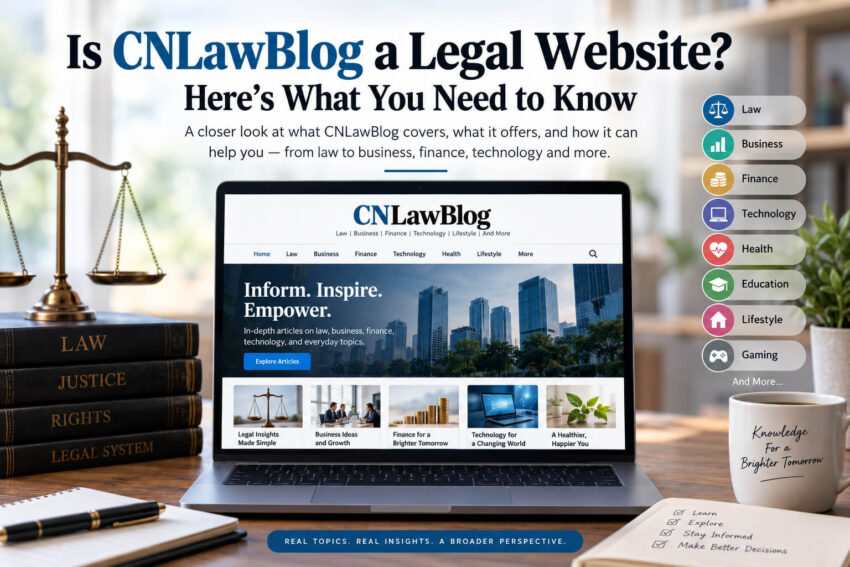
The name CNLawBlog immediately gives the impression that the website is entirely dedicated to law. For someone discovering the platform through a search engine, it would be reasonable to expect articles about legislation, court cases, lawyers, regulations, and other legal matters. Law is certainly an important part of the website, but that description no longer tells the whole story.
CNLawBlog describes itself as an independent digital publication that began with a strong foundation in legal publishing and later expanded into a much wider range of subjects. Today, visitors can find material related not only to law but also business, technology, finance, education, health, real estate, lifestyle, gaming, home improvement, and general consumer information.
So, is CNLawBlog a legal website? Yes in the sense that it publishes legal information, but it is more accurate today to describe it as a multi-topic informational publication with a significant legal component. Understanding that distinction is important, particularly for readers who arrive on the site looking for help with a serious legal matter.
What Is CNLawBlog?
CNLawBlog is an online publishing platform created to make complicated subjects easier for ordinary readers to understand. According to its About page, the publication was founded in August 2018 and developed from a background in legal publishing into a broader knowledge resource.
Its stated mission is relatively straightforward: provide information in a clear, organized, practical, and understandable form. Instead of assuming that every visitor already understands legal terminology, financial language, technology, or business concepts, the site tries to explain topics in a way that can be followed by readers with different levels of experience.
That approach helps explain why the word “Law” remains part of CNLawBlog’s identity even though its current content extends well beyond traditional legal subjects.
A reader might arrive through an article about a legal development and later find material about technology or personal finance. Another visitor might discover CNLawBlog through a business or gaming article without initially realizing that legal information formed an important part of the publication’s earlier identity.
Is It a Legal Website?
Calling CNLawBlog a legal website is not completely wrong, but the phrase needs some context.
The platform has published material covering areas such as corporate law, civil law, criminal law, legal developments, legal concepts, and case-related discussions. One of its own guides describes the platform as providing structured and simplified legal information intended for a modern online audience.
At the same time, the present website clearly contains many categories that have little or nothing to do with law.
Its homepage and About information identify topics including technology, finance, business, health, education, lifestyle, home improvement, real estate, gaming, and consumer information. Recent material has included subjects ranging from Treasury yields and interest rates to edge computing and gaming.
For this reason, CNLawBlog is better viewed as an informational publication that includes law among its major areas of coverage rather than as a website devoted exclusively to legal practice.
That distinction also prevents another common misunderstanding: publishing articles about law does not automatically make a website a law firm.
Is It a Law Firm?
There is an important difference between a website that writes about law and an organization that actually provides legal representation.
CNLawBlog presents itself as an independent online publication rather than a law firm. Its purpose is publishing educational and informational material. The site is therefore fundamentally different from a lawyer’s professional website, where visitors may be invited to arrange consultations, discuss representation, or establish a professional attorney-client relationship.
Reading an article about a legal subject is not the same as receiving personalized advice from a qualified lawyer.
A blog article can explain what a legal concept means, describe how a regulation generally works, discuss changes in the law, or provide background on a legal issue. What it normally cannot do is examine all the circumstances surrounding an individual reader’s case and determine exactly what that person should do.
That distinction matters because legal outcomes can depend on details that may appear minor to someone without legal training.
Legal Information
Law remains one of the recognizable parts of CNLawBlog’s content.
The site has described its legal coverage as including areas such as corporate law, civil law, criminal law, legal updates, and case studies. The aim is generally to translate complicated concepts into more accessible explanations rather than reproducing highly technical legal documents without context.
This kind of writing can be valuable for someone beginning research.
Imagine that a small-business owner encounters an unfamiliar compliance term. Going directly to a lengthy statute may be difficult if the reader does not understand the terminology or background. A clear introductory article can help establish basic context before the reader turns to official legislation or professional advice.
The same principle applies to students and general readers. Legal writing can be intimidating because the meaning of a single word may have consequences quite different from its ordinary everyday meaning. Accessible explanations can therefore provide a useful starting point.
However, a starting point should not automatically be treated as the final authority.
Legal Advice
One of the most important things readers should understand about sites such as CNLawBlog is the difference between legal information and legal advice.
Legal information is general. It might explain what a contract is, discuss a change in regulations, describe a court dispute, or provide an overview of a particular area of law.
Legal advice, by contrast, normally considers a person’s specific circumstances.
For example, an article could explain general principles surrounding business contracts. It could not know whether a particular clause in your own contract creates a legal risk without considering the wording, relevant jurisdiction, circumstances, applicable regulations, and potentially other documents.
CNLawBlog itself describes the platform as an independent informational resource and states in its legal-focused guide that it should not be considered a substitute for professional legal advice.
That is a sensible boundary for readers to remember. Articles may help people become better informed before speaking with a professional, but serious personal legal matters deserve individual attention from someone appropriately qualified in the relevant jurisdiction.
Beyond Law
The modern version of CNLawBlog covers considerably more than legal information.
Its published description lists business, entrepreneurship, finance, personal finance, technology, digital innovation, education, health, home improvement, real estate, lifestyle, gaming, consumer information, and general practical guides among the subjects readers may encounter.
This broader coverage changes how the site should be categorized.
A traditional legal blog might concentrate almost entirely on court decisions, regulatory developments, legal analysis, or professional commentary. CNLawBlog instead appears to operate more like a general knowledge publication built around several categories.
That approach can make the website attractive to a broader audience. A business owner, for example, may be interested in legal responsibilities but also in finance and technology. A student might initially visit for legal research and later read articles covering careers or education.
The trade-off is that users should pay attention to the category and subject of each individual article rather than assuming that everything appearing on CNLawBlog carries the same kind of legal relevance.
Who Reads It?
The format of CNLawBlog potentially serves several types of readers.
General readers may use it when they encounter an unfamiliar concept and want an explanation that does not require specialized training.
Students can use introductory articles to build basic understanding before moving to textbooks, academic publications, statutes, or other primary material.
Entrepreneurs and business owners may find subjects involving regulations, business structures, finance, technology, or practical commercial issues relevant to their work.
Professionals may occasionally use simplified articles as a quick introduction to areas outside their own expertise.
The common factor is accessibility. The publication repeatedly emphasizes readable language, logical organization, and practical explanations as part of its editorial approach.
Editorial Approach
A website’s reliability should not be judged solely by its name or appearance. Readers should also look at how it says information is produced.
CNLawBlog has published an editorial policy describing a process that includes topic selection, research, writing, editorial review, publication, corrections, and later updates where appropriate.
According to that policy, research may draw on government websites, official organizations, academic material, industry documentation, technical references, public reports, and other reputable information. Articles are described as being reviewed for factors such as factual consistency, grammar, readability, organization, and overall quality before publication.
The policy also says published articles may later be updated when laws, regulations, technologies, standards, or available information change.
That is particularly important for legal and financial subjects because an article can be accurate when published and outdated later.
CNLawBlog also states that digital tools may assist with parts of its editorial workflow, while published articles remain subject to human review.
These are useful editorial commitments, although readers should still evaluate important claims independently when the consequences of relying on information are significant.
How Reliable Is It?
There is no responsible way to declare every article on a large multi-topic website automatically correct simply because the publication has an editorial policy.
Reliability should be evaluated article by article and claim by claim.
For ordinary informational topics, a well-structured article may provide enough background to answer a reader’s basic question. For high-stakes areas such as law, finance, health, taxation, or regulation, however, additional verification is sensible.
Look for details such as the date of publication, whether the article identifies the relevant jurisdiction, whether major claims can be confirmed through authoritative material, and whether the information still reflects current rules.
This is particularly important with law.
A regulation applying in California may not apply in Texas. American law does not automatically apply in Britain, Germany, India, Pakistan, or another jurisdiction. Even within one country, different states, provinces, courts, or regulatory bodies can have different rules.
An article providing a general explanation may therefore be informative without being directly applicable to your particular situation.
Official Sources Matter
CNLawBlog and similar publications can make difficult topics easier to understand, but primary sources remain especially important when legal accuracy matters.
Depending on the issue, primary material may include legislation, regulations, court decisions, official government publications, regulator guidance, or documents released by the institution directly responsible for the subject.
Think of an informational article as a map.
A good map can help you understand where you are going, recognize important landmarks, and identify the general route. It is useful because it turns a complicated landscape into something easier to navigate.
But if you need to establish exactly what the law says, the underlying legislation or official record matters more than the summary.
The two types of resources do not necessarily compete with each other. A readable article can help someone understand official material that would otherwise seem confusing.
Updates Matter
Legal and financial information has another problem: time.
Rules change.
Governments pass new legislation. Courts interpret existing laws. Regulators publish new requirements. Financial conditions change. Technology develops. Products are discontinued. Policies are revised.
An article written several years ago may still rank highly in search results even though part of its information has become outdated.
CNLawBlog’s editorial policy acknowledges this issue and says previously published content may be revised to reflect legal, regulatory, technological, or factual changes.
Readers should still check dates themselves.
Before relying heavily on an article about current law or regulation, look at when it was first published and whether it has been updated. Then compare important details with current official information.
That small habit can prevent an old explanation from being mistaken for a current rule.
Guest Content
Another useful detail about the publication is that CNLawBlog accepts contributed articles.
Its guest-posting information says submissions may cover legal guides, business, finance, entrepreneurship, technology, digital trends, gaming, education, careers, and broader informational subjects. It also states that submissions are reviewed and must meet guidelines concerning originality, readability, structure, and factual presentation.
For readers, this is worth knowing because multi-author publications can contain different writing styles and levels of specialization.
The existence of guest contributions does not automatically make content unreliable. Many established publications use outside contributors. It simply reinforces the importance of evaluating each article based on its subject, evidence, date, and purpose rather than assuming that every page has identical authorship or expertise.
What Makes It Useful?
One of CNLawBlog’s most obvious advantages is its attempt to make complicated subjects approachable.
Many people searching for legal information are not lawyers. They may simply want to understand a phrase they heard in the news, learn what a legal process involves, or gain enough background knowledge to ask better questions.
Dense legal documents are often difficult for these readers.
A clear explanation can bridge the gap between complete unfamiliarity and deeper research.
The website’s broad coverage can also be convenient. Readers interested in law frequently encounter connected questions about finance, business, technology, property, or consumer issues. Having several of these subjects within one publication creates a broader informational environment.
At its best, this type of content helps readers understand a subject rather than simply memorize terminology.
Important Limitations
CNLawBlog should still be used with realistic expectations.
First, no general publication can know every reader’s personal circumstances.
Second, legal rules differ between jurisdictions.
Third, information changes.
Fourth, even accurate summaries may leave out exceptions that become important in a particular case.
Finally, online information cannot replace professional judgment when a decision has serious legal, financial, medical, or personal consequences.
This does not mean general articles have little value. It means their value depends on how they are used.
Reading an overview before speaking with a lawyer, accountant, adviser, or other professional can actually make that later conversation more productive because the reader already understands some basic vocabulary and context.
Problems arise when introductory information is treated as personalized professional advice.
How to Use CNLawBlog
The most practical approach is to use CNLawBlog as a starting point for understanding a topic.
Read the article carefully rather than relying only on its headline.
Check when it was published or last updated.
Identify which country, state, or jurisdiction the discussion concerns.
For important claims, consult official or primary sources.
If the subject directly affects your rights, money, health, business obligations, or legal position, seek appropriately qualified professional advice.
This approach allows readers to benefit from accessible online publishing without expecting a general article to do something it was never designed to do.
Final Thoughts
So, is CNLawBlog a legal website?
The best answer is: partly, but not exclusively.
CNLawBlog has strong roots in legal publishing and continues to feature legal information. Its own material identifies subjects such as corporate law, civil law, criminal law, legal updates, and case-related content among areas it has covered.
However, the publication has expanded well beyond law. Its current editorial scope includes business, finance, technology, education, health, real estate, lifestyle, gaming, home improvement, consumer information, and other general topics.
For that reason, describing CNLawBlog simply as a legal website gives an incomplete picture. It is better understood as an independent, multi-topic information publication with a substantial legal component.
More importantly, it should not be confused with a law firm or treated as a replacement for personalized legal advice.
For readers who understand those boundaries, CNLawBlog can serve as a useful starting point for exploring unfamiliar subjects, learning basic concepts, and building enough background knowledge to continue their research through authoritative sources when necessary.
That is ultimately the most sensible way to approach the platform: use it to become informed, but verify high-stakes information before acting on it.