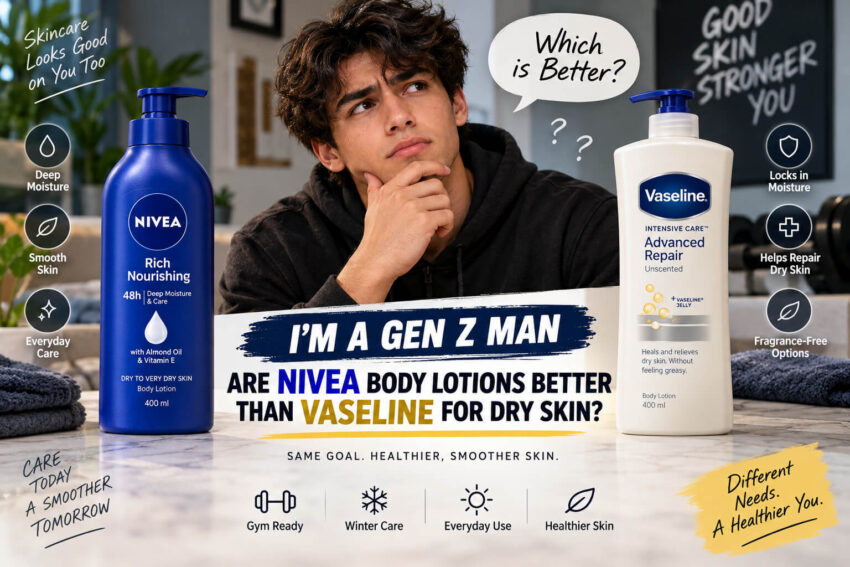
Body skincare used to feel like something many guys barely thought about. You took a shower, dried yourself, put on deodorant, and moved on. Today, things are different. Younger men are paying more attention to skincare, grooming, fragrance, fitness, and overall appearance. That makes questions such as “I am a Gen Z man. Are NIVEA body lotions better than Vaseline for dry skin?” completely reasonable.
The simple answer is that neither NIVEA nor Vaseline is automatically better for everyone. Both brands produce effective moisturizers, but their individual formulas can behave differently. Your skin type, the severity of the dryness, the climate where you live, whether you like fragrance, and even how much you dislike a sticky feeling can determine which bottle makes more sense.
Current NIVEA dry-skin products include formulas built around ingredients such as glycerin, mineral oil, vitamin E, sodium hyaluronate and almond oil, depending on the product and market. Vaseline’s dry-skin lotions frequently use glycerin alongside ingredients such as petrolatum, dimethicone, mineral oil, panthenol and skin-conditioning lipids.
So rather than asking which logo is better, it is more useful to ask which formula gives your dry skin what it actually needs.
Why Skin Gets Dry
Dry skin happens when the outer layer of your skin struggles to maintain enough water and protective oils. The result can be tightness, roughness, flaking, itching and that slightly dull or “ashy” appearance that tends to become more noticeable on the arms and legs.
Your daily habits can contribute. Long hot showers feel great after a workout or a stressful day, but they can also make dryness worse. Strong cleansers and frequent washing can remove oils from the skin, while cold weather and low humidity can make water escape from the skin more easily.
Even indoor environments matter. Air conditioning during a hot summer and heating during winter can both contribute to a dry atmosphere.
This is why moisturizing should not simply be something you do when your elbows start looking rough. For someone naturally prone to dryness, regular moisturizing is basic maintenance.
The NHS describes emollients as moisturizing treatments that soothe and hydrate skin by creating a protective layer that helps trap moisture. It also notes that ordinary soaps and some shower products can contribute to skin dryness.
What Your Skin Needs
You do not need to understand cosmetic chemistry like a dermatologist to choose a decent lotion, but knowing three basic ideas helps.
Humectants attract or hold water in the outer skin. Glycerin is one of the most familiar examples, and you will find it in products from both NIVEA and Vaseline.
Emollients make the skin feel smoother and softer. Fatty alcohols, oils and similar ingredients can fill some of the microscopic spaces between skin cells and improve the surface feel.
Occlusive ingredients reduce water loss. Petrolatum is probably the best-known example. Mineral oil and certain other oily ingredients can also contribute to the moisture barrier.
A well-designed dry-skin moisturizer can use several of these approaches at the same time. This is one reason reading the individual formula tells you more than simply deciding that one entire brand is “more moisturizing.”
NIVEA Lotions
NIVEA has built much of its body-care identity around creamy, nourishing moisturization. One current example is NIVEA Original Daily Moisture Body Lotion in the United States, which contains mineral oil, glycerin and vitamin E and is marketed for normal-to-dry skin. NIVEA describes it as a creamy but relatively light lotion intended for regular everyday use.
For skin that needs more, NIVEA Rich Nourishing Body Lotion sold in the UK is formulated for dry to very dry skin. Its current ingredient list includes mineral oil, glycerin, sodium hyaluronate, almond oil and vitamin E-related ingredients. NIVEA markets the formula as quick-absorbing and non-greasy while providing intensive moisturization.
This is the part of NIVEA that many guys may appreciate. You can get a richer moisturizing experience without necessarily feeling as though you have coated your entire body in petroleum jelly.
However, some popular NIVEA body lotions contain fragrance. If your skin reacts easily to fragranced skincare, that needs to be considered rather than assuming that a richer lotion will automatically be the best choice.
Vaseline Lotions
Vaseline takes a slightly different approach with many of its better-known body lotions. The brand is strongly associated with petrolatum, an occlusive ingredient that reduces moisture loss from the skin.
A good example is Vaseline Advanced Repair Unscented Lotion. Its current U.S. formula lists glycerin, panthenol, dimethicone, mineral oil and petrolatum, among other ingredients. Vaseline positions the lotion specifically for very dry and sensitive skin and states that the product is fragrance-free.
That combination makes Advanced Repair particularly interesting when dryness rather than fragrance or a luxurious sensory experience is your main concern.
Vaseline Cocoa Radiant takes another route. Its current U.S. formula contains glycerin, petrolatum, dimethicone, niacinamide, sunflower oil, coconut oil and cocoa butter, along with fragrance. It is designed more around dry, rough skin with an emphasis on softness and radiance.
So Vaseline is not simply “petroleum jelly in a lotion bottle.” Different varieties have noticeably different ingredient profiles and purposes.
NIVEA vs Vaseline
When you compare the two brands fairly, the differences become more interesting.
Both can contain glycerin, so both can help support skin hydration.
NIVEA’s richer lotions often combine glycerin with mineral oil and ingredients such as almond oil or hyaluronic acid. Vaseline frequently combines glycerin with petrolatum, dimethicone and other barrier-supporting ingredients.
That means Vaseline may have a slight practical edge when your main goal is preventing moisture from escaping from very dry skin, especially in a product such as Advanced Repair.
NIVEA may feel more appealing when you want strong everyday moisturization with a creamy, traditional body-lotion experience.
That does not mean every Vaseline lotion is stronger than every NIVEA lotion. A lightweight Vaseline product and a rich NIVEA lotion could easily reverse that expectation.
Compare formulas, not just brands.
Which Feels Better?
Texture is surprisingly important.
A moisturizer can have excellent ingredients, but if you hate how it feels, you will probably stop using it.
For many Gen Z men, convenience matters. You might be applying lotion before university, work, the gym or going out with friends. You probably do not want to stand around for fifteen minutes waiting for your jeans to stop sticking to your legs.
NIVEA Rich Nourishing is currently marketed as both non-greasy and quick-absorbing despite targeting dry to very dry skin.
Vaseline also designs several lotions around quicker absorption. Cocoa Radiant, for example, is intended to moisturize dry skin while maintaining a relatively non-greasy feel.
The actual sensory experience will still be personal. One person may love NIVEA’s creaminess while another considers it too rich. Someone else may prefer the spreading feel of Vaseline.
The moisturizer you enjoy applying consistently usually beats the theoretically perfect moisturizer sitting unused on your shelf.
Very Dry Skin
This is where the comparison starts leaning more toward specific Vaseline formulas.
When skin becomes genuinely rough and very dry, moisture retention becomes important. Vaseline Advanced Repair contains petrolatum as well as glycerin, panthenol, dimethicone, mineral oil and sunflower seed oil. It is also fragrance-free.
That is a convincing combination for someone whose priority is simply: “My skin is really dry; fix the dryness.”
NIVEA Rich Nourishing remains a strong alternative. Its mineral oil, glycerin, hyaluronic acid and almond oil give it a well-rounded moisturizing profile, and it is explicitly intended for dry and very dry skin.
If my skin were moderately dry and I preferred a creamy fragranced lotion, NIVEA could easily be my choice.
For persistent very dry or easily irritated skin, Vaseline Advanced Repair would make more sense to me on paper, largely because of the fragrance-free formula and its combination of humectant, emollient and occlusive ingredients.
Sensitive Skin
Fragrance deserves more attention than it often gets.
A good scent can make body lotion more enjoyable, especially if grooming is part of your overall style. But fragrance can also be a problem for some sensitive skin.
Mayo Clinic dermatologist Dr. Dawn Davis recommends choosing a hypoallergenic, fragrance-free moisturizer for people looking to minimize irritation and notes petrolatum as a particularly inert moisturizing ingredient.
That gives Vaseline Advanced Repair Unscented an advantage for someone who already knows that scented products make their skin uncomfortable.
By contrast, the current NIVEA Rich Nourishing ingredient list includes perfume and several fragrance components. That does not make the lotion “bad.” Most people can use fragranced body products without an issue. It simply means that sensitive-skin users need to consider tolerance.
If fragrance has never bothered you, this may not matter much.
If your skin regularly stings, turns red or becomes itchy after fragranced products, choose more cautiously.
After the Gym
Frequent gym sessions can create an unexpected dry-skin problem.
You train, sweat, shower and sometimes shower again later. If every shower includes hot water and strong cleanser, your skin may eventually start feeling tight.
The easiest routine is also one of the most effective: moisturize after showering.
You do not need a complicated ten-product body-care routine. Use a gentle cleanser, avoid ridiculously hot water, pat yourself dry and apply lotion.
For daytime or post-gym use, a lighter-feeling NIVEA or Vaseline lotion can be more realistic than a heavy ointment.
NHS guidance explains that creams and lighter emollients are often more convenient during the day because they spread easily and feel less greasy, while thicker ointments can be more useful when skin is extremely dry.
Hot Weather
Warm weather changes what feels comfortable.
When it is already hot or humid, a very rich moisturizer can make your skin feel sweaty and coated. You may start avoiding it altogether.
That is when texture becomes almost as important as moisturizing power.
Try using a lighter lotion during the daytime and reserving a richer product for night or for specifically dry areas such as the elbows, knees and lower legs.
There is no rule saying that the same bottle has to be perfect in January and July.
Your skin changes with the environment, so your routine can change too.
Winter Skin
Winter is where richer products begin to shine.
Lower humidity often makes dry skin more noticeable, and frequent hot showers can make the problem worse. Your shins may look flaky. Knuckles start drying out. Elbows suddenly feel like sandpaper.
During those periods, a more occlusive formula can be useful.
Medical guidance on emollients generally recognizes that thicker, oilier preparations provide a stronger moisturizing effect for severe dryness, whereas lighter lotions are easier to use but generally provide less occlusion.
This is another situation where Vaseline’s petrolatum-focused heritage makes sense.
But again, you do not necessarily need pure petroleum jelly everywhere. A well-formulated lotion can provide a much more wearable balance.
Scent Matters
Skincare does not have to smell like anything to work.
Still, scent affects whether people enjoy a product.
NIVEA has a recognizable traditional skincare fragrance in many of its products, while Vaseline offers both fragranced options such as Cocoa Radiant and fragrance-free products such as Advanced Repair.
Cocoa Radiant has a warmer, sweeter character and may suit someone who likes body care to become part of their fragrance routine. Advanced Repair is much more function-first.
There is no skincare benefit to smelling better, but enjoying the experience can make you more consistent.
For sensitive skin, however, function should win.
Price and Value
Do not judge value only by the price printed on the shelf.
Compare the bottle size.
Look at the price per 100 milliliters or per ounce.
Consider whether it comes with a pump.
Think about how much you need per application.
And most importantly, think about whether you actually like using it.
A cheaper lotion you dislike can become more expensive in practice because half the bottle stays unused.
Both NIVEA and Vaseline sit in the affordable mass-market category in many countries, although pricing varies considerably by retailer and region.
For everyday body care, either can provide good value.
A Simple Routine
You really do not need to turn body moisturizing into a complicated skincare project.
For most people with ordinary dry skin, a sensible routine looks like this:
- Shower with warm rather than extremely hot water.
- Use a gentle cleanser instead of aggressively scrubbing your entire body.
- Pat the skin dry rather than rubbing it harshly.
- Apply NIVEA or Vaseline lotion after bathing while the skin still retains some moisture.
- Use more product on naturally dry areas such as elbows, knees, shins and hands.
- Reapply when the skin begins feeling tight or dry again.
Consistency matters considerably more than owning a shelf full of products.
Mistakes to Avoid
One of the most common mistakes is waiting until the skin is visibly flaky before moisturizing.
Another is taking extremely hot showers every day and then wondering why lotion seems incapable of keeping up.
Over-exfoliation can also be an issue. Scrubbing dry skin aggressively does not necessarily solve the underlying moisture problem. Sometimes you are simply irritating an already compromised skin barrier.
And do not assume that you require a bottle with “MEN” written across the front.
Men’s skin can absolutely use regular body lotion.
A moisturizer does not stop working because the packaging was designed for a broad audience.
Choose according to your skin rather than marketing stereotypes.
Which One Wins?
So, I am a Gen Z man. Are NIVEA body lotions better than Vaseline for dry skin?
Not across the board.
If you want a creamy everyday moisturizer, enjoy fragranced skincare and have normal-to-dry or moderately dry skin, NIVEA has very good options. NIVEA Original Daily Moisture and Rich Nourishing are both formulated with established moisturizing ingredients, with Rich Nourishing being the more interesting choice for greater dryness.
If your skin is very dry, rough, sensitive or easily irritated by fragrance, Vaseline Advanced Repair Unscented stands out. Its combination of glycerin, petrolatum, dimethicone, mineral oil and panthenol gives it a strong practical profile for dry-skin care.
If you want something moisturizing but also like a sweeter scented body-care experience, Vaseline Cocoa Radiant offers yet another direction with glycerin, petrolatum, cocoa butter and other conditioning ingredients.
The real winner therefore depends on your priorities.
Final Verdict
For mild or everyday dry skin, I would call NIVEA and Vaseline roughly equal once you compare equivalent formulas.
For very dry skin, I would give a slight advantage to Vaseline’s stronger barrier-focused products, particularly Advanced Repair.
For someone who enjoys a rich, creamy traditional lotion experience, NIVEA Rich Nourishing is an excellent option.
For sensitive dry skin, a fragrance-free formula deserves serious consideration, which gives Vaseline Advanced Repair a clear practical advantage over fragranced alternatives.
Most importantly, stop thinking of moisturizer as a product you use only after your skin becomes visibly dry.
Use it consistently.
Your body skincare does not need to be expensive, complicated or marketed specifically toward men. A good cleanser, sensible shower habits and one moisturizer that you genuinely enjoy using can handle most everyday dryness.
And that is probably the most Gen Z-friendly answer possible: ignore the branding battle, read the formula, know your skin and buy the product that actually fits your routine.
If severe dryness persists, becomes painful, repeatedly cracks or causes significant itching despite regular emollient use, it is worth speaking with a doctor or dermatologist rather than continuously switching cosmetic lotions. NHS guidance similarly recommends medical advice when a dry-skin condition is severe or requires stronger treatment.