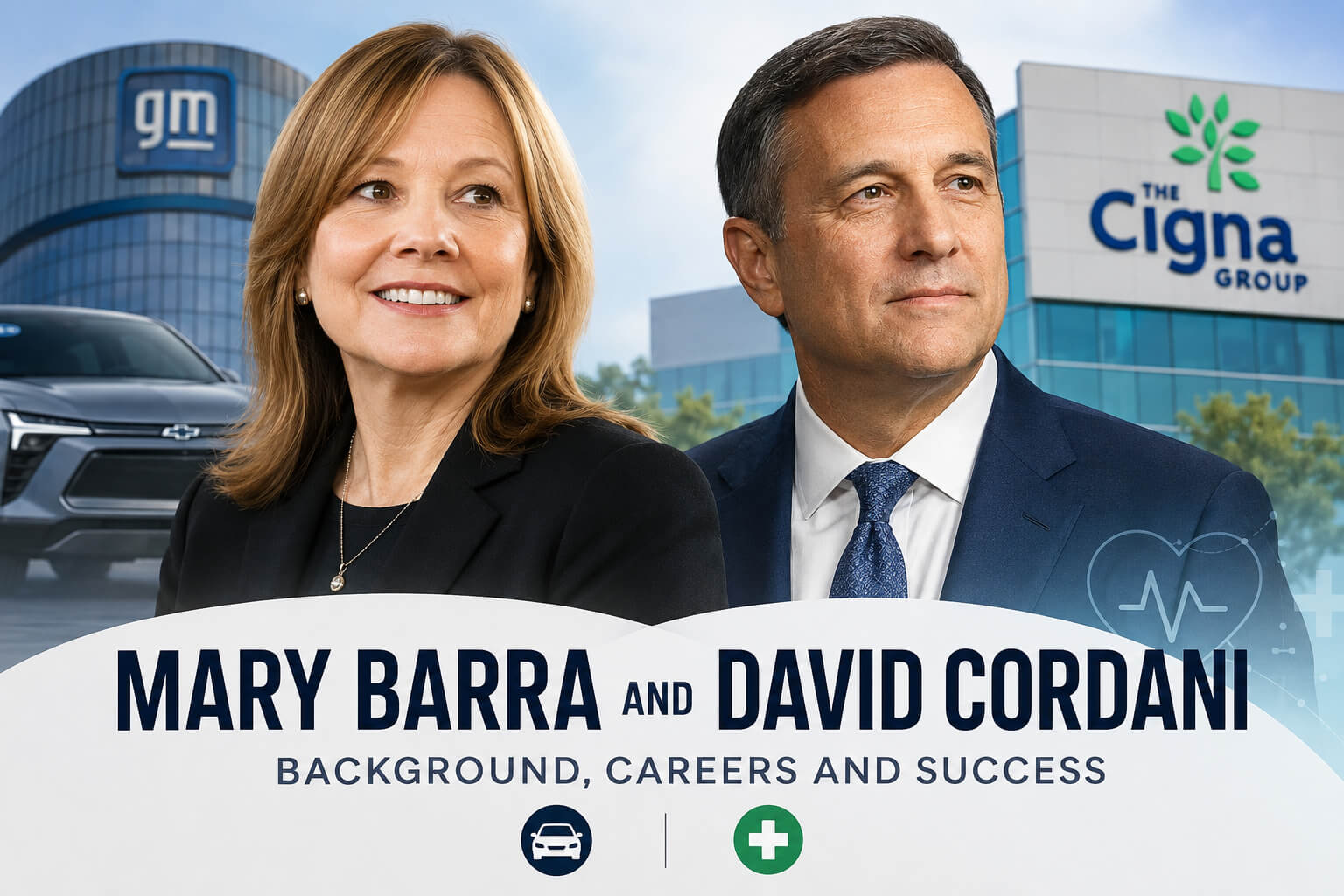
Mary Barra and David Cordani are two prominent American business leaders whose careers developed in very different industries. Barra has spent decades at General Motors, eventually becoming one of the most recognizable executives in the global automotive business. Cordani built his career in healthcare, leading Cigna through a period of major expansion and later moving into the role of Executive Chair of The Cigna Group.
Although their names may occasionally appear together in searches about corporate America and executive leadership, they are primarily known for their separate professional careers. Barra represents the transformation taking place in automobiles, manufacturing, software and electrification, while Cordani has spent much of his career addressing the increasingly complicated world of healthcare services.
Their stories are useful examples of how long-term experience, education, adaptability and leadership can take someone from an entry-level position to the highest levels of a major corporation.
Who Is Mary Barra?
Mary Teresa Barra is the Chair and Chief Executive Officer of General Motors. She became GM’s CEO in January 2014 and was elected Chair of its Board of Directors in 2016. Her appointment was historically significant because she became the first woman to serve as CEO of a major global automobile manufacturer.
Barra’s career is particularly notable because she did not arrive at General Motors from another corporation when she became CEO. Instead, she had spent decades learning the business from inside the company. She worked in engineering, manufacturing, human resources, product development, purchasing and supply-chain management before reaching the chief executive’s office.
GM continues to identify Barra as its Chair and CEO in 2026, with her strategy focused on strengthening the company’s traditional vehicle business while developing technologies involving electrification, software and autonomous driving.
Mary Barra’s Early Life
Barra grew up in the Detroit area, a region whose history is closely connected with America’s automobile industry. Her father worked as a die maker for General Motors, giving her an early connection with manufacturing and the company she would eventually lead.
In a 2026 discussion published by GM, Barra described growing up in a General Motors family and spoke about how good manufacturing jobs gave families like hers economic opportunity. Her father’s progression from apprentice to journeyman die maker also gave her direct exposure to the importance of technical skills and industrial work.
That background makes her career story somewhat unusual among modern CEOs. Rather than knowing the automobile business mainly through finance or corporate management, Barra’s understanding of GM developed from her exposure to the people, plants and processes responsible for actually building vehicles.
Mary Barra’s Education
Barra began working with GM in 1980 while studying at what was then known as the General Motors Institute, now Kettering University. She participated as a co-op student at GM’s Pontiac Motor Division, combining academic study with practical work experience.
She graduated in 1985 with a Bachelor of Science in electrical engineering. She later attended Stanford Graduate School of Business and earned an MBA in 1990.
This combination of engineering and business education became particularly useful as her responsibilities expanded. Engineering provided a technical foundation for understanding vehicles and manufacturing, while business education helped prepare her for strategic, financial and organizational responsibilities at the executive level.
Her GM Career
Barra’s rise through General Motors took decades rather than a few rapid promotions. After beginning as a co-op student, she moved through a variety of operational and management assignments.
Among her senior positions were Vice President of Global Manufacturing Engineering, Vice President of Global Human Resources, Senior Vice President of Global Product Development and Executive Vice President of Global Product Development, Purchasing and Supply Chain.
These assignments exposed her to several major parts of the organization. Manufacturing taught her how GM produces vehicles at scale. Human resources gave her experience with organizational culture and employees. Product development brought her closer to decisions about what vehicles the company should build, while purchasing and supply-chain responsibilities required dealing with complex global networks of suppliers.
By the time she became CEO in 2014, Barra had accumulated unusually broad experience across GM’s internal operations.
Leading General Motors
Running General Motors means managing far more than automobile design. The chief executive must balance manufacturing, labor, technology, regulation, safety, dealerships, global supply chains, investment, profitability and rapidly changing consumer preferences.
Barra has led the company during a period when the definition of an automobile manufacturer itself has been changing. Traditional manufacturers now compete not only over engines, styling and manufacturing efficiency but also over battery technology, software, connected services and advanced driver-assistance systems.
GM describes Barra’s strategy as centered on strengthening the company while developing technologies involving electrification, software and personal autonomous driving. That requires managing the profitable conventional vehicle business while investing in products that could shape the company’s future.
Electric Vehicles
Electric vehicles have become one of the most visible elements of Barra’s leadership.
GM has invested heavily in electric vehicles and battery technologies while bringing electric versions of vehicles across several of its brands to market. At the same time, the EV market has demonstrated that transitions of this size rarely happen in a straight line. Consumer demand, battery costs, charging infrastructure, competition and government policy can all affect how quickly adoption develops.
GM’s outlook at the beginning of 2026 reflected this more practical balance. Barra said the company continued to believe in EVs and noted that GM’s electric portfolio had brought almost 100,000 new customers to the company in 2025, while the automaker continued working to lower EV-related costs and move toward profitability.
That approach illustrates an important feature of Barra’s leadership: GM’s future involves electric technology, but the company must simultaneously respond to what customers are actually buying today.
Mary Barra’s Achievements
Barra’s most widely recognized milestone remains her appointment as the first woman to lead a major global automaker. The significance went beyond General Motors because automotive manufacturing had historically been a heavily male-dominated industry, especially at its highest executive levels.
Her longevity is also notable. She has remained CEO since 2014, giving her more than a decade of experience running one of America’s largest industrial companies.
Her influence extends outside GM as well. According to General Motors, Barra has served on organizations and boards including the Business Roundtable, The Walt Disney Company, Duke University Board of Trustees and Detroit Economic Club.
Still, her career should not be reduced to a symbolic first. Her professional record is rooted in decades of engineering, manufacturing and corporate-management experience that preceded her appointment.
Who Is David Cordani?
David M. Cordani is an American business executive best known for his long leadership career at Cigna.
Cordani joined the organization in 1991 and held numerous senior roles before becoming CEO in 2009. He later became Chairman of the Board in January 2022.
There has been an important leadership change since many older online biographies were written. Cordani retired as CEO on July 1, 2026, after nearly 17 years in that position. Brian Evanko succeeded him as chief executive, while Cordani became Executive Chair of The Cigna Group’s Board of Directors.
That distinction is important for an accurate current profile: Cordani remains an influential figure at The Cigna Group, but he is no longer its CEO.
Cordani’s Early Life
Cordani has described his upbringing as working-class and rooted in Connecticut. Texas A&M’s account of his background says he grew up in a multigenerational household with his parents, grandparents and two brothers.
He has credited his family with teaching him lessons about hard work, service and treating other people with respect. Those themes later became recurring elements when he spoke publicly about leadership.
His family temporarily relocated to Houston during his high-school years, and that move eventually played a role in his decision to attend Texas A&M University. Although his career would eventually take him into the highest levels of corporate healthcare, his early environment was far removed from the stereotypical picture of an executive upbringing.
Cordani’s Education
Cordani attended Texas A&M University, where he developed a strong interest in business.
Texas A&M records describe him as studying accounting and finance, experiences he later credited with teaching him how to analyze difficult situations, work with teams and adapt when circumstances changed.
He subsequently earned an MBA from the University of Hartford, according to The Cigna Group’s official board biography.
His education gave him a particularly useful foundation for healthcare leadership because large health companies operate at the intersection of finance, insurance, regulation, data, medical services and consumer needs.
His Early Career
Cordani did not begin his career as a healthcare CEO. After university, he joined Coopers & Lybrand, the accounting firm that later became part of PwC.
Working with financial-services and healthcare clients exposed him to industries that would shape his professional interests. He has recalled becoming increasingly interested in healthcare because of its direct effect on people’s lives.
In 1991, he joined Cigna. What followed was a long internal career somewhat comparable to Barra’s progression at General Motors: rather than moving from company to company on the way to the top, Cordani accumulated experience through numerous positions within one organization.
His Cigna Career
Before becoming CEO, Cordani served in several important positions at Cigna, including Chief Operating Officer, President of Cigna HealthCare and Senior Vice President of Customer Segments and Marketing.
He became chief executive in 2009 and remained in the position until July 2026.
That tenure covered a period of significant transformation. Cigna expanded well beyond the traditional image of an insurance company and developed a broader collection of health-service businesses.
One of the defining events was Cigna’s acquisition of Express Scripts, completed in 2018. The transaction substantially increased the company’s presence in pharmacy-benefit and health services and contributed to the development of what is now known as Evernorth Health Services. Reuters has described the Express Scripts acquisition as one of the major strategic moves of Cordani’s tenure.
Cigna’s Transformation
The scale of Cigna’s expansion during Cordani’s leadership is striking.
When the company announced his succession plan in March 2026, it said Cigna had evolved during his tenure from a traditional insurer with approximately 46 million customers and $18 billion in annual revenue into a global health company with around 180 million customer relationships and $275 billion in annual revenue.
These figures do not mean that every change was the work of one person. Companies of this size depend on tens of thousands of employees, acquisitions, market conditions, board decisions and entire management teams.
Nevertheless, the transformation took place while Cordani was chief executive, making portfolio expansion and diversification central parts of his professional legacy.
Cordani’s Leadership
Cordani frequently describes leadership in terms of trust, responsibility, adaptability and continuous learning.
In a 2026 discussion highlighted by Texas A&M, he emphasized integrity, active listening and remaining open to different perspectives. He has argued that leadership should not simply come from someone’s title; it depends on earning the confidence of other people.
That philosophy appears connected with his upbringing and education. Cordani has repeatedly spoken about the influence of family values and the service-oriented culture he experienced at Texas A&M.
His background as an endurance athlete has also influenced how he discusses leadership. Training for demanding events provides an obvious analogy for business: set a goal, prepare carefully, adapt when circumstances change and continue when conditions become difficult.
Beyond Business
Cordani’s public profile includes significant involvement in endurance sports and organizations supporting veterans and athletes with disabilities.
He has participated in triathlons and other endurance events and has worked with Achilles International, including serving as a guide for athletes with disabilities and wounded veterans.
He also co-authored The Courage to Go Forward: The Power of Micro Communities, a book built around lessons involving resilience, community and overcoming difficult circumstances.
In June 2026, The Cigna Group Foundation announced a $1.5 million, 10-year Courage in Service grant honoring Cordani’s leadership and supporting military and veteran communities.
Mary Barra and David Cordani
The keyword Mary Barra and David Cordani can naturally create the impression that there must be a major personal or professional relationship between them.
However, their public profiles are principally separate. Barra is associated with General Motors and the automotive industry, while Cordani’s career has centered on Cigna and healthcare services. Based on the authoritative corporate and biographical sources reviewed for this article, there is no reason to present them as spouses, business partners or as sharing some special personal relationship.
What makes them meaningful to compare is leadership.
Both spent decades inside the companies they eventually led. Both accumulated experience across different parts of their organizations before becoming chief executives. Both have managed businesses facing profound technological, regulatory and consumer changes.
Their similarities are therefore professional rather than personal.
Different Industries
Barra’s biggest challenges involve automobiles, factories, vehicle technology, software, international competition, supply chains and consumer preferences.
Cordani’s world has been different. Healthcare leaders must work within an industry involving insurers, employers, patients, pharmaceutical companies, pharmacy-benefit managers, healthcare providers and government programs.
Healthcare also comes with intense debate over cost, affordability and transparency. Pharmacy benefit managers, including Cigna’s Express Scripts, have faced substantial political and regulatory scrutiny over their role in prescription-drug pricing. The industry has disputed some of the criticisms, illustrating the difficult environment healthcare executives must navigate.
The issues Barra faces are different in detail but similar in scale. Automakers must respond to changing emissions rules, evolving trade policy, technological disruption and enormous capital requirements.
Neither executive has led in a stable industry.
Leadership Through Change
One of the clearest connections between their career stories is their willingness to manage transformation rather than simply protect an existing business model.
For Barra, that means preparing General Motors for an automotive market in which electric propulsion, advanced software and autonomous-driving technologies may play increasingly important roles.
For Cordani, transformation involved helping turn Cigna from a more conventional insurer into a broader health-services organization combining insurance with pharmacy and other healthcare capabilities.
These strategies carry risk. Large transformations demand enormous investments, and predictions about consumer behavior or technology do not always unfold on schedule.
Long-term leadership therefore requires adjustment rather than blind commitment to a fixed plan.
Challenges and Criticism
Successful executives should not be described only through achievements.
General Motors operates in a highly competitive industry where Barra must answer to customers, workers, investors, regulators and dealers. Decisions involving EV investment, manufacturing capacity and future technology are continuously evaluated against financial performance and market demand.
The Cigna Group operates under similarly intense scrutiny. American healthcare affordability remains a major political and public concern, while insurers and pharmacy benefit managers frequently face criticism about costs and the complexity of the healthcare system.
Cordani himself acknowledged in 2026 discussions that the status quo in American healthcare was unsustainable and highlighted rising demand for care as well as increasingly expensive drugs and treatments as important pressures.
Those challenges give more context to both executives’ records. Leadership at this level is rarely a simple story of uninterrupted success.
Why Their Careers Stand Out
Perhaps the most interesting similarity between Mary Barra and David Cordani is career depth.
Barra began with GM as a student in 1980 and spent decades learning the organization before becoming CEO.
Cordani joined Cigna in 1991 and likewise progressed through numerous responsibilities before becoming chief executive in 2009.
Modern executive careers are often portrayed as constant movement between companies. Barra and Cordani demonstrate another route: gaining increasingly broad responsibility inside one organization until there is enough operational experience to lead it.
That type of progression does not guarantee success, but it can provide something difficult to acquire quickly—the ability to understand how a large organization actually works beneath its executive titles.
Lessons From Their Success
One lesson from their careers is that technical or specialized knowledge does not have to limit someone’s path to general management. Barra began from an engineering background, while Cordani developed deep expertise in accounting and finance. Both eventually learned to manage organizations far broader than their original disciplines.
Another lesson is that continuous learning matters. Industries change, technologies change and customer expectations change. What made a company successful ten years earlier may not be enough to protect it ten years later.
Their careers also demonstrate the importance of experience close to operations. Barra spent time around manufacturing and product development. Cordani moved through operating, healthcare and customer-focused responsibilities. Neither reached the CEO position with experience in only one narrow corporate function.
Finally, both careers show that success at the highest level involves managing contradictions: investing for tomorrow while delivering results today, encouraging innovation while controlling risk, and making major decisions without having perfect information.
Where They Are Today
As of August 2026, Mary Barra remains Chair and CEO of General Motors. GM continues to describe its strategy under her leadership as combining strong vehicle execution with investment in electrification, software and advanced technology.
David Cordani’s role has recently changed. After serving as Cigna’s CEO from 2009 through June 2026, he became Executive Chair of The Cigna Group on July 1, 2026. Brian Evanko is now the company’s CEO.
This makes comparisons that describe both Barra and Cordani as current CEOs outdated. Barra remains an active chief executive, while Cordani has entered a new phase of his corporate career.
Frequently Asked Questions
Who is Mary Barra?
Mary Barra is the Chair and CEO of General Motors. She joined GM as a co-op student in 1980 and became CEO in 2014 after holding numerous engineering, manufacturing, human-resources and product-development positions.
Who is David Cordani?
David Cordani is the Executive Chair of The Cigna Group. He joined Cigna in 1991 and served as CEO from 2009 until July 1, 2026, when Brian Evanko succeeded him.
Are Mary Barra and David Cordani married?
There is no credible basis for describing Mary Barra and David Cordani as a married couple. They are separate public figures primarily known for their respective careers at General Motors and The Cigna Group.
What is Mary Barra known for?
Barra is especially known for becoming the first woman to lead a major global automaker and for guiding GM during a period of major change involving electric vehicles, software and advanced vehicle technologies.
What is David Cordani known for?
Cordani is best known for nearly 17 years as Cigna’s CEO and for overseeing the company’s transformation from a traditional insurer into a much larger health-services organization.
Conclusion
Mary Barra and David Cordani represent two different paths through corporate America that ultimately share several important characteristics. Both spent decades developing expertise within major companies. Both moved through varied responsibilities rather than following a single narrow career track. And both eventually found themselves responsible for navigating industries experiencing substantial change.
Barra’s story begins with engineering and manufacturing and leads to the top of General Motors, where she continues to guide one of the world’s best-known automobile companies through changes in technology and consumer demand.
Cordani’s path begins in accounting and finance, moves deeply into healthcare and culminates in a nearly 17-year tenure as Cigna’s CEO. His move to Executive Chair in July 2026 marks the beginning of a different stage in that career rather than the end of his association with the company.
There is no need to invent a personal connection between Mary Barra and David Cordani to make their stories interesting. Their real connection is more useful: each offers an example of how education, operational experience, adaptability and long-term commitment can shape leadership at the highest levels of American business.