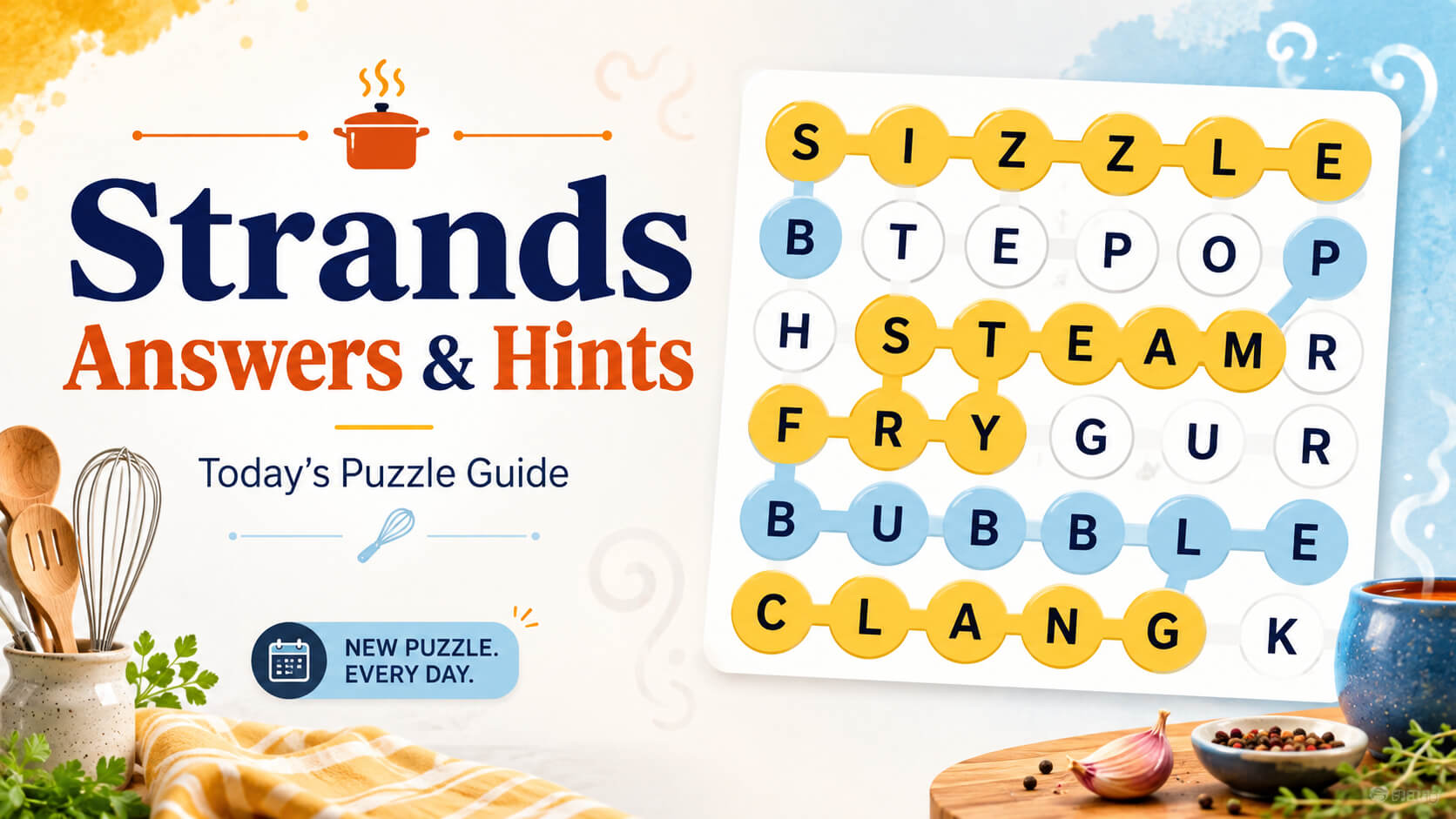
Strands Answers and Hints for Today’s NYT Puzzle
The NYT Strands puzzle for Saturday, August 29, 2026, brings a theme that feels familiar once you hear what is happening around the kitchen. Puzzle #909 uses the official theme clue “Now we’re cooking!”, but the words hiding in the grid are not ingredients, recipes, utensils, or types of food. Instead, today’s puzzle asks players to pay attention to something we often notice without consciously thinking about it: the sounds food and cookware can make while a meal is being prepared.
If you are searching for Strands answers today, you may not want every solution immediately. Part of the fun of Strands is getting just enough help to see the connection yourself. For that reason, this guide starts with lighter hints before moving toward the spangram and complete answer list.
Spoiler warning: The full Strands answers for August 29 appear later in this article.
Today’s Puzzle
Today’s Strands is puzzle #909, dated Saturday, August 29, 2026. The board contains six regular theme words and one spangram, meaning there are seven themed entries to discover altogether. The official clue is “Now we’re cooking!”
At first glance, that clue opens the door to dozens of possibilities. You could reasonably search for foods, cooking techniques, kitchen equipment, spices, ingredients, or even famous dishes. That broadness is what gives the puzzle some of its challenge.
The real connection becomes much clearer when you stop thinking about what you see in a kitchen and start thinking about what you hear.
Theme Hint
Here is your first gentle hint:
Imagine standing beside a stove while several different things are cooking at once. What noises might reach your ears?
That should point you in the right direction without giving away individual answers.
A stronger hint is that the words are largely sound-related terms. Several describe noises that can naturally happen when liquids heat, oil reacts with moisture, food touches a hot surface, or ingredients move around inside a pan or pot. Parade similarly describes the theme through the idea of onomatopoeia, while Nerds Chalk characterizes the answers as familiar cooking noises.
Another Hint
Still stuck?
Think about words that imitate or closely describe the noise they represent.
Some of today’s answers could easily appear in a sentence about frying, boiling, simmering, or heating something. You are not looking for the object making the sound. You are looking for the sound itself.
Once one or two of these words become visible, the rest of the puzzle becomes considerably easier because they belong to a tight and recognizable family.
Opening Letters
Players who need a slightly stronger push can use the beginning letters of the theme words.
The six regular theme words begin with:
BU
CR
GU
HI
SI
SP
These beginnings correspond to six sounds associated with cooking. Forbes also reports these opening pairs among the seven entries in the puzzle, including the spangram.
If you want to solve the puzzle largely on your own, this is a good place to stop reading and return to the grid.
Spangram Hint
Every Strands puzzle includes a special answer known as the spangram. Rather than simply being another word related to the topic, the spangram expresses the larger idea connecting the other answers.
Today’s spangram consists of 11 letters when written without the space, and it plays with the idea that the noises coming from the kitchen can be almost as appealing as the meal itself.
Another clue: it starts with SO.
The spangram runs mostly diagonally across the board, according to published solution guides for today’s puzzle.
Ready for the answer?
Today’s Spangram
The August 29 Strands spangram is:
SOUNDS TASTY
That phrase captures the entire joke behind today’s puzzle. Instead of focusing on how food tastes, the board focuses on the noises that suggest something delicious may be happening nearby.
The phrase also explains why a straightforward interpretation of “Now we’re cooking!” can initially send players down the wrong path. You may spend time trying to find words such as PAN, OVEN, ROAST, FRY, SPICE, or other obvious cooking vocabulary, when the puzzle is really interested in the soundtrack of cooking.
Forbes and Parade both identify SOUNDS TASTY as the August 29 spangram.
Strands Answers
Here are the complete Strands answers for Saturday, August 29, 2026:
BUBBLE
CRACKLE
GURGLE
HISS
SIZZLE
SPLATTER
Spangram: SOUNDS TASTY
These six theme words and the spangram complete the puzzle. Independent solution coverage from Forbes, Parade and Nerds Chalk reports the same set of theme answers.
How They Connect
The clever part of today’s puzzle is how naturally each word fits into a cooking environment.
BUBBLE immediately brings to mind a pot of water, soup, sauce, or another liquid reaching the right temperature. Seeing bubbles is often one of the easiest visual signs that heat is doing its work, but bubbling also produces a recognizable sound.
CRACKLE feels slightly sharper. It can describe the small, quick noises coming from food exposed to heat, especially when fats, skins, or surfaces begin changing as they cook.
GURGLE is particularly effective because it sounds almost like the noise it describes. Heated liquids, simmering mixtures, or movement inside a pot can create the irregular liquid sound associated with gurgling.
HISS is shorter than most of the answers, but it is strongly associated with a hot surface meeting moisture. Anyone who has dropped food into a heated pan has probably heard that immediate hiss.
SIZZLE may be the most recognizable cooking word in the set. It practically announces that something has hit a hot pan or grill. In everyday language, “sizzling” food is so closely associated with cooking that this answer may be one of the first theme words many players notice.
SPLATTER evokes hot oil, sauce, grease, or liquid popping outward during cooking. It describes an action, but the word also strongly suggests the sound produced by that action.
Taken together, the words form a surprisingly vivid kitchen scene without naming a single specific dish.
Why It’s Tricky
Today’s Strands is not especially difficult once the theme clicks. The challenge comes before that moment.
The clue “Now we’re cooking!” is broad enough to suggest an enormous vocabulary. A player might reasonably expect kitchen tools, culinary techniques, types of heat, popular dishes, or ingredients.
That ambiguity can make the opening stage feel harder than the second half.
Once you identify SIZZLE, BUBBLE, or another strong theme word, however, the category becomes easier to recognize. From there, you can begin asking yourself which other sound words might be hidden around nearby letters.
This kind of theme recognition is one of the central skills involved in Strands. The puzzle is not merely about spotting valid words; it is about discovering why certain words belong together.
How Strands Works
Strands takes the basic idea of a word search and makes it more flexible.
The board uses a 6-by-8 grid of letters, but hidden answers do not need to move in a straight horizontal, vertical, or diagonal line. Letters can connect in different directions, and the path can change direction while forming a word.
Theme words are highlighted when discovered, and every letter on the board ultimately belongs to a theme answer or the spangram. The themed words do not overlap.
This makes Strands feel noticeably different from a traditional newspaper word search. You cannot simply scan rows for obvious vocabulary. Sometimes an answer bends around other parts of the grid, forcing you to think spatially.
The Spangram
The spangram is particularly important because it identifies or summarizes the puzzle’s overall theme.
According to the game rules described by Forbes and Parade, the spangram connects two opposite sides of the board and appears in a different highlight from ordinary theme words. It can also consist of more than one word.
Finding it early can make a puzzle much easier.
If you had discovered SOUNDS TASTY before several of today’s regular answers, for example, you would immediately know that the theme probably combines food with noises. That would make words such as HISS, CRACKLE, and SIZZLE much easier to anticipate.
On the other hand, you can often work in reverse. Finding several theme words may reveal the likely meaning of the spangram.
Using Hints
Strands includes its own built-in hint system for moments when the board refuses to cooperate.
Players can earn a hint by finding three valid non-theme words of at least four letters. Activating the hint highlights the letters belonging to one theme word. If a hint is already active, another can help reveal the order of those letters.
This system rewards exploration. Even a word that does not belong to the official theme is not necessarily wasted effort.
Still, many experienced players prefer to save hints until they have exhausted obvious possibilities. Discovering the theme naturally is usually the most satisfying part of the puzzle.
Solving Faster
A good Strands strategy begins with the theme clue rather than random word hunting.
Before touching the board, spend a few moments brainstorming what the clue could mean. For “Now we’re cooking!”, reasonable categories might include utensils, foods, cooking methods, heat-related words, kitchen actions, or—as today eventually reveals—sounds.
Then scan the board for unusually distinctive letter combinations.
Longer words can be especially useful because they often provide a clearer indication of the category. Finding something like SPLATTER gives you more thematic information than stumbling upon a very short word.
It also helps to reconsider the theme whenever two confirmed answers seem related in an unexpected way. If BUBBLE and HISS are both correct, for instance, the connection is probably not a type of food. Asking what the two words have in common quickly points toward sound.
Watch the Edges
Edges and corners deserve special attention in Strands because every board letter must eventually be used.
If a difficult letter remains isolated near a border, examine which neighboring letters it can legally connect to. Working backward from those constrained positions can reveal answers that are difficult to notice when scanning the center.
The spangram is another useful structural clue because it reaches opposite sides of the board. If you suspect you have found part of it, following the available route toward another side can sometimes confirm the answer.
Avoid Straight-Line Thinking
Perhaps the most common mistake for newcomers is treating Strands like an ordinary word search.
The answers can turn.
They can move diagonally, vertically, and horizontally as long as consecutive letters touch. Forbes notes that players can switch direction in the middle of a word, which dramatically increases the number of possible paths through the grid.
If you can see the first half of a likely answer but the next letter appears to be missing, inspect every adjacent square rather than continuing along the same direction.
Many difficult words suddenly become visible once you stop expecting them to behave like traditional word-search entries.
Don’t Chase Every Word
Another common mistake is assuming every valid word you discover belongs to the theme.
Strands deliberately allows you to form ordinary dictionary words that are not part of the solution. Those words contribute toward earning hints, but they do not remain as theme answers.
This is why meaning matters as much as spelling.
After identifying a possible word, ask whether it actually supports the clue and whether it fits with other confirmed theme words. If not, treat it as useful hint progress rather than forcing it into your interpretation of the puzzle.
Difficulty
Today’s puzzle sits in a comfortable middle ground.
The official clue is broad enough to cause some early uncertainty, but the theme words themselves are familiar. There are no especially obscure technical terms, rare names, or unusual spellings in the final answer list.
The biggest breakthrough is realizing that cooking sounds, rather than cooking objects, are the focus.
Once SIZZLE, HISS, or BUBBLE appears, the theme becomes much easier to predict. The playful spangram SOUNDS TASTY then ties everything together in a satisfying way.
For players comfortable with identifying sound words, August 29 may feel relatively approachable. For anyone who interprets the initial clue too literally, it can take longer to uncover the trick.
Final Thoughts
Today’s NYT Strands puzzle is a good example of how a simple clue can hide a more playful idea.
The theme “Now we’re cooking!” initially invites you to search for obvious culinary vocabulary. The actual answers—BUBBLE, CRACKLE, GURGLE, HISS, SIZZLE, and SPLATTER—shift attention from ingredients and tools to the sounds surrounding the cooking process. The spangram SOUNDS TASTY completes that idea with a memorable bit of wordplay.
The best way to approach puzzles like this is to use hints gradually. Begin with the official theme, look for one unmistakable answer, and let that word change how you interpret the rest of the grid. When the connection finally becomes clear, Strands turns from a difficult letter hunt into a much more manageable—and enjoyable—logic puzzle.
FAQs
What are today’s Strands answers?
The Strands answers for August 29, 2026 are BUBBLE, CRACKLE, GURGLE, HISS, SIZZLE, and SPLATTER. The words all relate to sounds associated with cooking.
What is today’s Strands spangram?
Today’s spangram is SOUNDS TASTY. It connects the puzzle’s cooking theme with the sound-related answers hidden around the board.
What is today’s Strands theme?
The official theme for Strands #909 on August 29 is “Now we’re cooking!” The solution interprets that clue through familiar noises heard while food is being cooked.
How do hints work in Strands?
Finding three valid non-theme words earns a hint. The hint can reveal the letters belonging to one of the hidden theme words, helping players make progress without immediately revealing the full answer.
Can Strands words go diagonally?
Yes. Strands answers can connect letters horizontally, vertically, and diagonally, and a word can change direction as it moves across the board. That flexible movement is one of the features that separates Strands from a standard word search.