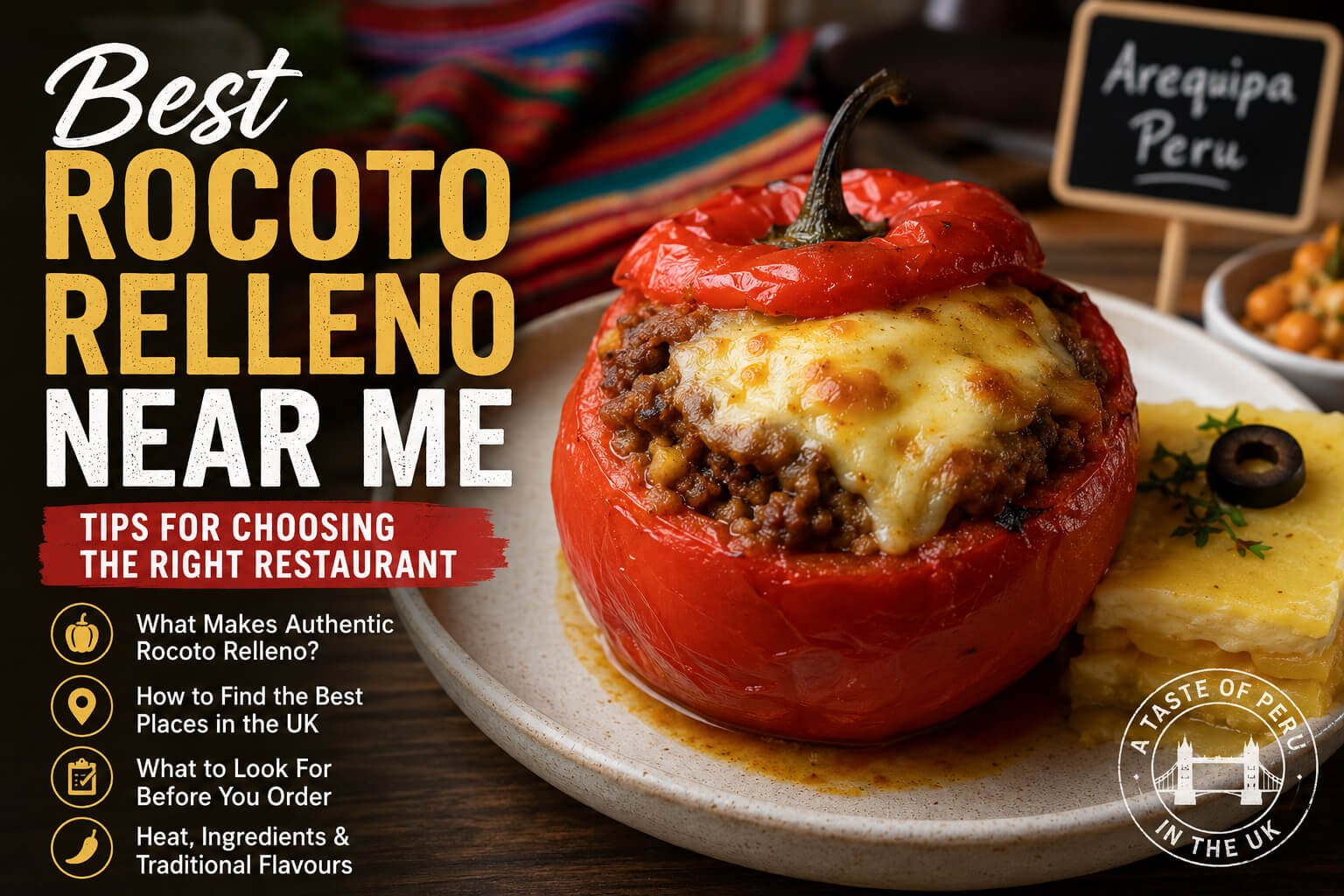
Searching for the best rocoto relleno near me in the UK can be surprisingly challenging. Peruvian food has become much easier to find in Britain, particularly in London, but rocoto relleno remains a more specialised dish than familiar favourites such as ceviche, lomo saltado or pollo a la brasa. Finding a restaurant that serves Peruvian food is therefore only the first step; finding one that prepares a convincing rocoto relleno requires a little more attention.
For anyone unfamiliar with it, rocoto relleno is far more than an ordinary stuffed pepper. It is one of the signature dishes associated with Arequipa in southern Peru, a city with a distinctive regional food culture. Peru’s official tourism website describes the dish as rocoto pepper filled with meat, cheese, egg and olives before being covered with melted cheese.
In Britain, availability can change between permanent menus, weekend specials and food events. That makes checking the restaurant’s latest menu particularly important before travelling across town—or across the country—specifically to try it.
What Is Rocoto Relleno?
Rocoto relleno literally refers to a stuffed rocoto pepper. Its appearance can initially be deceptive because a rocoto may resemble a small red bell pepper. The flavour, however, is considerably different. Rocoto belongs to Peru’s long tradition of chilli-based cooking and brings noticeable heat together with a distinctive fruity quality.
Traditional preparation begins by opening the pepper and removing the seeds and internal membranes. Peru’s official tourism material describes boiling the pepper with salt and vinegar as part of the preparation, which helps moderate some of its natural intensity. A seasoned meat mixture is then prepared, commonly using onion, garlic, herbs and spices before additional ingredients are incorporated.
Once stuffed, the pepper is normally topped with cheese and baked. The result combines several contrasting elements in one dish: chilli heat, savoury meat, sweetness from the pepper, richness from the cheese and occasional salty or nutty notes from ingredients such as olives and peanuts.
Its Arequipa Roots
Understanding the origins of the dish makes it easier to judge what you are ordering. Rocoto relleno is closely associated with Arequipa, sometimes called Peru’s White City. The region is known for its traditional picanterías, restaurants connected with a long-established style of regional cooking.
Peru Travel identifies rocoto as an iconic ingredient of Arequipa and lists rocoto relleno among the region’s emblematic foods. Traditional picanterías are also noted for methods such as wood-fire cooking, which form part of the area’s broader culinary identity.
This regional background matters in the UK because a restaurant offering authentic Arequipeño cooking may approach the dish differently from a venue serving broadly Latin American food. Neither setting automatically guarantees better food, but knowledge of the dish’s origin is a useful clue when comparing restaurants.
What It Tastes Like
The first thing many diners expect from rocoto relleno is extreme heat. It certainly can be spicy, but a well-made version should offer much more than chilli intensity.
The rocoto itself has a characteristic flavour that helps distinguish the dish from a conventional stuffed pepper. Preparation techniques such as removing the seeds and boiling the pepper can reduce its heat. The filling then adds richness and depth, while melted cheese provides a creamy contrast.
Depending on the recipe, you may also encounter peanuts, olives, egg or slightly sweet elements. Peru Travel’s recipe includes meat, onion, oregano, cumin, ají panca and toasted peanuts, illustrating how layered the seasoning can be.
A successful plate therefore should not simply leave your mouth burning. You should be able to taste the pepper, filling, seasoning and cheese separately while still feeling that they belong together.
Traditional Ingredients
There is no reason to reject a restaurant simply because its recipe differs slightly from another one. Family traditions and restaurant interpretations naturally vary. Still, several ingredients give you a useful reference point.
Official Peruvian tourism material describes the classic Arequipa version as containing rocoto, chopped meat, cheese, egg and olives, topped with melted cheese. Other documented recipes add onions, garlic, cumin, oregano, ají panca and peanuts.
Some versions may incorporate raisins or other additions for a sweet-and-savoury contrast. UK chefs may also substitute particular cheeses or ingredients when exact Peruvian products are difficult to source.
Authenticity should therefore be judged by the overall character of the dish rather than by demanding one rigid ingredient list.
Finding It in the UK
Typing best rocoto relleno near me into a search engine may produce a mixture of Peruvian restaurants, general Latin American venues, recipes and delivery listings. That does not mean every result actually serves the dish.
Current research suggests London provides the strongest concentration of identifiable places connected with rocoto relleno, while availability becomes harder to establish elsewhere in Britain. UK restaurant research has linked establishments such as El Señorío Criollo, Darkest Peru and MAKA Peruvian Cuisine with the dish, while other Peruvian venues are worth checking directly for changing menus and specials.
The important word here is checking. Specialist dishes often disappear temporarily, appear only during particular events or change with a restaurant’s seasonal menu.
Start With London
For UK diners, London is the most practical place to begin. The capital has a developed Peruvian restaurant scene covering traditional cooking as well as modern interpretations.
However, even respected contemporary Peruvian restaurants may use rocoto without serving rocoto relleno itself. For example, LIMA Fitzrovia’s current menu includes rocoto in its bread accompaniment, alongside dishes such as ceviche, anticucho and other Peruvian-inspired plates, but its current published menu does not list traditional rocoto relleno.
This is a useful reminder not to assume that seeing “rocoto” somewhere on a menu means the stuffed Arequipeño dish is available.
Search using the exact dish name, check restaurant websites and look at recent menu photographs rather than relying solely on the restaurant’s general description.
Beyond London
Finding rocoto relleno outside London is possible, but you may need more patience. Independent Peruvian businesses, market traders, cultural events and temporary menus can be just as important as permanent restaurants.
Taste Peru in Doncaster, for example, has previously been linked with rocoto relleno through Peruvian food and cultural events, although recent research indicates its standard online offering does not necessarily feature the dish permanently.
If you live in Manchester, Birmingham, Bristol, Leeds, Liverpool, Edinburgh, Glasgow or another UK city, searching only for “rocoto relleno” may produce limited results. Try combining terms such as “Peruvian restaurant”, “Arequipa food”, “Peruvian food festival” and your city.
Smaller businesses may also announce specials through social media before updating a formal website.
Check the Pepper
One of the simplest questions you can ask is whether the restaurant uses an actual rocoto pepper.
A red bell pepper filled with minced beef can still make an enjoyable meal, but it does not provide the same flavour or heat as genuine rocoto. The pepper is not simply a container for the filling—it is one of the defining components of the dish.
This distinction matters especially in Britain, where specialist South American ingredients may require more careful sourcing.
If authenticity is your priority, ask the restaurant directly: “Is your rocoto relleno made with genuine rocoto peppers?” A knowledgeable member of staff should understand why the question matters.
Look at the Filling
The filling should be substantial without completely overwhelming the pepper. Meat is central to the traditional version, although individual preparations vary.
Look for a filling with visible texture rather than something resembling an anonymous paste. Onion, herbs, spices, olives, egg, nuts or other ingredients may provide contrasting flavours.
A good filling should also taste seasoned throughout. Rocoto itself has enough personality that bland meat can make the entire plate feel unbalanced.
At the same time, excessively salty or heavily sauced filling may hide the pepper’s character. The best versions allow both components to contribute.
Check the Cheese
Cheese has an important role in rocoto relleno. Peru Travel’s description specifically notes the generous melted cheese placed over the stuffed pepper.
Besides adding richness, cheese provides an important contrast to the chilli. The fat and creamy texture can soften the perception of the rocoto’s heat and bind the different flavours together.
UK restaurants may not always use exactly the same cheese found in Arequipa. That is not necessarily a problem. A thoughtful local substitution can work extremely well if it melts appropriately without becoming overwhelmingly greasy or salty.
Consider the Sides
A restaurant’s choice of accompaniment can provide another clue about its approach to Peruvian regional cooking. Rocoto relleno is frequently associated with potato-based accompaniments, particularly pastel de papa, a layered potato preparation.
If a restaurant offers the two together, it can create a satisfying balance. The mild, comforting potato helps calm the heat of the rocoto while making the dish more substantial.
A restaurant may serve rice, salad or another side instead, particularly when adapting the plate to contemporary tastes. That does not automatically make it inferior, but traditional accompaniments can be worth seeking if your aim is to experience something closer to an Arequipeño meal.
Traditional or Modern?
Not every good rocoto relleno needs to be identical to what you would encounter in a traditional Arequipa picantería.
Britain’s Peruvian food scene includes chefs working with seasonal British produce, contemporary presentation and international influences. LIMA Fitzrovia, for instance, describes its cooking as inspired by Peru while emphasising seasonal produce and ingredients that can change according to availability.
For some diners, a traditional version with familiar ingredients and rustic presentation will be more satisfying. Others may enjoy a chef-led interpretation with altered fillings, sauces or plating.
What matters is transparency. A modern reinterpretation should be presented as such rather than passed off as an unchanged traditional recipe.
Read the Whole Menu
When choosing where to eat, look beyond rocoto relleno itself.
A menu featuring dishes such as ceviche, causa, anticuchos, ají de gallina, lomo saltado or other recognisably Peruvian preparations can indicate that the kitchen has a broader understanding of Peruvian cuisine.
This does not mean a long menu is automatically better. In fact, a smaller menu prepared carefully may be preferable to dozens of unrelated dishes.
Look at how foods are described. Restaurants that clearly identify ingredients, regional influences and preparation styles usually give diners more useful information than those using vague descriptions such as “spicy stuffed pepper”.
Read Recent Reviews
Online ratings are useful, but a restaurant with a 4.8-star average does not automatically make the best rocoto relleno.
Search within reviews for the specific words “rocoto” or “rocoto relleno.” Comments about the dish itself are more valuable than hundreds of reviews discussing cocktails or ceviche.
Pay particular attention to recent reviews because chefs, recipes and menus change.
Customer photographs can also be helpful. You can often see whether the pepper arrives whole, how generously it is filled, whether the cheese has browned properly and what accompaniments are served with it.
Use photographs as supporting evidence rather than absolute proof, since older images may show dishes that are no longer available.
Ask Before Travelling
This may be the most useful tip in the entire search.
If rocoto relleno is the main reason for visiting a restaurant, phone or message the venue before leaving home. Ask whether it is available that day and whether it needs to be pre-ordered.
This is particularly worthwhile if you are travelling outside your local area. Current UK research shows that some venues connected with rocoto relleno have offered it through specials or events rather than as a permanent menu item.
A two-minute phone call is much better than travelling an hour only to discover that the dish disappeared from the menu months ago.
Think About the Heat
Rocoto is supposed to have heat, so a completely mild version may lose part of the dish’s character.
That does not mean you need to prove anything by ordering the hottest preparation available. Traditional cooking techniques can reduce the intensity of the pepper, and restaurants may adjust their preparation for different diners.
If you normally tolerate jalapeños but struggle with stronger chillies, ask the server how their rocoto relleno compares with other dishes on the menu.
Remember that chilli intensity can vary naturally. Two peppers prepared by the same kitchen may not deliver precisely the same heat.
Check Allergens
Rocoto relleno can contain several ingredients relevant to people with allergies or intolerances, particularly milk, eggs and peanuts, depending on the recipe.
In the UK, food businesses must provide information about regulated allergens used in the food they serve. The Food Standards Agency advises diners with allergies to check menus in advance, contact the restaurant where necessary and discuss possible cross-contamination or ingredient substitutions with staff.
Do not assume a dish is safe simply because you have eaten rocoto relleno somewhere else. Restaurant recipes can vary, and even a familiar establishment can change ingredients.
For serious allergies, speak directly with restaurant staff rather than relying entirely on descriptions on delivery platforms.
Vegetarian Versions
Traditional rocoto relleno is normally meat-based, but contemporary restaurants may create vegetarian versions using vegetables, grains, mushrooms, pulses or plant-based proteins.
A vegetarian interpretation can still preserve much of what makes the dish enjoyable if it uses real rocoto, thoughtful seasoning and an appropriate topping.
Vegans will need to check more carefully because traditional preparations may include both egg and cheese.
When searching online, try phrases such as “vegetarian rocoto relleno UK” or contact local Peruvian restaurants to ask whether they can prepare one in advance.
Price and Value
There is no single correct UK price for rocoto relleno. Costs depend on restaurant style, location, portion size, ingredients and whether accompaniments are included.
Specialist imported ingredients can also make traditional dishes more expensive than a basic stuffed pepper.
Instead of automatically choosing the cheapest option, consider what you receive. Is genuine rocoto being used? Is the filling freshly prepared? Does the dish include a substantial side? Is it served as a starter or a full main course?
A slightly higher price can represent better value when the restaurant is sourcing specialist ingredients and preparing the dish properly.
Dine-In or Delivery
Rocoto relleno can be ordered as takeaway where available, but eating it fresh from the kitchen has advantages.
The contrast between a hot pepper, melted cheese and freshly cooked filling is usually at its best shortly after baking. Delivery time can soften the surface and allow cheese or juices to settle differently.
If takeaway is your only practical option, collection may preserve the dish better than a long delivery journey.
Availability on apps should also not be treated as permanent. Search by postcode on the day you plan to order and consider contacting the restaurant directly when the dish does not appear.
Signs of a Good Restaurant
A promising restaurant should be able to explain what goes into its rocoto relleno and how it is prepared. Staff do not need to give away a chef’s entire recipe, but they should understand the dish they are serving.
Look for a recognisably Peruvian menu, recent customer feedback, genuine rocoto where possible, clearly described ingredients and sensible accompaniments.
Restaurants that take allergens seriously, update their menus and answer questions confidently are also easier to trust.
Authenticity is not about decorative Peruvian flags or elaborate marketing. It is much more apparent in the ingredients, cooking and understanding behind the food.
Warning Signs
Be cautious when a restaurant calls something rocoto relleno but describes it simply as an ordinary sweet pepper filled with generic mince.
Another warning sign is outdated information. A blog post or customer photograph from several years ago may prove that the restaurant once served the dish, not that it serves it today.
Likewise, avoid relying entirely on copied restaurant directories. Go to the restaurant’s own menu or contact staff whenever possible.
If you are searching specifically for authentic rocoto relleno, clarity about the pepper itself should always be part of your decision.
Search More Effectively
A smart search is usually more useful than simply typing “Peruvian food near me.”
Try combinations such as “rocoto relleno London,” “rocoto relleno UK,” “Arequipa restaurant near me,” “Peruvian stuffed rocoto,” or the dish name followed by your city.
Google Maps can help identify nearby Peruvian restaurants, after which you can search reviews for the exact dish. Restaurant websites and recent social media posts are useful for checking specials.
For harder-to-find dishes, calling the restaurant remains one of the most reliable methods.
The goal is not simply to find the closest restaurant. It is to find the nearest place currently preparing the dish you actually want.
Why It Is Worth Trying
Many people’s first encounter with Peruvian cuisine is ceviche, and understandably so. Yet focusing only on Peru’s internationally famous dishes misses much of the country’s regional diversity.
Rocoto relleno introduces diners to a different side of Peruvian cooking. Its association with Arequipa, use of a distinctive chilli and combination of savoury filling with cheese make it memorable.
Peru Travel presents rocoto among Arequipa’s iconic foods alongside other regional specialities, reflecting how closely food and place are connected there.
For anyone interested in exploring Peruvian food beyond the familiar classics, it deserves a place on the list.
Final Thoughts
Finding the best rocoto relleno near me in the UK takes a little more effort than finding ceviche or lomo saltado, but that is part of what makes discovering a good version rewarding.
Start with restaurants that demonstrate genuine knowledge of Peruvian cooking. Check whether they use real rocoto, look closely at the filling and cheese, examine current photographs and read reviews about the specific dish rather than the restaurant in general.
London currently provides some of the strongest leads, while independent Peruvian businesses and cultural events elsewhere in Britain can also provide opportunities. Because rocoto relleno is not always a permanent menu item, confirm availability before making a special journey.
Most importantly, do not judge the dish simply by how spicy it is. A well-prepared rocoto relleno should offer heat, richness, savoury depth and balance in the same mouthful. Find a kitchen that understands that balance, and you will be much closer to experiencing why this Arequipeño classic has remained such an important part of Peruvian food culture.
FAQs
Where can I find rocoto relleno in the UK?
London currently offers some of the strongest possibilities because of its larger Peruvian restaurant scene. Independent Peruvian food businesses and cultural events elsewhere in Britain may also serve it, but checking current menus before travelling is recommended.
Is rocoto relleno very spicy?
Rocoto is naturally hot, although traditional preparation can reduce some of that intensity. Removing the seeds and preparing the pepper before stuffing it helps control the heat, while cheese and filling create balance.
What is inside traditional rocoto relleno?
Classic versions commonly contain meat, cheese, egg and olives. Depending on the recipe, onions, garlic, cumin, oregano, ají panca and peanuts may also appear.
Is rocoto relleno vegetarian?
Traditional rocoto relleno normally contains meat, but restaurants can prepare vegetarian interpretations. Always check the exact ingredients, particularly if you also avoid eggs, dairy or nuts.
What should I look for when choosing a restaurant?
Prioritise genuine rocoto, a well-seasoned filling, appropriate cheese, knowledgeable staff and recent evidence that the dish is actually available. Reviews mentioning rocoto relleno specifically are much more helpful than the overall star rating.
Can I order rocoto relleno for delivery?
It depends on the restaurant and your postcode. Because the dish may appear as a special rather than a permanent menu item, check current delivery menus or contact the restaurant directly before ordering.