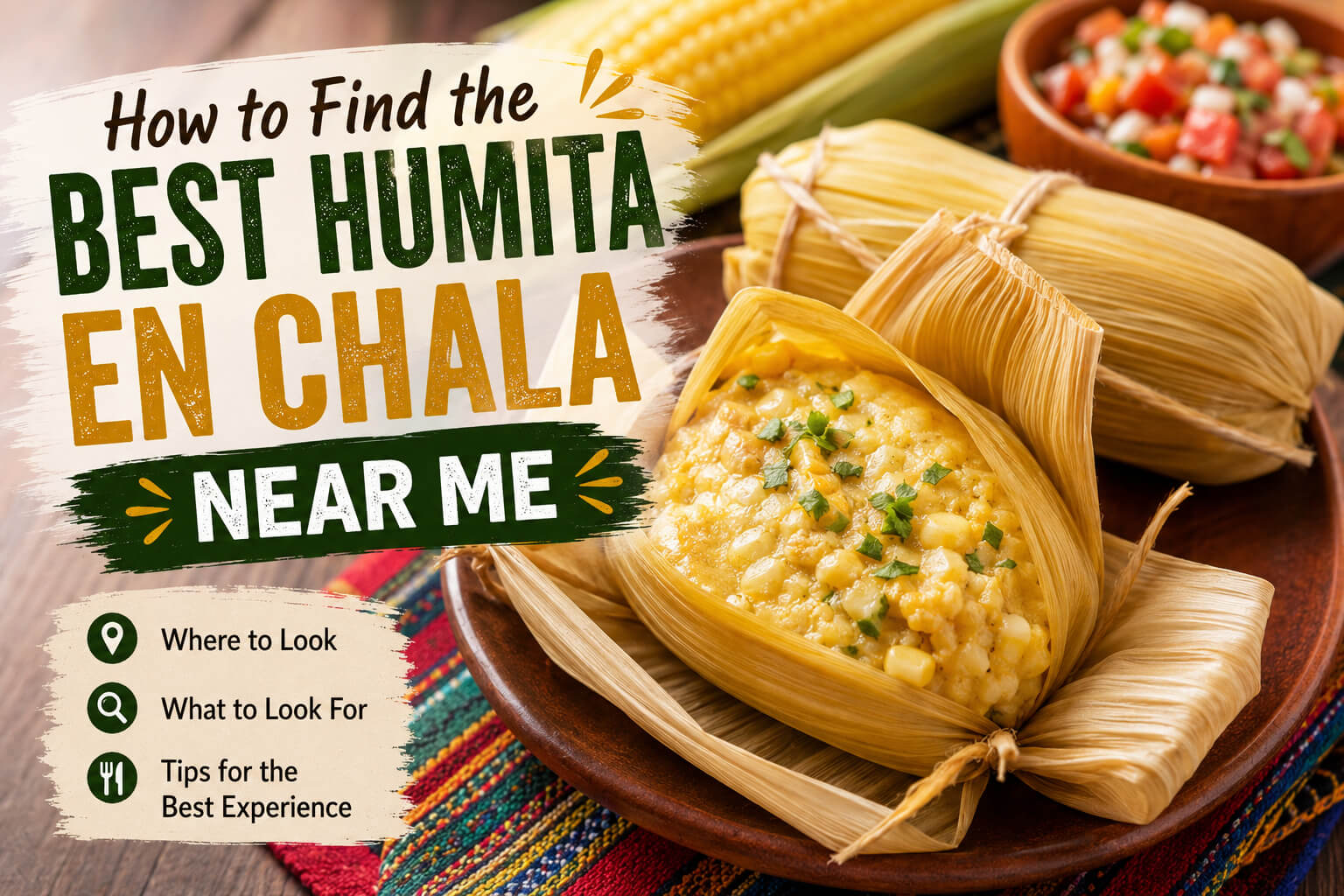
Finding the best humita en chala near me can be surprisingly difficult in the UK. Argentine restaurants have become much easier to find, particularly in London, but many British diners are still more familiar with steak, chimichurri and empanadas than with this traditional corn-based dish.
Humita has deep roots in South American cooking. Argentina’s official tourism information describes it as a pre-Hispanic preparation based primarily on corn, with versions served from a pot or cooked inside corn husks. For humita en chala, the corn mixture is placed inside the husks of the corn, tied into a parcel and cooked.
That distinction matters when searching in Britain. A restaurant advertising “humita” may be serving creamy sweetcorn in a dish, while another may use humita as an empanada filling. Both can be delicious, but neither is automatically the traditional humita en chala someone may have in mind.
This guide explains what to search for, how to identify the genuine dish and where UK diners are most likely to find traditional or closely related versions.
What Is Humita en Chala?
Humita en chala is a traditional South American corn preparation cooked inside corn husks. The precise recipe changes from region to region and even from family to family, but fresh corn is normally the central ingredient.
In northern Argentina, the corn kernels may be grated to create a thick, creamy paste. Pumpkin can be added, while onions, peppers, basil, paprika, cumin and cheese may also form part of the recipe. The mixture is placed between corn leaves, traditionally arranged to form a parcel, tied and then cooked. Argentina’s official tourism site specifically describes humita en chala as being cooked in boiling salted water after the parcel has been closed and tied.
The result is comforting rather than complicated. Fresh corn supplies natural sweetness, while onions, herbs, spices and cheese can bring savoury depth. A good humita should still taste clearly of corn rather than being overwhelmed by dairy or seasoning.
It Is Bigger Than Argentina
Humita should not be understood as an exclusively Argentine food. Closely related preparations are found throughout the Andes.
Ecuador’s official statistical food classification describes humitas or humintas as an Andean food associated with Argentina, Bolivia, Chile, Ecuador and Peru. Ecuadorian versions can contain fresh ground corn, cheese, eggs, butter and other ingredients, with preparations varying by region and family tradition.
Chile also has a strong humita tradition. Chile’s official tourism website describes humitas as corn paste wrapped in corn husks and lists ingredients such as onion, milk, basil, paprika and spices in a traditional preparation.
This wider background is useful when looking for the dish in the UK. Searching only for an Argentine steakhouse could cause you to miss a Bolivian, Ecuadorian, Chilean or wider Latin American business preparing something very similar.
Know What You Are Ordering
One of the easiest mistakes when searching for the best humita en chala near me is assuming that every menu item called humita refers to the same dish.
It does not.
Humita en chala is wrapped in corn husks. Humita a la olla is prepared and served more like a creamy corn stew. Empanada de humita places a corn-based filling inside pastry.
Current UK menus demonstrate the difference clearly. Buenos Aires Café has listed humita a la olla as a northern Argentine dish made with creamy sweetcorn, onions, peppers and tomatoes and finished with cheese and olives. Meanwhile, De Nadas lists a humita empanada among its vegetarian options.
So if your goal is specifically the corn-husk-wrapped dish, do not stop when you see the word “humita.” Read the description or ask the restaurant how it is prepared.
Finding It in the UK
Traditional humita en chala remains a fairly specialist dish in Britain. This does not mean it cannot be found, but diners usually need to search more carefully than they would for empanadas or Argentine steak.
Current London menus provide good evidence that humita itself has a presence in the UK food scene. Santa Maria del Sur has listed a creamy sweetcorn humita with blue cheese and cherry tomatoes, while CHANGO has offered a sweetcorn, pepper and pumpkin humita stew. La Patagonia has also listed a corn, cheese and béchamel humita.
These examples are useful, but they also underline the problem: the word humita on a British restaurant menu does not necessarily mean en chala.
If the corn-husk presentation matters to you, confirmation before travelling is worthwhile.
Start With Argentine Restaurants
Argentine restaurants are still one of the most sensible starting points. Rather than searching only for steak restaurants, however, look for businesses that place emphasis on regional Argentine cooking.
Restaurants serving food from northern Argentina may be especially interesting because humita is strongly associated with provinces such as Salta, Jujuy and Tucumán. Argentina’s national tourism information specifically highlights humitas in this northern part of the country.
Read beyond the headline items on the menu. Humita may appear among starters, sides, vegetarian choices or seasonal specials instead of among the main courses.
A restaurant with dishes such as locro, provoleta, regional empanadas and other traditional preparations may also be more promising than one focused almost entirely on grilled beef.
Search Beyond Argentine Food
The next step is to expand your search.
Try Bolivian, Chilean, Ecuadorian, Peruvian and broader Latin American restaurants, particularly businesses that advertise traditional or regional home-style cooking.
The dish may not always be written as “humita en chala.” Depending on the country and restaurant, you may encounter the words humita, huminta or similar regional terminology.
This is why searching the exact keyword alone can be limiting. Someone typing best humita en chala near me may receive relatively few results, while “Bolivian food near me” or “traditional South American restaurant” could uncover a business worth contacting.
Search Smarter Online
Google Maps and ordinary search engines can be useful, but change your wording several times.
Useful searches include “humita near me,” “humita en chala UK,” “Argentine humita London,” “Bolivian huminta near me,” “traditional Argentine restaurant near me” and “South American corn husk dish near me.”
Once you find a promising restaurant, search its reviews for the word “humita.” Customer photographs can sometimes reveal whether the dish was served in corn husks, a bowl or pastry.
Pay attention to the date of the review. A photograph uploaded several years ago does not prove that the restaurant serves the dish today.
Current menus deserve more weight than old blog articles, review photographs or social posts.
Check the Menu Carefully
A menu description can answer many questions before you leave home.
Look for terms such as corn husks, corn leaves, chala, steamed, boiled parcel, fresh corn or traditional northern Argentine preparation.
If the menu describes a creamy corn stew, then you are probably looking at humita a la olla rather than humita en chala.
Likewise, if humita appears under an empanada section, the corn mixture will normally be enclosed in pastry.
For example, a current UK menu search shows Mingo Argentine Steakhouse listing a humita option specifically under its empanadas, while other London restaurants list humita separately as a creamy corn preparation.
These are related foods, but a reader seeking the traditional husk-wrapped experience should know the difference.
Call Before Travelling
For a niche dish, a quick phone call can save a wasted journey.
Ask: “Do you currently serve humita en chala, wrapped and cooked in corn husks?”
That wording is clearer than simply asking whether the restaurant has humita.
You can also ask whether it is available every day, only at weekends, seasonally or as a special. Restaurants working with fresh corn may change dishes according to ingredient availability.
If you are travelling a significant distance, confirming the dish on the same day is sensible.
Look in London First
For UK diners, London gives you a broad starting point because of its large range of Argentine and Latin American restaurants.
Current menus show numerous forms of humita across London’s dining scene, from creamy corn preparations to humita empanadas. For example, Santa Maria del Sur lists a creamy sweetcorn version, Buenos Aires Café has listed humita a la olla, and De Nadas offers a humita empanada.
That does not mean each restaurant serves traditional humita en chala. Rather, it shows that the underlying dish and flavour profile have an established foothold in the capital.
People outside London should use the same approach in cities such as Manchester, Birmingham, Bristol, Leeds, Liverpool, Edinburgh and Glasgow: search broadly, inspect menus and contact restaurants directly.
Try Latin American Shops
Restaurants are not your only option.
Specialist Latin American supermarkets, delis and grocery stores may sell frozen or freshly prepared regional foods, or staff may know caterers who make them.
Even when humita en chala is not on the shelf, asking staff can be worthwhile. Shops serving immigrant communities often know local independent bakers, caterers, market traders and home-style food businesses that may not rank highly in ordinary search results.
Look especially for shops carrying Argentine, Bolivian, Ecuadorian, Chilean or Peruvian products.
Explore Markets and Events
Latin American food festivals and community events can be another useful route.
Independent cooks sometimes prepare labour-intensive traditional foods for festivals and special events that would not make economic sense as a permanent restaurant menu item.
Search for Latin American cultural festivals, Argentine community celebrations, South American street-food markets and regional food fairs.
Again, check the event’s current vendor list where possible rather than assuming humita will be present.
Recognising Good Humita
Once you find the traditional dish, what should you expect?
Good humita should have a clear fresh-corn flavour. It can be naturally sweet, but savoury versions normally balance that sweetness with onion, herbs, spices and sometimes cheese.
Texture is important. The filling should generally be soft and moist, but not resemble thin soup. Depending on the recipe, it can range from creamy to relatively firm.
The corn husk itself is a cooking wrapper and presentation element rather than something you normally eat.
Regional variations mean that one authentic humita can taste quite different from another. A sweeter Ecuadorian-style preparation should not automatically be judged against a strongly savoury Argentine version.
Regional Differences Matter
There is no universal recipe that defines every humita.
Northern Argentine preparations may feature pumpkin, onion, peppers, basil, paprika and cumin alongside corn, and some include a centre of melted cheese.
Traditional Chilean humitas can combine corn with onion, basil, paprika, milk and seasoning before being wrapped in corn leaves.
Ecuadorian versions may use ground fresh corn with cheese, egg, butter or other additions and can be made sweet or savoury.
For UK diners, this variety is part of the appeal. “Authentic” does not necessarily mean every restaurant should make the dish identically.
What Does It Taste Like?
The dominant flavour should normally be corn.
Fresh sweetcorn gives humita a naturally gentle sweetness and creamy quality. Onion adds savoury depth, while peppers, herbs and spices give the filling more character.
Cheese can create richness and a salty contrast. Pumpkin, when used, can make the filling smoother and subtly sweeter.
People trying it for the first time may find it somewhere between a soft corn pudding, a savoury corn mash and a steamed parcel, although traditional preparations have their own distinctive character.
Is Humita Vegetarian?
Many humita recipes are vegetarian, but the safest answer is not always.
Traditional examples commonly contain corn, vegetables, herbs and cheese. Ecuadorian recipes may also incorporate eggs, butter or other animal-derived ingredients.
Anyone following a vegan diet should therefore ask specifically about milk, cheese, butter, eggs and cooking fats.
Do not assume that a dish is vegan simply because corn is its main ingredient.
Is It Gluten-Free?
Corn itself does not contain gluten, and many traditional humita recipes do not require wheat flour. That does not make every restaurant version automatically safe for someone with coeliac disease.
Additional ingredients, sauces and kitchen cross-contact can change the situation.
In the UK, food businesses must provide information about regulated allergens used in the food they sell, and official guidance also addresses preventing allergen cross-contamination. Diners with coeliac disease or serious food allergies should speak directly with the restaurant instead of relying only on the traditional recipe.
Check Allergens Properly
Humita commonly raises another important question: dairy.
Cheese, milk or butter can appear in several regional versions, so people with milk allergies should never assume it is dairy-free.
UK government guidance states that food businesses need to provide accurate allergen information and have procedures for managing cross-contamination.
If ordering online or by phone, official UK guidance also requires allergen information to be available before the purchase is completed and again when food is delivered.
That makes asking questions before ordering particularly important when dealing with a traditional recipe that varies from cook to cook.
How Much Should You Pay?
There is no meaningful nationwide price for humita en chala because it remains a specialist dish in the UK.
The price will depend on location, portion size, restaurant style and whether it is being served as a side, starter or larger dish.
Current London examples demonstrate this variation. Santa Maria del Sur lists a humita starter at around £8, while other menus show smaller humita sides or empanadas at lower prices.
Traditional husk-wrapped versions may also require more preparation than a simple side dish, so price alone is not a reliable measure of quality.
Common Search Mistakes
The biggest mistake is assuming that the first result containing “humita” is exactly what you want.
Another is travelling based on an old menu.
Restaurant menus change, businesses close, recipes evolve and seasonal dishes disappear. Always check recent information.
Do not rely exclusively on star ratings either. A highly rated Argentine steakhouse may serve wonderful beef but no humita, while a smaller community caterer could make exactly the traditional dish you want.
Finally, do not reject a preparation simply because it differs from one you ate elsewhere in South America. Regional differences are normal.
Outside London
Finding humita en chala outside London may require more patience, but your search does not have to stop.
Start with independent South American restaurants rather than large chains. Then search Latin American shops, catering businesses, food stalls and community events.
Try country-specific terms alongside your city, such as “Bolivian food Manchester,” “Argentine food Birmingham,” “Ecuadorian food Bristol” or “South American catering Leeds.”
If you discover a business offering huminta rather than humita, examine the description before dismissing it. It could be a regional version of the dish you are looking for.
Restaurant or Homemade?
If you cannot find traditional humita en chala nearby, making it at home can be a worthwhile alternative.
The basic technique is approachable: prepare a fresh corn mixture, soften and arrange the corn husks, fill them, secure the parcels and cook them according to the regional recipe you are following.
The challenge in Britain can be sourcing suitable fresh corn with intact husks. Specialist greengrocers, international markets and Latin American food suppliers may be more useful than standard supermarket packs where the husks have already been removed.
Cooking it yourself also makes the regional diversity of humita easier to appreciate.
Finding the Best One
The best humita en chala near me is not necessarily the version from the most expensive restaurant or the place with the most online reviews.
Look for a kitchen that understands the dish, uses good corn and can explain how it is prepared.
If you specifically want en chala, confirm that it comes wrapped in corn husks. If you are simply curious about the flavour of humita, a well-made humita a la olla or humita empanada can also be an enjoyable introduction.
Use several searches, inspect current menus, read recent customer comments and contact restaurants before making a long journey.
Final Thoughts
Finding traditional humita en chala in the UK takes a little more work than finding familiar Argentine favourites, but that search can lead you deeper into South America’s varied food traditions.
The most important thing is knowing exactly what you want. Humita en chala is a corn-based preparation cooked inside corn husks, while the same word can also describe stewed versions and fillings used in empanadas.
Current UK menus show that humita is certainly present in Britain’s Argentine dining scene, particularly in London, although the traditional corn-husk version appears to be less routinely advertised than humita stews, sides and empanadas.
Start with Argentine restaurants, but do not stop there. Check Bolivian, Chilean, Ecuadorian and wider South American businesses, explore specialist food shops and community events, and ask restaurants directly how their humita is made.
When you finally open a warm corn-husk parcel and find a soft, fragrant corn filling inside, you will understand why this simple traditional dish has remained part of Andean cooking for generations.
FAQs
Where can I find humita en chala near me in the UK?
Start with Argentine and other South American restaurants, especially those specialising in traditional regional food. London currently has several restaurants serving different forms of humita, but you should contact the restaurant to confirm whether it specifically offers the corn-husk-wrapped version.
Is humita en chala the same as a humita empanada?
No. Humita en chala is cooked inside corn husks, whereas a humita empanada uses a corn-based filling enclosed in pastry. Both share similar flavours but are different dishes.
What is traditional humita made from?
Fresh corn is the main ingredient. Depending on the regional recipe, it may also contain pumpkin, onion, peppers, herbs, spices, cheese, milk, butter or eggs.
Can I find humita in London?
Yes. Current London restaurant menus include several forms of humita, ranging from creamy sweetcorn dishes to humita empanadas. However, menu availability changes and a listing for “humita” should not automatically be interpreted as humita en chala.
Is humita en chala vegetarian?
Many versions are vegetarian because they are primarily made with corn and vegetables, often with cheese. Recipes vary, however, so it is worth checking the ingredients before ordering.
Is traditional humita gluten-free?
Many traditional recipes are naturally based on corn rather than wheat, but restaurant recipes and preparation methods differ. Anyone with coeliac disease should ask the restaurant about ingredients and cross-contamination rather than assuming that a dish is safe.