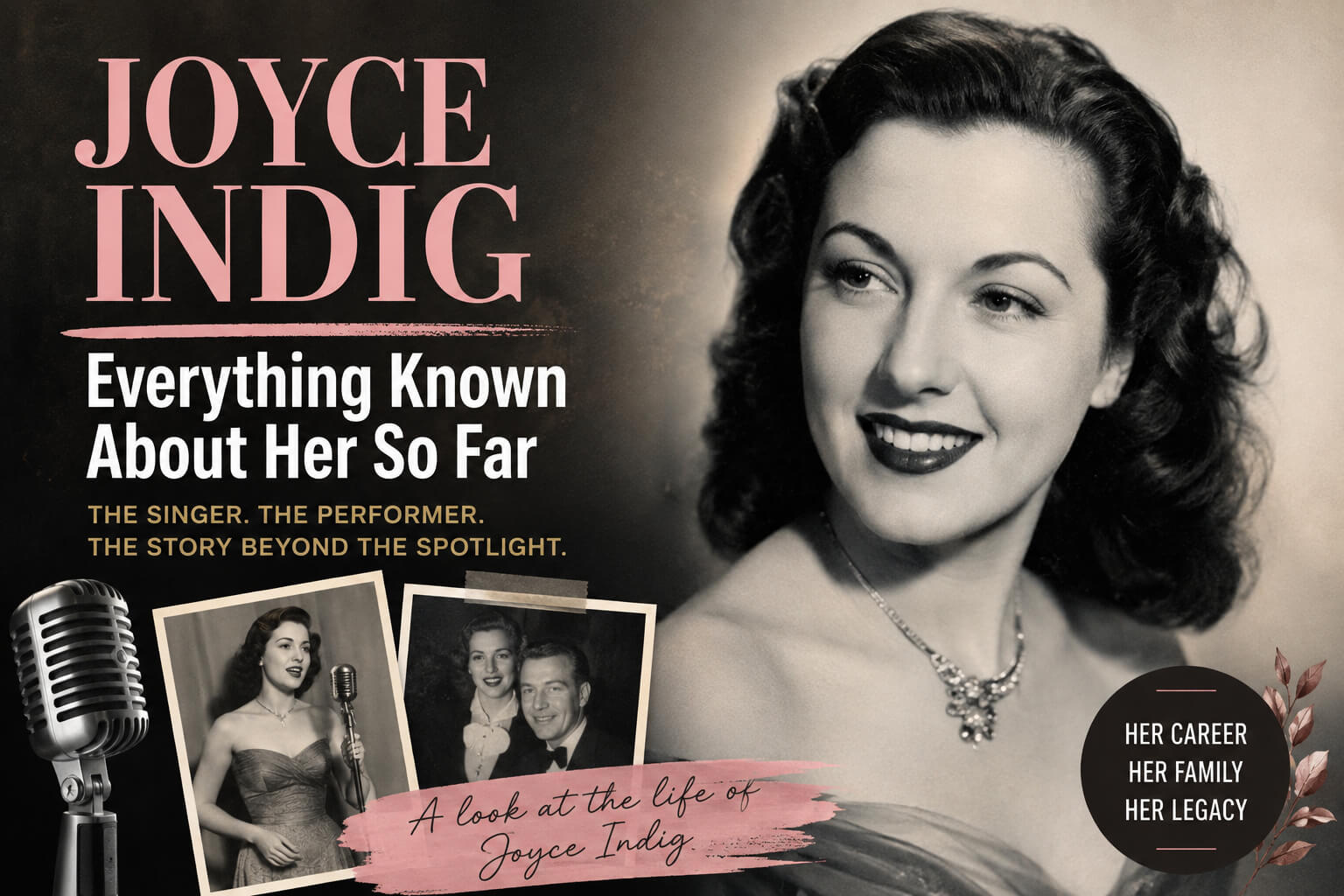
Joyce Indig is a name that often appears in biographies of legendary American comedian Rodney Dangerfield, yet describing her simply as his former wife leaves out an important part of the story. Years before Dangerfield became nationally famous for his self-deprecating comedy and the phrase “I don’t get no respect,” Joyce was already working professionally as a singer and entertainer.
Her surviving public record is relatively small. Unlike performers who remained in show business for decades, Joyce did not leave behind a huge collection of interviews, television appearances, photographs, or extensively documented albums. That limited record has unfortunately encouraged modern websites to fill the gaps with unsupported claims.
Contemporary newspaper archives, entertainment records, and major biographies of Dangerfield paint a clearer picture. They show Joyce as a working vocalist during the late 1940s and early 1950s, a woman involved in radio, television and recorded music, and later a mother whose marriage coincided with one of the most uncertain periods of Dangerfield’s career.
Who Was Joyce Indig?
Joyce Indig was an American singer who performed professionally around the end of the 1940s and beginning of the 1950s. Today, however, she is primarily remembered because she married Rodney Dangerfield before he became one of America’s best-known comedians.
That association sometimes creates the misleading impression that Joyce became noteworthy only after meeting him. Historical material shows otherwise.
A newspaper report published in August 1949 described Joyce as one of New York’s busy entertainment performers and stated that she had previously been a featured vocalist with Art Mooney’s orchestra. It also noted that she had appeared at theaters and entertainment venues around the country.
Her name additionally appears in the credits for The Art Ford Show, a WPIX television program broadcast in 1949. IMDb records Joyce appearing as herself on the program, whose May 28, 1949 episode included several musicians and entertainers.
These traces establish something important: Joyce had a recognizable entertainment career of her own before her marriage became the part of her life most frequently discussed.
Early Life
Reliable information about Joyce Indig’s childhood is surprisingly difficult to find.
Several recent biography websites provide precise birth dates, places of birth, parents’ names and other details. The problem is that many of these claims are repeated without references to contemporary public records. Some websites even contradict one another.
For that reason, details such as her exact date of birth, childhood home, schools and early family circumstances should not be presented as established fact unless backed by stronger documentation.
What can be established from period material is that Joyce had developed enough professional experience by 1949 to be described as a working vocalist associated with a recognized orchestra.
That suggests her involvement with music began before the point at which newspapers and television records started preserving her name, but exactly how she trained and entered professional entertainment remains unclear.
The lack of documentation is not particularly unusual. Many working nightclub, radio and orchestra singers of the 1940s did not receive detailed biographical coverage unless they later became major stars.
Her Singing Career
Joyce Indig’s career becomes much clearer when contemporary sources are examined.
A particularly useful document comes from the Athens Banner-Herald in Georgia. In August 1949, the newspaper announced a special radio broadcast starring Joyce and identified her as a former featured vocalist with Art Mooney’s orchestra.
Art Mooney was a well-known American bandleader during the big-band and popular-music period. Being identified as a featured vocalist with such an orchestra places Joyce within the professional entertainment world rather than among amateur performers.
Joyce also appeared during the early era of television. Her credit for The Art Ford Show dates from 1949, when television was still a relatively young medium in the United States. The series was produced by WPIX-TV and featured musicians, singers and other performers.
Although her surviving television filmography appears small, this appearance helps demonstrate that she was working across more than one entertainment format.
For performers at the time, careers could involve nightclubs, orchestra appearances, local radio, television and individual recordings rather than the album-focused career model familiar today.
Her Radio Work
One of the most interesting surviving records of Joyce Indig’s career has little to do with celebrity entertainment.
In 1949, she starred in a radio program titled “Baby and Me.”
The production addressed a serious public-health issue: syphilis during pregnancy. According to the contemporary newspaper announcement, the drama followed an expectant mother who discovered that she had the disease and explored how medical examination and treatment could protect her child.
The program was produced by the Communication Materials Center at Columbia University Press for a nationwide campaign concerning venereal disease. Joyce starred alongside the Tony Burell Trio.
This appearance is significant because it shows another side of her professional work. Joyce was not simply appearing in nightclubs or singing popular songs. She participated in an educational broadcast that used entertainment to communicate medical information to the public.
Radio remained enormously influential during this period, and dramatized public-service broadcasts were an important way of reaching American households.
It is one of the strongest pieces of primary-era evidence available about Joyce Indig as a performer in her own right.
Her Recordings
Evidence also survives of Joyce’s work as a recording singer around 1950.
One title associated with her is “The Black Rose.” A December 1950 issue of The Cash Box, an important American music-industry publication, includes “The Black Rose” by Joyce Indig in a radio personality’s list of popular selections.
Discography-based accounts also associate Joyce with recordings including “Ev’rybody Clap Hands,” “Wish Me Luck,” “I’ll Never Be Free,” and “The Best Thing for You.” Some releases have been linked to professional orchestral arrangements and period record labels.
The surviving evidence does not support describing Joyce as a major national recording star, however.
There is a meaningful difference between saying she worked professionally as a recording vocalist and claiming that she enjoyed a huge commercial music career. No strong evidence currently shows her becoming a nationally dominant chart performer or producing a large album catalog.
Her career appears instead to represent the experience of many talented mid-century vocalists: regular professional work, radio exposure and recordings without the long-term fame achieved by the biggest stars.
That distinction makes her story more accurate rather than less interesting.
Meeting Rodney Dangerfield
Joyce Indig’s personal history became connected to comedy when she met the man later known internationally as Rodney Dangerfield.
Dangerfield was born Jacob Cohen and performed for a period under the name Jack Roy. His early comedy career was difficult and financially unstable.
Reliable biographical accounts state that Joyce was a singer when the couple met at a New York club. Both understood the uncertainty of earning a living as entertainers.
Dangerfield had spent years trying to build a comedy career without achieving the security he wanted. According to later accounts, marriage became one of the reasons he temporarily walked away from professional comedy.
The official Rodney Dangerfield website similarly describes Joyce as a singer and explains that Dangerfield worried prolonged travel for club performances could damage their marriage. He therefore gave up comedy and entered more conventional employment.
Their relationship consequently belongs to a period before Rodney Dangerfield became “Rodney Dangerfield” in the popular imagination.
Their Marriage
Sources agree that Joyce Indig and Rodney Dangerfield married, separated, later remarried and ultimately divorced again, although there is some disagreement about the exact date of their first marriage and divorce.
The Los Angeles Times obituary of Dangerfield reported that he left show business at approximately 28 to marry Joyce, whom it described as a 23-year-old singer. It states that the couple divorced in 1962, remarried the following year, and divorced again in 1970.
The Independent likewise records a first marriage followed by a divorce in 1962, a remarriage in 1963 and a final divorce in 1970.
Other databases provide slightly different years, particularly for the first marriage. IMDb, for example, lists marriages beginning in 1951 and 1963.
Because historical sources differ, articles should avoid pretending that every date is universally settled.
What is firmly established is the larger timeline: the pair married, divorced, reconciled and remarried, then permanently divorced around 1970.
A More Conventional Life
Marriage brought a dramatic change to Rodney Dangerfield’s professional life and presumably to Joyce’s as well.
Instead of continuing to travel constantly as a struggling comedian, Dangerfield moved toward conventional employment. Accounts describe him selling paint and aluminum siding while the couple built a suburban household in Englewood, New Jersey.
Dangerfield later explained that the couple had wanted a normal family life away from the uncertainty of entertainment.
The decision is revealing because both partners understood that uncertainty firsthand. Joyce had been working as a singer while Dangerfield had been moving through clubs trying to establish himself as a comic.
Their move toward domestic stability therefore represented a significant shift for two people whose early adult lives had been connected to performance.
Eventually, however, the arrangement did not last.
Their Children
Joyce Indig and Rodney Dangerfield had two children, Brian and Melanie.
This fact is consistently reported in established profiles and obituaries of Dangerfield. The Washington Post, Los Angeles Times and Dangerfield’s official biography all identify Brian and Melanie as the couple’s children.
Some online biography sites provide additional precise dates and personal information about the children, but not all of those details are consistently documented.
Their children nevertheless became an important part of the period during which Dangerfield stayed outside professional comedy.
The official Dangerfield biography says that after the marriage eventually fell apart, Rodney raised the children while putting together a new comedy act.
His return to entertainment eventually transformed him from a struggling comic into an internationally recognizable performer.
The Divorce Years
The relationship between Joyce and Rodney appears to have been complicated.
Contemporary retrospective accounts describe marital problems leading to their first divorce. Yet their reconciliation and remarriage demonstrate that the separation was not initially permanent.
By the early 1960s, Dangerfield was also becoming increasingly drawn back toward comedy.
The Los Angeles Times reported that during his 1962 divorce he was deeply in debt and decided to attempt another career in stand-up. He later explained that the desire to perform had never disappeared.
That comeback proved decisive.
After years away from professional comedy, Dangerfield gradually developed the persona that audiences would later recognize instantly. His television appearances eventually brought national attention, and by the late 1960s his career had entered an entirely different phase.
Joyce and Rodney’s second marriage ended in 1970, by which point his comeback was well underway.
Life Outside the Spotlight
One of the hardest parts of writing responsibly about Joyce Indig is explaining what happened later without filling the empty spaces with invented details.
Reliable mainstream sources say surprisingly little about her post-marriage life.
There is no well-documented long-running acting career, major celebrity profile, memoir, extensive interview archive or established public social presence connected to her later years.
This silence has resulted in numerous modern websites publishing detailed claims about her lifestyle, physical measurements, wealth, relationships and family background.
Many of those details lack strong sourcing.
For readers, that distinction matters. Absence of information does not give writers permission to manufacture certainty.
What can safely be said is that Joyce’s public visibility became much lower than that of her former husband and that most historical references to her after their marriage appear in discussions of Dangerfield’s early life.
Her Public Image
Joyce Indig presents an interesting example of how fame can reshape historical memory.
During the late 1940s, she could be described by newspapers through her own profession: vocalist, entertainer and radio performer.
Decades later, the description most commonly attached to her name became “Rodney Dangerfield’s first wife.”
The shift is understandable because Dangerfield eventually achieved enormous fame. His comedy albums, television appearances and films such as Caddyshack and Back to School gave him a cultural reach far beyond anything either partner possessed when they first met.
Yet remembering Joyce only through that marriage risks erasing the evidence that survives of her own professional work.
Her 1949 television appearance, her work with Art Mooney’s orchestra, her radio role and her documented recordings all came from a period when Dangerfield himself was still struggling to establish a career.
Why Information Conflicts
Searching for Joyce Indig today produces an unusual amount of contradictory information.
Some websites call her a singer. Others describe a person of the same name as an entrepreneur, designer, executive or professional in entirely unrelated industries.
Those conflicting biographies are a warning that pages generated from loosely connected search results can accidentally combine different people who share the same name.
There are also disagreements about Joyce’s first marriage date, exact birth information and later life.
For this reason, the safest approach is to give priority to contemporary newspaper archives, established newspaper obituaries, period entertainment publications and records directly connected with Rodney Dangerfield’s documented life.
Where such sources do not provide an answer, acknowledging the uncertainty is more responsible than guessing.
What Is Confirmed
Several important points about Joyce Indig can be stated with considerable confidence.
She was a professional singer. Historical newspaper coverage identifies her as a vocalist and performer.
She worked with Art Mooney’s orchestra. A 1949 report specifically described her as a former featured vocalist with the orchestra.
She appeared on early television. IMDb documents Joyce appearing as herself on The Art Ford Show in 1949.
She participated in a public-health radio production. The 1949 drama Baby and Me placed her in the starring role of a story designed to educate listeners about maternal health and syphilis testing.
She made recordings. Period music-industry material documents “The Black Rose” under her name.
She married Rodney Dangerfield twice and had two children with him. Major biographical sources consistently confirm the remarriage and identify their children as Brian and Melanie.
These facts alone provide a more substantial portrait than simply describing Joyce as the former spouse of a famous comedian.
What Remains Unclear
Other details should still be regarded cautiously.
Joyce’s exact birth date, detailed childhood history, education, precise family background, financial status and many aspects of her later private life are not clearly established by the strongest publicly accessible sources reviewed for this article.
Similarly, precise claims about her height, weight or personal wealth appearing on modern celebrity-biography websites have little relevance without reliable documentation.
The year of the first marriage also illustrates why caution matters. Some respected retrospective sources use 1949, while others place the marriage around 1951. The divorce is variously reported as 1961 or 1962, although the 1963 remarriage and 1970 final divorce are much more consistently documented.
Rather than selecting whichever date appears most convenient, a researched biography should acknowledge the disagreement.
Why Joyce Indig Still Draws Interest
Modern interest in Joyce Indig largely comes from people exploring the personal history of Rodney Dangerfield.
His later success makes his earlier years fascinating. Before the famous red tie, repeated television appearances and Hollywood films, he experienced financial insecurity, abandoned comedy for ordinary employment, struggled in his marriage and eventually rebuilt his career.
Joyce was central to that chapter.
But renewed interest has also allowed people to rediscover that she was a working entertainer herself.
A name that might appear to be only a footnote in a celebrity biography leads back to early American television, orchestra music, radio drama, public-health broadcasting and the culture of professional vocalists working around New York in the late 1940s.
That broader context makes her story worth examining independently.
Legacy
Joyce Indig never achieved the lasting international recognition associated with Rodney Dangerfield, and it would be misleading to rewrite her career as though she had.
Her surviving body of documented work is modest.
But modest does not mean insignificant.
She belonged to a generation of professional singers who worked during a period when entertainment was moving rapidly between live clubs, radio, records and the new medium of television. Evidence that survives from 1949 and 1950 shows her participating in several parts of that world.
Her appearance in Baby and Me is particularly noteworthy because it shows entertainment being used for public education at a time when radio remained one of America’s most powerful mass-media tools.
Her recordings likewise preserve evidence that Joyce had an artistic identity independent of the comedian she later married.
Conclusion
Joyce Indig was more than Rodney Dangerfield’s former wife. The historical record identifies her as a professional singer who performed with an established orchestra, appeared on early television, participated in radio programming and made recordings during the late 1940s and early 1950s.
She later married Dangerfield during the difficult years before his fame. Their relationship included children Brian and Melanie, divorce, reconciliation, remarriage and an eventual permanent separation around 1970.
Much of Joyce’s personal history remains outside the documented public record. That limitation should be respected rather than filled with unsupported claims.
Perhaps that is also why Joyce Indig continues to attract curiosity. There is enough evidence to reveal a real performer and an important figure in Dangerfield’s early life, but not enough to turn every aspect of her private story into certainty.
What remains is a portrait of a woman who had already stepped onto stages, television screens and radio broadcasts before history largely remembered her through somebody else’s fame.